
This guide walks founders and product managers through early stage startup MVP budget planning USA with clear steps and realistic expectations. Building an MVP is a trade off between speed and quality. You must choose where to conserve cash and where to invest for credibility. Many startups miss hidden costs like third party services, compliance, and early marketing. I will share practical rules of thumb for development, design, testing, and operations. You will also get a simple way to stress test your runway and adjust scope before spending. This is not marketing fluff. It is a checklist for real founders who need to make small budgets work. Expect some hard choices. Expect to iterate. If you want a roadmap that matches US market costs and common hiring models this guide will help you avoid the usual budgeting traps.
Why Early Budget Planning Matters
Budget planning is not a spreadsheet exercise. It is a decision tool that shapes product shape and timing. Early planning forces you to choose the smallest useful feature set. It lets you test assumptions without burning runway. In the US market costs vary by talent model and location. Knowing rough ranges for design, engineering, and hosting helps you trade scope for speed. Planning also creates guardrails for hiring and vendor selection. A vague budget invites scope creep. A clear budget encourages focused sprints and measurable milestones. Many founders treat budgets as optimistic wish lists. That is risky. A realistic plan reduces surprise and helps you raise the right amount of capital for the next milestone. If you want a related deep dive, read How to Choose the Right Tech Stack for Your MVP Development.
- Force minimal scope decisions
- Set realistic timelines
- Estimate talent and vendor costs
- Prevent scope creep
- Align team on deliverables
Core Cost Categories To Expect
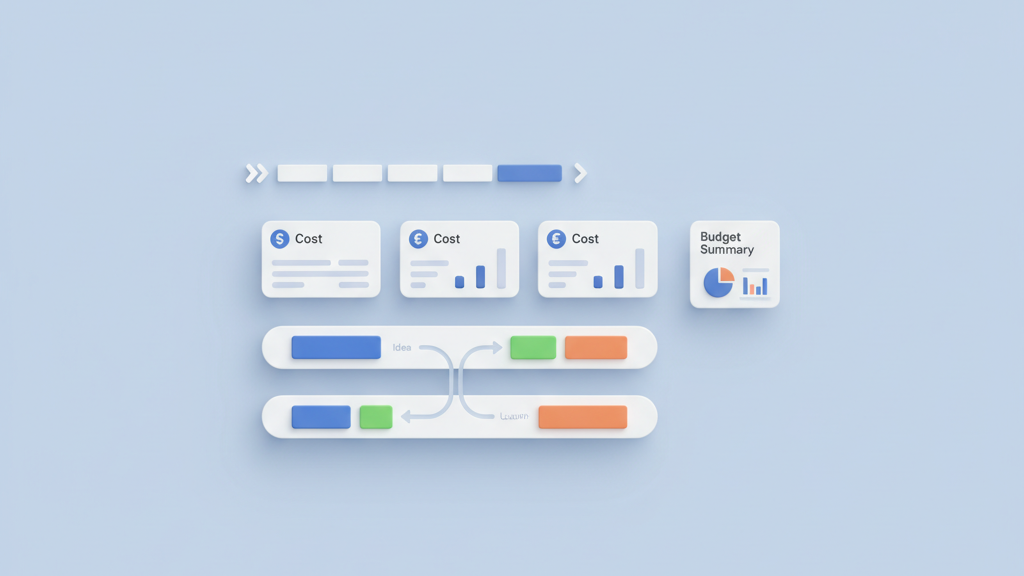
A simple budget breaks costs into clear buckets. Development is the largest line item. Design and UX are critical and not optional. Infrastructure includes hosting, databases, and monitoring. Third party services cover payments, messaging, and maps. Marketing and user acquisition costs appear early in the US market. Legal, compliance, and basic operations create predictable fees. Finally allocate a buffer for unexpected technical debt. Estimating each bucket helps you spot cheap wins and expensive risks. For example moving to a serverless stack may cut ops costs but increase vendor lock in. Planning by category helps you compare quotes and pick trade offs that match your runway and growth assumptions. For a practical follow-up, see Uncovering the Key Metrics for Monitoring MVP Effectiveness in Startup Growth.
- Development and QA
- Design and user testing
- Hosting and infrastructure
- Third party services
- Marketing and operations
How To Estimate Development Costs
Estimating development means breaking work into deliverable units. Define the user flows and the minimal screens for each flow. Estimate each screen or flow in days rather than vague story points. Use market ranges to convert days into cost. In the US market hourly rates vary by seniority and region. Consider a mixed team with a senior architect and mid level engineers to control cost. Add QA and integration time separately. Factor in end to end testing, device testing, and basic accessibility checks. Many teams forget ongoing maintenance and add only initial build costs. A modest contingency of ten to twenty percent is prudent. This method gives practical numbers you can compare with vendor estimates and internal hiring plans. If you need implementation support, explore Software maintenance and scaling.
- Define minimal user flows
- Estimate in days per flow
- Use mixed seniority teams
- Include QA and testing time
- Add a contingency buffer
Prioritizing Features For An MVP
Prioritization is a survival skill when cash is tight. Start with the problem you want to validate and map features to that core hypothesis. Rank features by validation value and cost to build. Aim to remove anything that does not directly prove demand. Use experiments to replace features with cheaper tests when possible. For example landing pages and concierge onboarding can replace early automation. Set acceptance criteria for each feature so the team knows when a feature is done. Regularly review priorities against runway. I think many founders try to prove too much in the first release. Focus and discipline will get you better learning per dollar spent. Teams moving from strategy to execution can review FlutterFlow development.
- Map features to core hypothesis
- Rank by value and build cost
- Prefer experiments over features
- Set clear acceptance criteria
- Review priorities with runway
Managing Non Development Costs And Runway
Non development costs can erode runway faster than you expect. Marketing spend for user acquisition can be volatile in the US. Budget for initial experiments and a higher cost per acquisition than your long term plan. Legal and compliance fees are often front loaded. Payments integration, terms of service, and privacy work need early attention for certain verticals. Operations costs include basic tools for collaboration, analytics, and customer support. Salaries and contractor fees are fixed commitments that affect monthly burn. Build a runway model that shows best case and stress case scenarios. Many startups assume linear progress. That rarely happens. Plan for slower traction and keep runway in months rather than weeks.
- Budget for early marketing tests
- Include legal and compliance fees
- Track fixed monthly burn
- Model best and stress cases
- Prioritize cash preserving actions
A Simple Budget Template And Next Steps
Start with a one page budget that lists major categories, estimates, and assumptions. Include lines for development, design, hosting, third party services, marketing, legal, and contingency. Document your assumptions and the range for each line. Use low medium and high scenarios to see how scope changes when funding shifts. Validate your estimates by getting two quotes for larger line items. Run a quick sensitivity analysis to find the highest impact cost levers. Share the budget with investors and advisors to get early feedback. Many founders treat budgets as private. Openness invites practical improvements and realistic expectations. The final step is to turn the budget into quarterly milestones and go build the smallest thing that will prove your hypothesis. A related guide worth reviewing is How to Validate an MVP Idea Step by Step for Founders.
- Create a one page budget
- Use low medium high scenarios
- Get multiple vendor quotes
- Run sensitivity checks
- Translate budget into milestones