
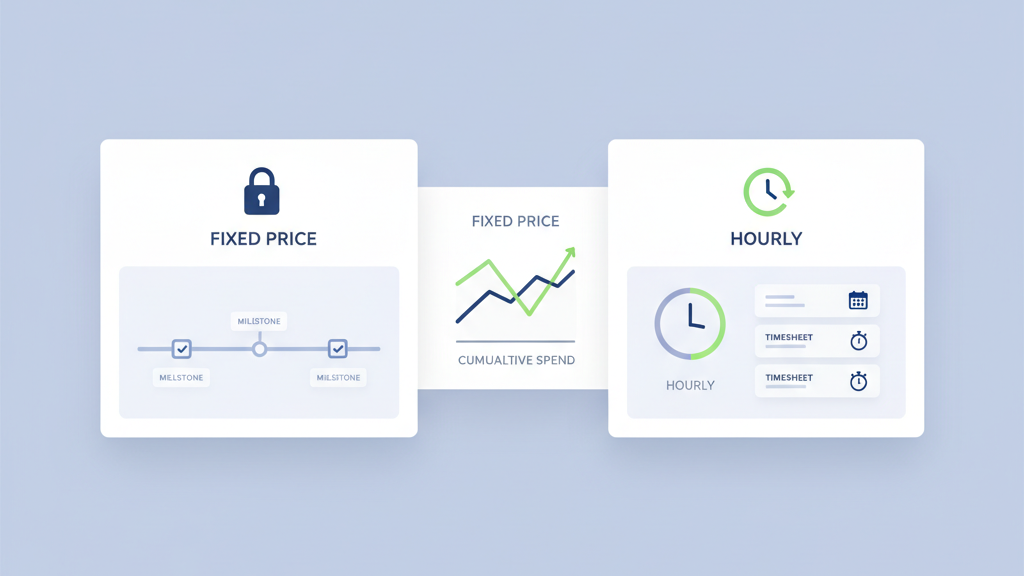
Choosing between fixed price and hourly contracts can change your runway and product direction. The phrase fixed price vs hourly MVP development cost USA is central to budgeting for a first release. This guide is for founders and product managers in the USA who need clear trade offs, realistic timelines, and ways to reduce waste. Many startups miss hidden fees and scope creep when they pick a model without a plan. I will explain when each model helps, how to estimate real cost, and how to negotiate terms that keep your team focused on outcomes rather than hours. Expect practical warnings and simple templates you can adapt.
Quick Overview Of Models
Fixed price and hourly contracts sit at opposite ends of a spectrum. A fixed price deal sets a total budget for defined scope, which helps startups lock cost but can lead to long negotiation and rigid scope. An hourly contract bills for time and gives flexibility to change priorities, but it can be hard to forecast cost if requirements shift. Startups often choose fixed price for a narrow MVP when requirements are clear. They pick hourly when they expect frequent learning and pivots. Teams with mature processes and clear acceptance criteria can make fixed price work. If your product is experimental you will likely pay for that learning under an hourly model. Many founders underestimate management time in both models, so plan for product and stakeholder work as well. If you want a related deep dive, read Hourly Rate Pricing Vs Fixed Price MVP Cost For Startup Founders.
- Fixed price trades flexibility for budget certainty
- Hourly trades budget certainty for adaptability
- Choose fixed price when scope is stable
- Choose hourly when you expect pivots
- Account for product management time
When Fixed Price Makes Sense
Fixed price works when your MVP is small, clear, and unlikely to change. If you have wireframes, acceptance criteria, and a short list of user flows you can define scope tightly. This model appeals to investors and founders who need predictable cash burn. It also forces teams to focus on priorities and ship a usable slice. There is a catch, many fixed price contracts add overhead for change requests. You should expect rigid change control, and you should budget a contingency for mid project shifts. When negotiating a fixed price, break work into milestones and tie payments to deliverables. Insist on demoable acceptance tests and a phase for polishing after core features are done. Many startups miss building time for user testing into the fixed price timeline. For a practical follow-up, see How To Budget An MVP For Early Teams (enterprise app MVP pricing for small businesses USA).
- Use fixed price for well defined scopes
- Define acceptance tests before signing
- Split work into milestone payments
- Budget for change request fees
- Include user testing time
When Hourly Works Better
Hourly contracts excel when the product needs fast learning and frequent changes. Early stage founders often do customer interviews and pivot features based on feedback. Under an hourly model you can reassign effort quickly and test ideas without formal change orders. This model also pairs well with in house product managers who can steer work daily. However hourly work requires discipline. Without clear goals it can drift into endless refinement. You must track time carefully, review weekly, and use short sprints with clear acceptance criteria. Consider a weekly or biweekly cap to protect your budget while keeping flexibility. Many teams forget to audit hourly reports and miss inefficiencies that slowly inflate costs.
- Choose hourly for high uncertainty
- Use short sprints and weekly reviews
- Set a budget cap to limit exposure
- Require clear time reporting
- Pair with active product management
Estimating Real Costs For An MVP
Estimating an MVP cost requires more than developer rates. Start with user journeys and break them into screens and integrations. List third party services and any design work. For a fixed price estimate add discovery, dev, QA, and a buffer for scope changes. For hourly work estimate hours per role and multiply by realistic rates for the USA market. Do not forget non engineering costs like devops, app store fees, and legal. Benchmarks help but treat them as rough guides. A small market MVP often lands between low five figures and mid five figures in the USA depending on complexity. Be conservative with timelines and assume 10 to 20 percent time for rework after user testing. Practical warning, many founders fall into the trap of using freelancer lower rates without accounting for the extra coordination cost. A related guide worth reviewing is How to Calculate a Real Price Estimate for Web App MVP Development USA.
- Map user journeys first
- Include discovery, QA, and buffer
- Estimate hours per role for hourly deals
- Account for third party and ops costs
- Use conservative time assumptions
Contract Terms That Matter
Contract details decide how risk is shared. For fixed price insist on clear acceptance criteria and a definition of done. Add a change request process and a contingency budget. For hourly agreements set reporting requirements and a notice period for stopping work. Include intellectual property assignment and a clause for code handover. Define maintenance and support terms after launch, do not assume free fixes. For both models set communication cadences and designate a product owner with final decisions. Many startups miss performance incentives which can align teams better than blunt hourly rates. Consider milestone bonuses or a reduced burn if the team delivers early. These small changes reduce friction and give founders more control over cash outflow. If you need implementation support, explore Software maintenance and scaling.
- Specify acceptance criteria in fixed price deals
- Define a clear change request process
- Require regular time and progress reports
- Include IP assignment and handover terms
- Agree on post launch support fees
Managing Scope And Expectations
Control scope with a prioritized backlog and strict definition of done. Whether you are on a fixed price or hourly plan you must decide what belongs in the first release. Use a simple scoring model for features and focus on user value. Run early usability tests with prototypes to reduce expensive rework. Keep product decisions in one place and limit stakeholder meetings that add noise. For fixed price contracts use a frozen scope approach after discovery and reserve a small bucket for experiments. For hourly work enforce weekly demos and scope reviews. Practical warning, teams that do not discipline scope under hourly trade flexibility for runaway cost. Regular retrospectives help tighten estimation over time. Teams moving from strategy to execution can review Mobile app development.
- Prioritize backlog by user value
- Run prototype tests before dev
- Limit stakeholders who can change scope
- Freeze scope after discovery for fixed price
- Hold weekly demos for hourly projects
Negotiation Tactics For Founders
Negotiation is not just about price, it is about risk sharing and incentives. Ask vendors to split larger projects into phases so you can validate early and stop if needed. Request a pilot sprint to test team fit before committing to a long engagement. For fixed price deal push for a trial or smaller initial milestone at a lower rate. For hourly proposals negotiate clear hourly rates by role and get a volume discount if you commit to a predictable number of hours. Ask for a clause that allows you to keep code and work artifacts if the contract ends. Be ready to walk away if a provider resists transparency. Mild opinion, vendors who refuse clear reporting will cost you more than their hourly rate.
- Divide work into phases and milestones
- Negotiate role based hourly rates
- Request a pilot sprint for evaluation
- Ask for a retention clause for code
- Insist on transparent reporting