
Launching a video product is hard and bandwidth is the first thing that can break your plans. This article covers video streaming app MVP bandwidth and user retention in practical terms for founders and product managers. You will get a clear sense of trade offs between quality and cost, and a list of tactical moves to keep early users engaged. Many startups miss the basics and spend too much on infrastructure before they test real demand. Read on for a compact plan you can use to set up a minimal streaming flow, measure behavior, and iterate without losing customers or cash. If you want a related deep dive, read FlutterFlow eduTech app MVP product strategy for US product managers: A Practical Guide.
Why Bandwidth Matters For Your First Build
Bandwidth is the largest variable cost for streaming apps and it shapes user experience from day one. When you build an MVP you must balance file sizes, resolution, and concurrency to avoid surprise bills. Startups often pick a high quality baseline and then scale costs out of control. Instead aim for a realistic baseline based on expected concurrent users, average session length, and typical connection types in your target market. Use conservative growth scenarios and include buffer for spikes. Many teams forget to model peak hour usage and pay the price. Focus on measurable levers like bitrate ladder, codec choice, and CDN pricing tiers to keep costs predictable while preserving perceived quality. For a practical follow-up, see MVP Development for TravelTech Apps: Launch Smart Travel Solutions for the US Market.
- Estimate concurrent users and average session duration early
- Model peak demand and include a safety buffer
- Prefer proven codecs and avoid bleeding edge options
- Track bandwidth costs daily in the first months
Simple Architecture That Keeps Costs Low
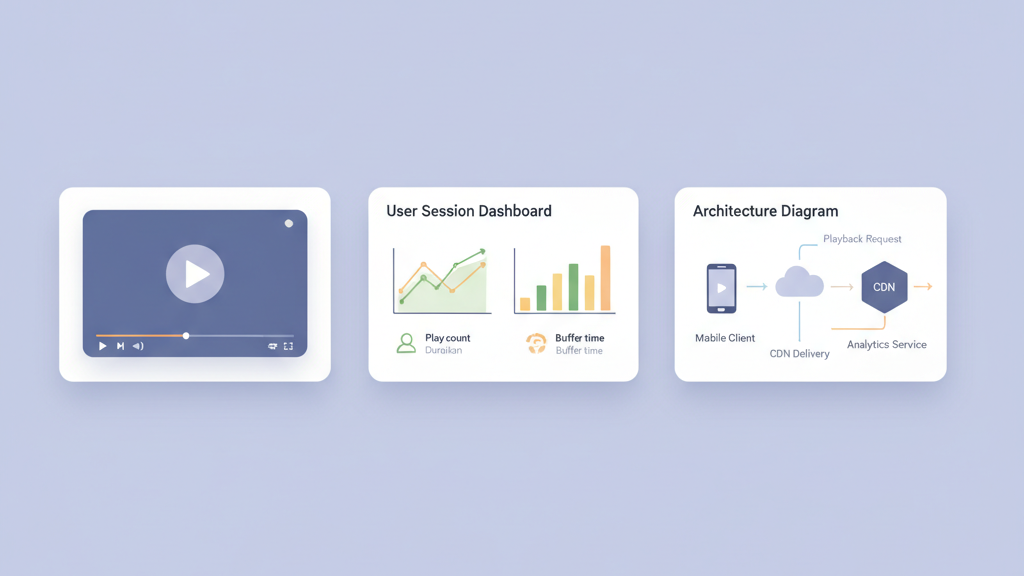
Pick a minimal architecture that covers ingestion, storage, delivery, and analytics without unnecessary layers. For an MVP you do not need a complex microservice mesh. Use a managed encoder, store content in a cost efficient object store, and front content with a single CDN provider. That setup reduces operational overhead and gives you predictable billing. You can add transcoding or multi CDN routing later. Many founders try to optimize for every edge case and end with an architecture they can not operate. Start with a simple flow that your team understands and can maintain. Keep logs and events lightweight to avoid extra egress costs when you stream analytics. If you need implementation support, explore MVP development for startups.
- Use managed encoding and a single CDN to start
- Store originals in cheap object storage
- Avoid premature microservices and complex routing
- Keep analytics events small and focused
Adaptive Bitrate And Perceived Quality
Adaptive bitrate streaming is the best way to manage bandwidth and preserve user satisfaction. Implement a small bitrate ladder that covers common mobile and desktop environments. Do not overdeliver many redundant renditions. A compact ladder with three to five profiles will handle most conditions and save storage and delivery costs. Test how the player switches under realistic mobile speeds. Poor switching causes stalls and drives users away. In my view it is better to tune the player for stability than maximum resolution at all times. Many teams underestimate the impact of initial startup time. Optimize for fast first byte and a smooth first 10 seconds of playback to improve retention. A related guide worth reviewing is How To Budget An MVP For Early Teams (enterprise app MVP pricing for small businesses USA).
- Start with a compact bitrate ladder of three to five renditions
- Prioritize fast startup and smooth early playback
- Test switching behavior on real mobile networks
- Tune for stability over maximum resolution
CDN Strategy And Cost Controls
A CDN will handle most delivery pain but your choices affect both cost and performance. Pick a provider with good presence in your target country and a clear pricing model. Some CDNs offer bandwidth caps, reserved capacity, or pricing breaks for caching efficiency. Use aggressive caching for static segments and short cache time for manifest files. Monitor cache hit rates because a low hit rate means more origin egress and higher bills. Many startups ignore cache metrics until the bill arrives. Implement cache friendly headers and test cache behavior during simulated load. Also consider tiered pricing and negotiate if you reach significant volume.
- Choose a CDN with good local presence and simple pricing
- Monitor cache hit ratio from day one
- Set cache headers for static segments
- Simulate load to validate billing assumptions
Retention Tactics That Work With Limited Features
Retention is not only about features. It is about reliable playback, clear value, and habit forming cues. For an MVP focus on a few retention levers you can measure. Improve onboarding to reduce time to first play. Offer relevant recommendations based on a simple rule engine rather than heavy personalization to keep complexity low. Use push or email sparingly to bring users back. Collect short feedback prompts after sessions to learn why users left or stayed. Many founders chase advanced personalization too early. Build trust with stable playback and simple hooks, then expand recommendations when you see repeat patterns in usage data. Teams moving from strategy to execution can review FlutterFlow development.
- Reduce time to first play during onboarding
- Use simple recommendations before heavy personalization
- Ask for brief feedback after sessions
- Use reengagement notifications sparingly
Analytics And Metrics To Prioritize
Track a focused set of metrics that tie bandwidth to retention and revenue. Key metrics include startup time, buffering rate, average bitrate delivered, session length, and churn after first play. Map bandwidth consumption to these metrics so you can see which optimizations yield retention gains. Avoid instrumenting everything out of the gate. Many teams send excessive telemetry and face high egress costs. Start with essential events and add more when you need to diagnose problems. Use sampling where possible and aggregate on the edge to reduce event volume. Visualize the correlation between quality metrics and user retention to make data driven trade offs.
- Monitor startup time and buffering rate closely
- Map bandwidth to session length and churn
- Use event sampling to control analytics costs
- Aggregate events at the edge before sending
Testing, Pricing, And Launch Lessons
Test pricing and hosting scenarios before a broad launch to avoid surprises. Run small paid pilots or invite only tests to validate consumption patterns. Use feature flags to roll out adaptive bitrate and different encoding settings so you can measure impact without full redeploys. Many startups learn the hard way that a single viral event can destroy their budget. Prepare rate limits and emergency throttles to protect cash. Be ready to adjust quality targets quickly based on real usage. Finally, communicate clearly with early users when you make changes. Transparency about limits and updates builds goodwill and helps with retention.
- Run paid pilots to measure real consumption
- Use feature flags for progressive rollout
- Prepare emergency throttles and rate limits
- Communicate changes clearly to early users