
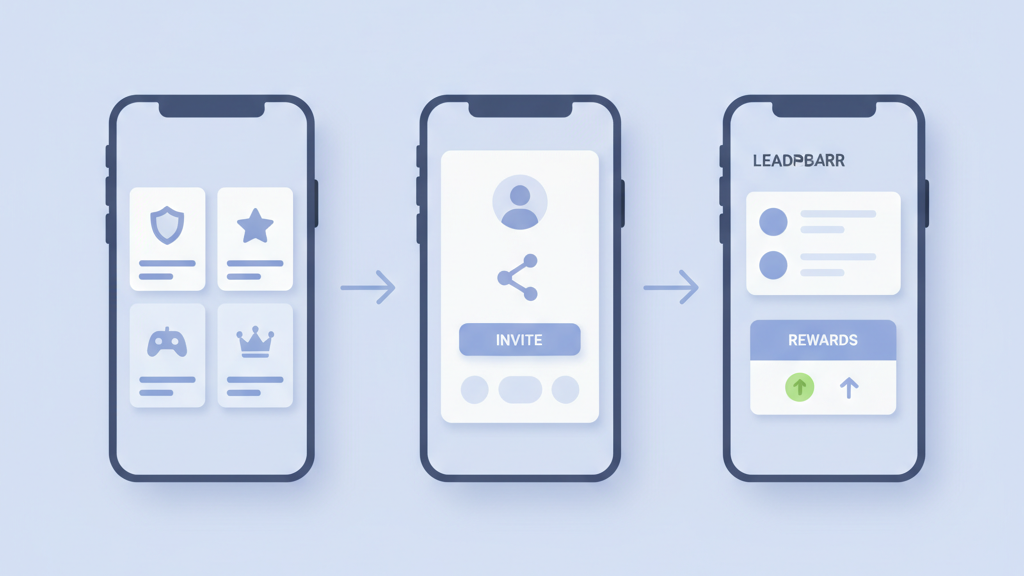
This guide explains how to launch a social gaming app MVP virality mechanics and growth plan that moves quickly and learns fast. Startups often waste time on shiny features that do not help sharing. Focus on simple loops that motivate invites and repeat play. I will cover initial design choices, lightweight referral paths, onboarding tweaks, and the metrics that matter. Many startups miss the value of a small set of reliable experiments. This piece favors hands on work over long design reviews. Expect practical warnings and clear trade offs. If you are a founder or product manager in the USA you will find tactics you can test in weeks not months. If you want a related deep dive, read How To Budget An MVP For Early Teams (enterprise app MVP pricing for small businesses USA).
Start With A Clear Viral Loop
A viral loop is the simplest engine for organic growth. Design a loop that begins with a core action. That action should naturally trigger a social step like inviting a friend, sharing a result, or challenging someone. Keep the loop short and visible. Users must see the benefit of the social step quickly after they take it. Avoid buried features that rely on perfect timing or heavy coordination. Measure the conversion at each handoff. If invites do not convert to installs and first sessions, tighten the reward or reduce friction. Many teams overestimate the power of generic rewards. Focus on rewards that tie directly to the game experience and feel meaningful to players. A tight loop reduces the need for paid acquisition early on and gives you a real product signal. For a practical follow-up, see Real-Life Case Studies: The Power of MVP Development for Startups.
- Map a single simple loop from play to invite to return
- Make the social action visible within the first two sessions
- Reward actions that improve gameplay for both sender and receiver
- Track conversion rates at each loop stage
Design Social Hooks That Add Value
Social hooks should be part of gameplay and not feel like ads. Build hooks that highlight status, progress, or friendly competition. Think about moments when users feel pride or urgency. Those moments are natural share points. Avoid asking for shares immediately after negative outcomes. Instead tie sharing to wins or milestones. Create micro incentives that are easy to fulfill and do not break balance. For an MVP, avoid complex economies. A small cosmetic reward, an extra turn, or a preview of a new level works well. Test which hooks drive real invites with a few simple variants. Do not assume what players prefer. Run short A B tests and be willing to remove hooks that do not move the needle. If you need implementation support, explore MVP development for startups.
- Place share prompts on wins and milestones only
- Offer rewards that feel meaningful but do not unbalance
- Test a few hook types with short A B tests
- Avoid intrusive or frequent share requests
Optimize Onboarding For Quick Social Actions
Onboarding should reduce decision points and guide players to a social first win. The goal is a short initial loop that ends in a social action within the first session. Use progressive disclosure to avoid overwhelming new players. Teach core mechanics with a single interactive tip. Then prompt a low friction social action such as inviting a friend to gain a small bonus. Make the invite flow native and familiar. Pre fill messages with friendly, game centric copy and allow personalization. Track drop off points closely during onboarding. If many users abandon before the social step, simplify the flow and reduce required permissions. A clean onboarding that surfaces social value fast will boost early virality tests and give you cleaner data to iterate on.
- Aim for a social action inside the first session
- Use one interactive tutorial to teach core mechanics
- Keep the invite flow native and short
- Monitor onboarding drop offs and simplify aggressively
Leverage Lightweight Invite Mechanisms
Invites should work with minimum friction and maximum clarity. Use deep links to bring invited users directly to the promised context. Offer multiple share channels but optimize for the few that drive the most installs. SMS and popular social apps still perform well in many markets. Avoid heavy external dependencies that slow down iteration. For an MVP, build a small set of tested share templates and measure which channels convert. Track installs from invites separately so you can calculate invite to install ratios. Make sure rewards are granted reliably and quickly. Many startups fail to automate reward delivery which kills trust. Small reliable systems beat complex systems that frequently break. A related guide worth reviewing is Uncovering the Untold Tactics: Navigating MVP Iteration for Product-Market Fit.
- Use deep links to land new users in the right place
- Start with two to three high value share channels
- Measure invite to install conversion per channel
- Automate reward delivery to sustain trust
Measure Early Signals Not Vanity Metrics
Focus your analytics on signals that matter for virality. Track invite rate, invite to install conversion, short term retention, and invite based retention. Vanity metrics like total installs or raw shares can mislead decision making. Set up funnels that show where invited users drop off. Measure the quality of users coming from invites versus paid channels. Use simple dashboards to keep the team aligned on the metrics that influence iteration. Many founders forget to instrument reward delivery and discovery events. Missing events lead to bad decisions. Start with a minimal analytics plan and add events as you test new mechanics. Good data helps you prioritize the next experiment and cut what does not work.
- Track invite rate and invite to install conversion
- Compare retention for organic and invited users
- Use funnels to find drop off points
- Instrument reward and discovery events first
Iterate With Small Fast Experiments
Run narrow experiments with clear success criteria. A useful experiment changes one variable and measures its effect on a single metric. For virality tests that could be the invite conversion rate or the percentage of players who share after a win. Keep sample sizes realistic for your traffic and run tests long enough to see meaningful effects. Use feature flags to roll changes out quickly and to roll them back if needed. Document learnings and standardize hypotheses for future tests. Avoid chasing tiny lifts that are not repeatable. Prioritize experiments that are cheap to build and give directional answers. I believe fast iteration beats long planning in early stages. Many teams waste months on a single untested feature.
- Change one variable per experiment
- Define clear success criteria before launching
- Use feature flags for rapid rollouts and rollbacks
- Favor cheap tests that give directional clarity
Plan For Retention After The Viral Spike
Virality can drive short term spikes, but retention determines long term growth. Build retention hooks that keep invited users engaged after the initial social step. Consider daily challenges, light progression, and shared goals that require returning players. Ensure the product experience is satisfying without the social layer so players do not feel forced to invite friends. Plan reengagement messages and time them to natural churn points. Use cohorts to see how different invite types influence long term value. Be cautious with over rewarding invites as that can attract low quality users. I advise focusing on a small set of retention features that are polished and sustainable rather than many shallow attempts. Teams moving from strategy to execution can review Mobile app development.
- Add retention hooks that work without invites
- Use cohorts to measure long term value of invited users
- Time reengagement tactically at likely churn points
- Avoid heavy rewards that attract low quality users