
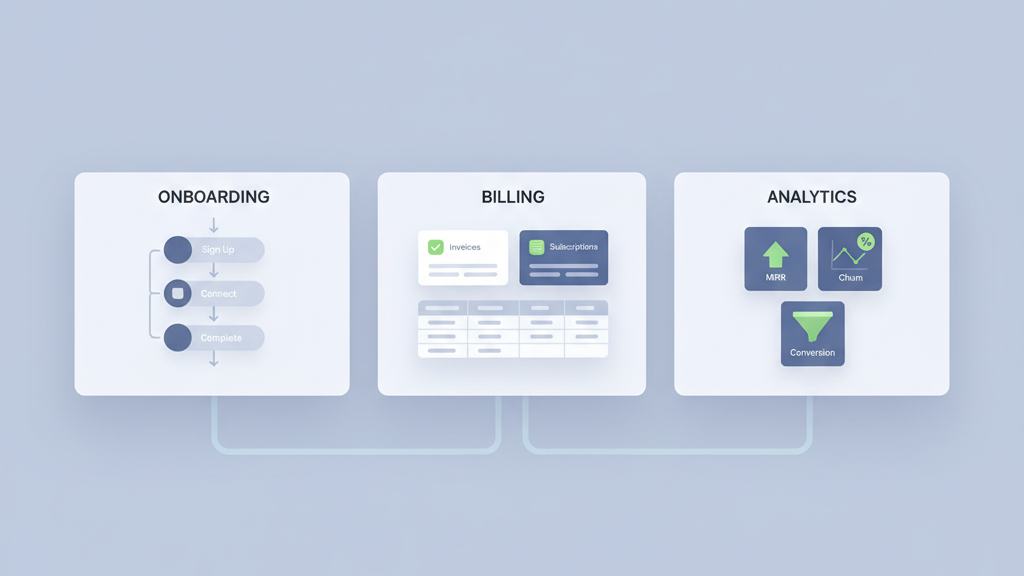
This post walks founders and product managers through a subscription service software MVP feature roadmap for founders. It keeps priorities lean and practical. You will get clear guidance on what to build first, which trade offs matter, and how to validate revenue quickly. Many startups miss the mark by overbuilding billing or skipping simple onboarding. I give a pragmatic order for features, plus warnings about common traps. The voice is simple and direct. Use this as a working checklist when you scope your first sprint. Count on real trade offs, not wishful thinking. If you need a tighter plan for your team I offer suggestions you can adapt in an afternoon of planning. If you want a related deep dive, read Building an Analytics Dashboard Software MVP for Product Managers: A Practical Guide.
Start With The Core Value
Focus your first release on the single problem your subscription product solves and the simplest paid path to test it. Founders often confuse feature richness with product fit. For a subscription service software MVP feature roadmap for founders the priority is a repeatable value loop that a user is willing to pay for. Build a minimal experience that demonstrates that value in minutes. Keep account creation short and skip optional settings. Add a basic payment flow that accepts the most common card types in the USA. Validate willingness to pay before investing in custom onboarding, analytics, or complex entitlement rules. This approach saves time and reveals real usage patterns. In my opinion this focus beats building a feature rich demo that no one pays to use. For a practical follow-up, see B2B Onboarding Software MVP Product Market Fit Steps That Actually Work.
- Define one core user job
- Map a short paid path
- Ship a usable loop in weeks
- Delay advanced features
Billing And Payments First
Shipping a smooth billing flow is non negotiable for subscription products. Start with a trusted payment provider and standard recurring plans. Handle card payments, basic proration, and simple plan upgrades or downgrades. Make the billing page clear and mobile friendly. Many startups underestimate payment error handling and lose revenue as a result. Implement receipts, a billing history, and a retry strategy for failed charges. Keep taxes and compliance simple at first by using region defaults or the payment provider tools. Plan to automate refunds and cancellations with clear signals for the app. This core billing layer will carry you through early growth and avoid expensive migrations later. My advice is to invest in reliability over custom cost optimization at the MVP stage. If you need implementation support, explore MVP development for startups.
- Use a proven payment provider
- Support basic proration
- Show receipts and history
- Retry failed charges
Onboarding And Activation
Onboarding decides whether users become paying customers. Design a short welcome flow that proves the product value quickly. Use progressive disclosure to avoid overwhelming new users. Offer a guided task or sample content that lets users finish one success moment in the first session. Track activation events so you can measure where people drop off. Collect only the data you need to start a subscription and defer profile complexity. Include a clear free to paid conversion path and surface benefits of upgrading. Many founders falsely believe lowering friction is only about fewer fields. It is also about creating meaningful steps that feel productive. Good onboarding reduces churn and makes your billing experiments more reliable.
- Create one clear activation task
- Use progressive disclosure
- Measure activation events
- Make upgrade benefits visible
Product Catalog And Entitlements
Model your offerings with simple tiers and clear entitlements. For an early subscription you need no more than three plans and a la carte add ons if needed. Keep permissions and feature flags minimal. Implement server side checks so the client never displays premium controls to unpaid users. Build a small product catalog service to map subscriptions to access rights. This helps when you iterate on pricing or introduce trials. Avoid building a complex pricing engine at launch. It will slow you down and add risk. Use simple naming for plans that customers understand. In my view simplicity here reduces support load and speeds up experiments with promotions and trials. Teams moving from strategy to execution can review Software maintenance and scaling.
- Offer up to three plans
- Map subscriptions to entitlements
- Enforce access server side
- Keep naming customer friendly
Analytics And Metrics To Learn Fast
Collect minimal analytics that answer the big product questions. Track MRR, churn, trial conversion, activation rate, and key funnel steps. Use lightweight event tracking to link user actions to revenue outcomes. Instrument dates for signup, first value, subscription start, and cancellation. These signals reveal whether features move growth levers. Many founders wait too long to add tracking and then guess at causes of churn. Start with dashboards that update daily and expose raw event logs for troubleshooting. Keep privacy in mind and do not log unnecessary personal data. Good metrics let you prioritize the roadmap and stop wasting time on vanity features.
- Track MRR and churn
- Measure trial conversion
- Log activation and cancellation dates
- Keep dashboards simple
Security And Compliance Basics
Secure payment and user data from day one. Use tokenized payment processing so sensitive data is never stored on your servers. Apply HTTPS everywhere and enforce strong passwords or SSO options for enterprise prospects. For US focused startups be aware of PCI scopes and use provider tools to reduce your compliance burden. Add audit logs for billing changes and administrative actions. Plan for data export options in case customers request their data. Many teams ignore compliance until they face audits or legal requests. Addressing basic security early avoids costly retrofits and protects your reputation when you grow.
- Use tokenized payments
- Enforce HTTPS and strong auth
- Limit PCI scope with provider tools
- Keep audit logs for billing actions
Architecture And Integrations
Design an architecture that supports quick iterations without premature optimization. Favor modular services for billing, user management, and content delivery so you can swap providers later. Expose a simple API for integrations with CRMs, help desks, and analytics tools common in the USA market. Use webhooks for real time events like subscription changes and payment failures. Keep the MVP deployment simple with one region and clear monitoring. Automate backups and create runbooks for common incidents. My pragmatic take is to build for maintainability and quick fixes rather than extreme scale. You will likely refactor as you learn product market fit and customer needs. A related guide worth reviewing is Uncovering the Untold Tactics: Navigating MVP Iteration for Product-Market Fit.
- Use modular services
- Provide simple APIs
- Send webhooks for key events
- Automate backups and monitoring