
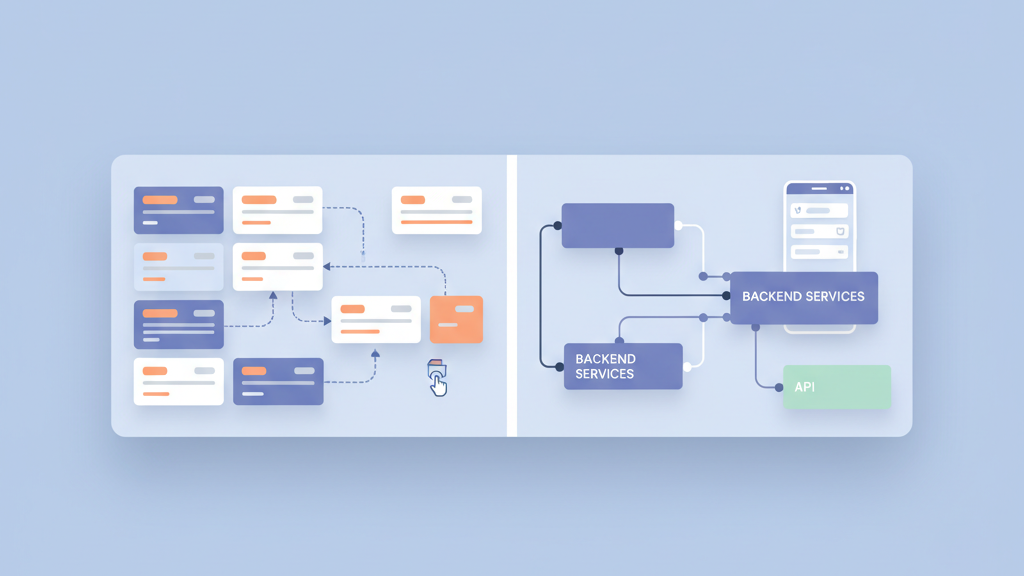
Choosing the right build strategy feels urgent for early teams. In this article we compare No code vs custom MVP development for startups and unpack practical trade offs founders face when testing product market fit. I will cover speed, cost, technical risk, and user experience in plain terms. You will get a simple framework to decide which path makes sense for your stage. Many startups miss hidden costs and assume speed equals success. That warning matters. Read on if you want to avoid common traps and pick an approach that keeps options open while validating real user needs.
When To Choose Each Approach
Picking between visual builders and a custom code stack begins with a clear question. Are you trying to validate a demand hypothesis quickly or build a durable product that will scale to complex workflows and integrations. No code platforms let you prototype user flows fast and iterate on feedback in days. They work well when core logic is simple and you expect many pivots. Custom development is better when your product requires unique performance, proprietary algorithms, or deep integrations with backend systems. It costs more up front and takes longer to reach users. Good founders weigh how much learning they need from real users and how long they can tolerate technical debt before choosing a path. A pragmatic mix often works, but avoid committing to a single choice without a timed plan. If you need implementation support, explore Software maintenance and scaling.
Speed And Time To Market
Speed matters in the early days, but not every fast build is useful. No code tools excel at removing setup friction so you can test landing pages, signups, and core flows quickly. You can gather real user data in a weekend or a few weeks. That speed uncovers demand and user priorities with minimal spend. Custom builds take longer because you must plan architecture, build APIs, and run QA. The delay is a cost but it buys flexibility and control. If your hypothesis depends on subtle performance cues or bespoke interactions, investing time up front can avoid rework. Many founders default to the fastest route without a rollback plan. That is risky. Decide on an acceptable time to learn and choose the path that gives you actionable signals within that window.
Cost And Budgeting
Cost is more than development hours. No code subscriptions and plugins add recurring bills. They cut hiring needs early and reduce upfront cash burn. Custom builds increase initial payroll and contractor costs but can lower long term expenses if you avoid vendor lock in. Founders should model three scenarios: basic validation, moderate growth, and scaled operation. Estimate hosting, integrations, maintenance, and design work for each option. Do not forget hidden costs like migrations, performance tuning, and feature rewrites. Many startups misprice their second iteration because they did not budget for refactoring a no code prototype into a robust product. A simple rule will help. Spend only enough to validate the riskiest assumptions and keep reserve budget for the follow up build that turns a validated concept into a durable product. If you want a related deep dive, read Uncovering the Untold Tactics: Navigating MVP Iteration for Product-Market Fit.
Scalability And Technical Debt
Scalability is both a technical and a product question. No code platforms abstract many infrastructure decisions which speeds delivery but can make complex scaling harder. When user growth or data complexity increases you may hit limits or performance bottlenecks tied to the platform. Custom code gives you more control over data models, caching, and deployment strategies, but it also requires good engineering discipline to avoid debt. The key is anticipating growth triggers and instrumenting your prototype to measure them. If you expect rapid growth or strict compliance needs, plan for a staged migration. If you choose a no code route, pick tools with exportable data and clear APIs. Technical debt is manageable when it is intentional and time boxed. Many founders overlook the cost of rewriting poor assumptions later. For a practical follow-up, see How to Choose the Right MVP Development Company for Your Startup’s Unique Needs.
User Experience And Customization
User experience often decides whether a product wins. No code platforms provide templates and consistent UI patterns that lower design effort. They can deliver polished flows fast but they limit deep customization. If your value depends on unique interactions, animations, or fine tuned latency, custom development gives you full control. Think about the smallest user journey that proves value and test it. A clean minimal experience that solves a real problem beats a flashy prototype that confuses users. You can also combine approaches by shipping the core flow on a no code stack while building a custom component for the highest value interaction. Be careful though. Mixing tools can create inconsistent behavior and maintenance overhead. Test prototypes with real users and iterate based on observed friction. A related guide worth reviewing is Steps to Create a Lean Prototype for Startups That Validate Fast.
Team And Skill Requirements
Your available talent influences the build path. If your team has designers and product people but limited engineering capacity, no code tools allow you to ship without hiring senior engineers. That reduces time and recruitment pressure. If you have access to engineers who can own backend systems and long term architecture, custom development can deliver a stronger foundation. Consider hiring cost and time to recruit when you plan. Also evaluate operational skills like devops and security. No code can reduce those needs early but you will still need someone to manage integrations and data. Many founders assume their early hires will scale with the product. That is false in most cases. Define clear roles for prototype maintenance and for the eventual product build so responsibilities do not fall through the cracks. Teams moving from strategy to execution can review Backend API development.
Decision Framework And Next Steps
A short framework helps you decide without overthinking. First list the riskiest assumptions you must validate. Then ask which approach gives you the fastest, cheapest, and most reliable way to test each assumption. Add constraints like compliance, time to demo, and runway. Score each approach against those constraints and pick the one with the highest expected learning per dollar. Set a strict timeline and success criteria for the prototype. If the test passes, plan the next build and budget for migration or extension. If it fails, capture lessons and pivot quickly. My advice is practical and cautious. Many startups skip the scoring step and end up overbuilding features that do not matter.