
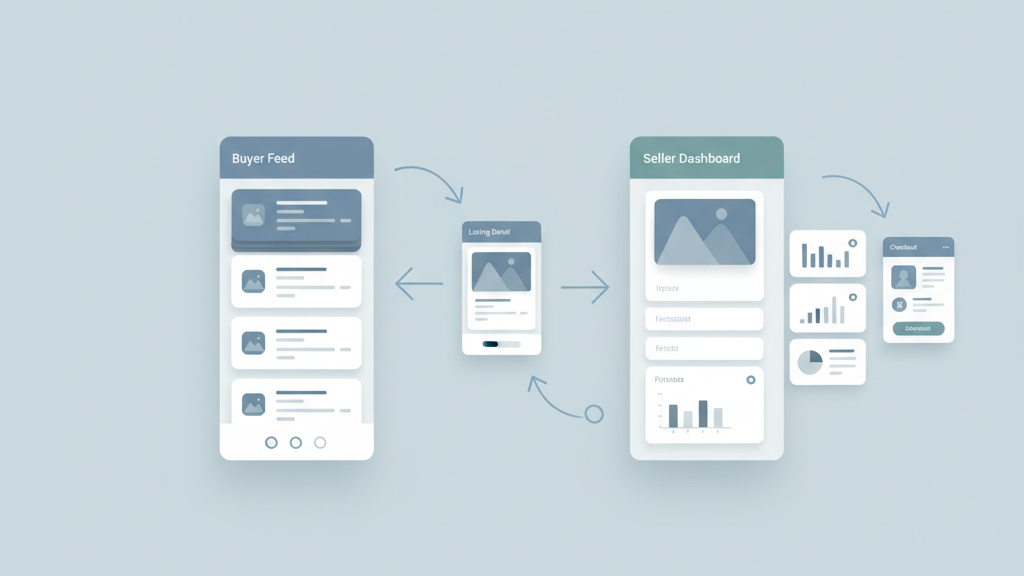
This guide lays out a clear product strategy for building a marketplace MVP using the FlutterFlow approach. The focus keyword helps keep things practical. Founders and product managers will get a repeatable plan to validate demand, prioritize features, and move from prototype to a measurable launch. Many startups miss basic validation steps, so expect to iterate quickly and accept trade offs. The goal is to reduce time to learning, not to build a perfect platform on day one. If you want a related deep dive, read FlutterFlow eduTech app MVP product strategy for US product managers: A Practical Guide.
Why FlutterFlow Accelerates Early Validation
Visual builders let teams move from idea to usable prototype in weeks instead of months. For early stage marketplaces that speed matters a lot. With a visual tool you can assemble listing screens, user flows, and basic transactions without hiring a custom front end team. That means you can test demand and price sensitivity sooner. There are trade offs with control and long term architecture. Plan to limit the initial scope to the smallest set of features that prove the marketplace hypothesis. Use the builder to test messaging and conversion points. Record real user behavior so you can decide what justifies custom development. Many startups assume the prototype will scale unchanged and that leads to expensive rewrites later. If you need implementation support, explore MVP development for startups.
- Build core flows first
- Validate pricing and demand
- Keep scope tightly focused
- Document APIs early
- Plan for a handoff
Define The MVP And Testable Hypotheses
Start by listing the riskiest assumptions about your marketplace and turn them into measurable tests. Define buyer intent, seller onboarding friction, and acceptable transaction friction as primary hypotheses. Then design the MVP to falsify or validate those assumptions with the least build effort. Prioritize features that directly impact conversion and retention. Avoid building nice to have items like complex search or advanced filters until the core match rate is proven. Set clear success metrics and time bound experiments. Use simple A B tests and basic analytics to learn fast. If you ignore hypothesis driven work you will waste effort on features that do not move the business needle. This approach keeps the team focused and reduces sunk cost.
- List your riskiest assumptions
- Convert assumptions into tests
- Prioritize conversion and retention
- Run time bound experiments
- Use simple analytics
Design Core User Flows For Buyers And Sellers
A marketplace lives and dies on a few critical flows. Map those flows visually before building. For buyers focus on discovery, listing detail, and checkout. For sellers focus on onboarding, listing creation, and order management. Keep screens uncluttered and remove decisions that do not help match users. Use progressive disclosure to hide complexity until it matters. Test onboarding with real users to watch where they drop off. Messaging and notifications are important but can be mocked initially. Prioritize flows that unlock the first successful transaction. Small UX wins often improve conversion more than additional features. A practical warning is to avoid mirroring large platforms at launch. They have solved problems at scale that you do not need to solve at day one. For a practical follow-up, see A Practical Guide For Onboarding Your First Ten Paying Users.
- Map buyer and seller journeys
- Ship discovery and checkout first
- Simplify onboarding steps
- Mock complex features early
- Watch actual user drops
Integrations And Technical Choices To Minimize Risk
Choose integrations that let you move fast and later replace parts without a full rewrite. Use managed services for payments, authentication, and storage so you avoid building infrastructure. Wire up analytics from day one to capture funnels and retention. Keep custom logic isolated so you can extract it to a backend when needed. If you need advanced search or matching use external services and treat them as replaceable. Document data models and API contracts so backend work can proceed in parallel. Have a rollback plan for any third party that becomes costly. Many startups underestimate vendor lock in and that can force expensive migrations. Prioritize flexibility over premature optimization. Teams moving from strategy to execution can review Backend API development.
- Use managed payments and auth
- Capture analytics from day one
- Isolate custom logic
- Document data and APIs
- Plan vendor exit paths
Roadmap For Growth And When To Reengineer
Set milestones that trigger engineering investments. Early milestones should focus on product market fit signals like repeat usage and organic growth. When those signals are clear, plan a phased move to custom development for performance or unique features. Keep experiments in the existing stack while extracting high value services to a backend. Measure unit economics and customer acquisition cost before scaling acquisition spend. Hire engineers when you need sustained velocity on technical debt or platform improvements. Do not reengineer purely for aesthetics. Rewrites are expensive and disruptive, so only start them when the business gains justify the effort. A clear roadmap helps investors and the team understand when spending on technical scale makes sense. A related guide worth reviewing is Uncovering the Untold Tactics: Navigating MVP Iteration for Product-Market Fit.
- Define trigger milestones
- Measure unit economics
- Phase extraction of services
- Hire for sustained velocity
- Avoid premature rewrites