
The intersection of social media and e-commerce has created a massive opportunity for new founders. Many teams struggle to build these complex platforms because custom development takes too much time and money. Using a visual builder is a smart way to bypass the early technical hurdles. This guide explores how FlutterFlow social commerce app MVP product market fit validation for startups helps you launch faster and learn more about your users. You do not need a massive engineering team to test a marketplace idea. You only need a functional product that solves a specific pain point. This approach lets you focus on the business logic instead of the code. If you can get real people to buy items on your platform, you have the proof you need to scale. Speed is your primary weapon in the early stages of a startup. Do not let a long development cycle kill your momentum.
The Strategic Value of Speed in Social Commerce
Building a marketplace with integrated social features is a massive undertaking for any new company. Traditional development cycles often last six months or more before a single user sees the app. This delay is dangerous because it prevents you from gathering real world data. Many startups miss this and focus on building the perfect architecture before they even know if people want their product. Using a visual development tool allows you to launch a high quality app in a fraction of the time. This means you can test your core hypothesis while you still have most of your budget. The social commerce space moves very fast and trends change every month. If you take too long to build, you might launch a product that is already obsolete. Your main goal should be to get a version one into the hands of real users as soon as possible. This is not about cutting corners but about prioritizing the right tasks. You should spend your energy on marketing and user acquisition instead of debugging complex backend code. A functional MVP provides more insights than a perfect prototype. By shipping early, you discover what features your users actually value. This data is the only thing that should guide your future development decisions. Every week you spend in a dark room coding is a week you are not learning from your customers.
Essential Features for Your First Social Marketplace
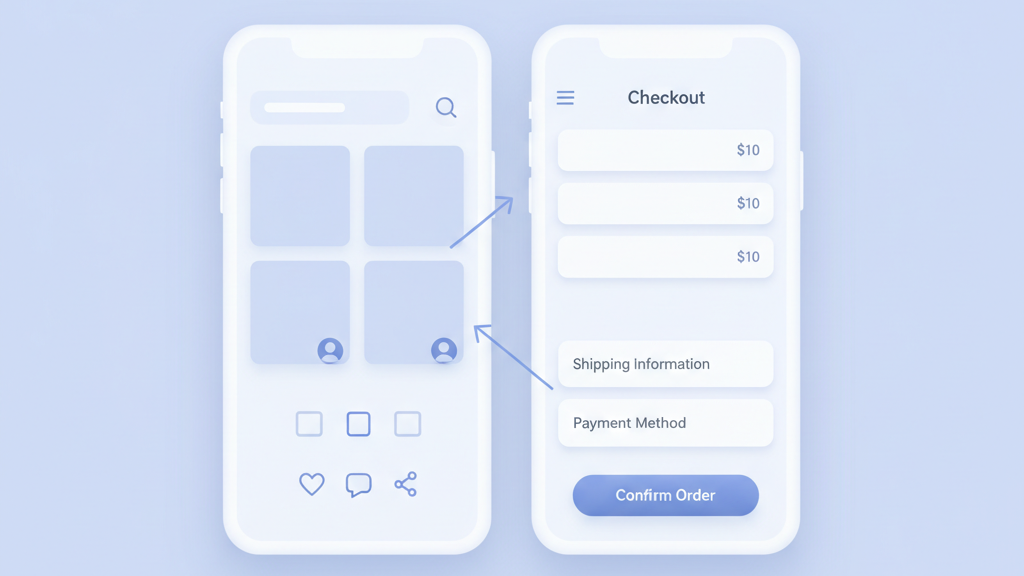
When you are working on FlutterFlow social commerce app MVP product market fit validation for startups, you must choose your features carefully. It is very easy to get distracted by flashy social features that do not drive revenue. Your MVP should focus on the path to a transaction. Users need to be able to find products and pay for them without any friction. Social features like comments and likes should only exist to build trust between buyers and sellers. Many founders try to build a full social network and an e-commerce platform at the same time. This is usually a mistake because it dilutes the user experience. You want to create a clear reason for people to use your app instead of a giant like Amazon. This often comes down to a niche community or a unique way of discovering goods. Start with a simple feed that shows products based on basic tags. Do not worry about complex AI recommendation engines yet. Human curation is often more effective for early stage social commerce anyway. Focus on making the checkout process as smooth as possible. If people cannot buy easily, they will not come back. Trust is the most important currency in a social marketplace. Features that verify users or show their history are much more valuable than custom animations. Keep the initial scope small so you can iterate based on what your first fifty users tell you.
- Seamless payment integration with providers like Stripe or Braintree
- Simple user profiles that showcase a history of successful trades
- Direct messaging for buyers and sellers to negotiate or ask questions
- A chronological feed of product posts with high quality images
- A basic search function with category filters for easy discovery
- Push notifications for new messages and order updates
Measuring Success and Finding Product Market Fit
Product market fit is not a binary state but a gradual process of refinement. You will know you are getting close when your retention numbers start to stabilize. In the world of social commerce, you want to see users coming back to check the feed even when they do not intend to buy something. This indicates that your social element is actually engaging. You should track the ratio of active users to paying customers. If you have a lot of traffic but no sales, your social features might be distracting from the commerce side. On the other hand, if you have sales but no social interaction, you might just have a standard store. The magic happens when the two work together to create a unique shopping experience. FlutterFlow social commerce app MVP product market fit validation for startups requires you to look at qualitative data as much as quantitative data. Talk to the people who are using your app every day. Ask them what they would do if the app disappeared tomorrow. If they would be very disappointed, you are on the right track. Many founders get discouraged by low numbers in the first month. This is normal. The key is to find the small group of people who love what you built and figure out why they love it. Use those insights to refine your marketing and reach more people like them. Validation is about proving that your business can survive and grow in a competitive market.
Technical Considerations for Future Scaling
While your focus is on validation, you cannot completely ignore the technical foundation. A poorly structured database will cause major headaches as soon as you get a few thousand users. You should use Firebase or a similar scalable backend to handle your data. Keep your user objects and product objects separate and use references to link them. This makes it easier to run complex queries later on. Many startups miss this and create flat data structures that become impossible to manage. You should also think about how you handle media. Social commerce apps are heavy on images and videos. Use a content delivery network to ensure that your app stays fast even as your user base grows. Speed is a huge part of the user experience. If your feed takes more than a couple of seconds to load, people will leave. You do not need to build a custom global infrastructure on day one, but you should use tools that can scale with you. FlutterFlow allows you to export your code, which gives you a clear exit path if you ever need to move to a fully custom environment. This flexibility is a major benefit for founders who are worried about platform lock in. Keep your logic as simple as possible in the beginning. You can always add complexity later once you have the revenue to support a larger team.
- Use Firebase Cloud Functions for heavy server side processing
- Implement image compression to keep the app responsive
- Set up automated backups for all user and transaction data
- Keep security rules strict to protect sensitive payment info
- Monitor app performance with built in analytics tools
Avoiding the Common Pitfalls of Early Development
The biggest threat to your startup is not a competitor but your own desire to over engineer. It is very easy to spend weeks on a beautiful profile page that no one ever visits. You must be disciplined about what you build. Every feature should be a direct response to a user need. Many founders fall into the trap of thinking that more features will lead to more success. In reality, a cluttered app usually confuses users and drives them away. Stick to the core value proposition of your platform. If you are building a place for people to buy vintage clothes, focus on the photography and the search. Do not spend time on a dark mode or custom font settings in the first month. These things do not help you validate your business model. You should also be careful with your early marketing spend. Do not buy expensive ads until you know that your conversion funnel works. It is much better to get twenty users through organic outreach and see how they behave. This gives you a baseline for what to expect when you eventually scale. Social commerce is built on community and authenticity. If your app feels like a corporate tool, it will fail. Keep the design simple and let the products and the people be the stars of the show. Validation is a humbling process that often requires you to kill features you love. Be prepared to listen to the market above your own intuition.