
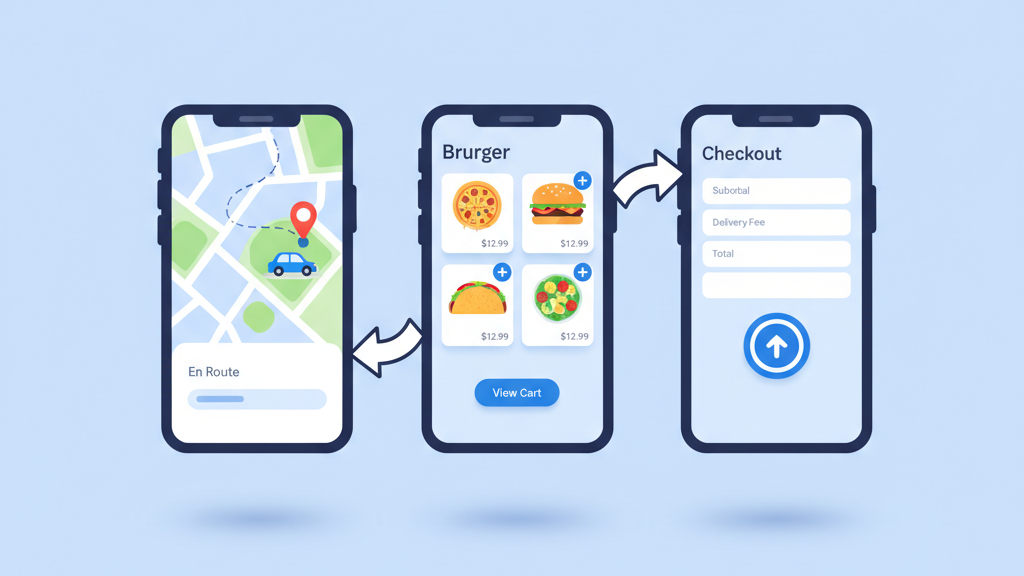
Starting a delivery business requires more than just a bike and a product. You need a reliable technical stack that handles orders, payments, and tracking in real time. Many founders get stuck in long development cycles that drain their budget before they even reach their first customer. This is where FlutterFlow on demand delivery app MVP development agency services become a game changer for early stage startups. By focusing on speed and core features, you can get to market while your competitors are still arguing over database structures. Our approach at Indent Technologies ensures that you launch with a product that is both functional and professional. We prioritize the user experience and reliable backend architecture to give your startup the best possible start. This guide explores how visual development can transform your delivery business model into a working mobile application.
The Complexity of Modern Delivery Platforms
Launching a delivery platform is inherently complex because it requires three separate user experiences. You need an interface for the customer, a dashboard for the merchant, and a mobile tool for the driver. Traditional coding often leads to delays because every small change must be synced across all three platforms. We see many startups fail because they spend six months building a perfect app that nobody wants. Using a low code approach allows you to iterate on these interfaces simultaneously. It lets you focus on the business logic rather than the boilerplate code. This shift in priority is essential for anyone trying to compete in the fast moving logistics space. Many founders ignore the fact that the backend must communicate perfectly with three different front ends. If the driver app lags, the customer gets frustrated. If the merchant app misses an order, the business loses money. Visual development tools like FlutterFlow allow us to build these connections with precision. We can create complex workflows that trigger based on order status changes. This ensures that everyone in the delivery chain stays informed without manual intervention. By reducing the time spent on basic UI elements, we can spend more time refining the specific logic that makes your delivery service unique.
Prioritizing Core Features for Your First Version
A successful MVP must prioritize features that prove your business model. You do not need a complex AI engine to suggest meals on day one. You do need a way to process payments and track where the driver is located. Most founders try to include every possible bell and whistle in their first release. This is usually a mistake that leads to a buggy experience for the user. We recommend focusing on the following core functionalities to ensure your first version is actually useful. When you limit the scope, you increase the quality of the features you do ship. A simple app that works perfectly is always better than a complex app that crashes. We have seen startups waste thousands of dollars on features that users never touched. By keeping the initial build lean, you preserve your capital for marketing and growth. This strategy allows you to learn from real user behavior before committing to expensive long term development tasks. The goal is to solve the primary problem of getting a package from point A to point B as smoothly as possible.
- Real time map integration for location tracking.
- Secure payment gateway integration for instant transactions.
- Push notifications for order status updates.
- Simple profile management system for all user types.
- Order history and digital receipts.
Scalability and Future Proofing Your Code
Scalability is often the biggest concern for technical founders looking at visual development tools. They worry that their app will break once they hit one thousand orders a day. However, modern visual tools export clean code that runs on Google Firebase or your own cloud infrastructure. This means your app is not locked into a closed system. You can always hire a developer to add custom code for specialized logic if the built in features are not enough. Many startups miss this detail and assume low code means low quality. In reality, it just means you are starting with a better foundation. As your user base grows, you can optimize your database queries and introduce caching strategies. The underlying framework is built on top of Flutter, which is used by some of the largest companies in the world. You are not building on a hobbyist platform. You are building on a professional ecosystem that supports high performance animations and heavy data processing. We ensure that the architecture we build today can handle the traffic of tomorrow. This involves setting up proper data structures and security rules from the very first day. You want to spend your time scaling your business, not fixing broken infrastructure.
Reducing Total Cost of Ownership
The cost of building a custom app from scratch can easily exceed six figures. For a startup, that capital is better spent on marketing and driver recruitment. By using specialized development services, you reduce the hours required for front end development. This leads to a significantly lower total cost of ownership during the most vulnerable stage of your company. It also allows you to pivot your strategy based on early feedback without rebuilding the entire system. We often see founders spend their entire seed round on a single version of their software. When they realize the market wants something different, they have no money left to change it. Our process focuses on flexibility and cost efficiency. We use pre built components for common tasks like login and settings screens. This frees up budget for custom features that actually set your brand apart. The following benefits highlight why this financial approach is superior for early stage ventures. You get a professional product without the enterprise price tag.
- Reduced timeline for designing user interfaces.
- Lower maintenance costs due to standardized code structures.
- Faster deployment cycles to the App Store and Play Store.
- Easier handoff between design and development teams.
User Experience Design for Logistics
User experience in delivery apps is unforgiving. If a customer cannot find the checkout button or if the map lags, they will delete the app and use a competitor. This is why we prioritize a clean and responsive layout that feels native on both iOS and Android. Visual development allows us to prototype these interactions in real time. We can show a working model to potential investors or early users within weeks. This immediate feedback loop is the most valuable asset a founder can have. It turns guesses into data driven decisions. A common mistake is making the driver app too complicated. Drivers are often in a rush and may be using older devices. We focus on large buttons and clear instructions to make their job easier. For the customer app, the focus is on speed and trust. They need to know exactly when their food or package will arrive. We use visual indicators and live updates to keep the user engaged. A polished design builds brand loyalty from the very first order. It signals to the market that you are a serious player in the delivery space.
Ensuring Data Security and Compliance
Security and data privacy are non negotiable for modern software. You are handling sensitive customer data and financial information. It is critical to ensure that your database is configured correctly from the start. We find that many developers overlook simple permissions which can lead to data leaks later on. Using a structured approach to development ensures that your user roles are clearly defined and enforced at every level of the application. Many startups miss the importance of encrypting data at rest and in transit. This is especially vital when dealing with delivery locations and payment tokens. We implement best practices for API security to prevent unauthorized access to your business logic. The points below represent the standard security measures we integrate into every delivery project. These layers of protection help you avoid legal issues and build a reputation for reliability. Your users need to feel safe when they enter their credit card information. We make sure that safety is built into the core of the app rather than added as an afterthought.
- End to end encryption for sensitive user data.
- Role based access control for different app versions.
- Compliance with standard data protection regulations.
- Secure API connections for all third party services.