
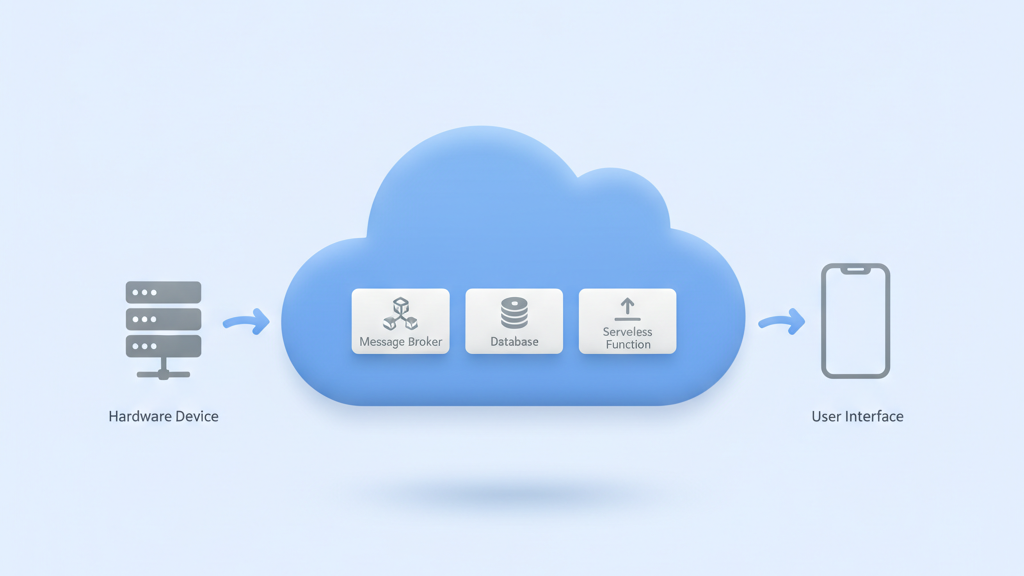
Every hardware journey eventually leads to a software problem. When founders transition from a functional prototype to a real product, they face the challenge of building a reliable back end. A solid IoT platform MVP architecture for hardware startups provides the foundation for data ingestion, device management, and user interaction. Without this core, your physical device is just an isolated piece of plastic and silicon. This guide explores how to build that foundation while avoiding common pitfalls that drain budgets and delay launches.
Prioritizing Core Features Over Custom Infrastructure
The first hurdle for most teams is deciding what to build versus what to buy. Many founders try to build custom device management tools from scratch because they want full control. This is usually a mistake that leads to months of wasted development time. An IoT platform MVP architecture for hardware startups should leverage existing cloud primitives to handle basic tasks like device shadows and firmware updates. You need to focus your limited resources on the features that make your specific product unique. If you are building a smart thermostat, your value is in the thermal algorithms, not in the way you maintain a socket connection. Many startups miss this and end up with a buggy custom broker that cannot handle even a few hundred concurrent users. We recommend starting with a standard protocol like MQTT because it is lightweight and widely supported. It allows you to maintain persistent connections without draining the battery on your hardware. Keep the initial stack as simple as possible to ensure you can iterate quickly based on user feedback. Complexity is the enemy of a successful launch. If your architecture is too rigid on day one, you will find it nearly impossible to pivot when you discover that users want a different set of features.
Structuring the Three Tier System Model
Organizing your system into clear layers is the best way to maintain sanity during the development process. Most successful architectures follow a three tier model consisting of the device layer, the communication layer, and the application layer. The device layer includes your physical hardware and the firmware that runs on it. The communication layer handles the movement of data between the device and the internet. Finally, the application layer is where your users interact with the data through mobile apps or web dashboards. You should treat each layer as a separate entity with clear interfaces. This separation allows your hardware team and software team to work in parallel without blocking each other. In the early days, you should prioritize the interfaces over the internal logic. If the mobile app knows exactly what data format to expect from the cloud, the app developers can build the user interface using mock data while the hardware is still being finalized. This reduces the time to market significantly. Many startups fail because the software team is waiting for the hardware team to finish the first batch of prototypes. By defining your architecture early, you create a roadmap that everyone can follow. It also makes it much easier to debug issues when they arise because you can isolate problems to a specific layer. Consider including these elements in your initial design.
- Use a secure bootloader to protect firmware integrity from the start
- Implement a reliable message broker to manage bidirectional data traffic
- Store telemetry data in a time series database for efficient querying
- Create an abstraction layer between the hardware and the cloud API
- Design a robust user authentication system that links users to specific devices
Designing for Security and Device Identity
Security is the one area where you cannot afford to take shortcuts during the early stages. A single breach can destroy the reputation of a new company before it even gets off the ground. You must implement end to end encryption for all data moving from the device to the cloud. Many developers rely on simple API keys for authentication, but this is often insufficient for physical devices that might be tampered with in the field. Using certificates for mutual authentication is a much better approach. This ensures that only authorized devices can connect to your server. You also need a plan for over the air updates. Hardware is never perfect, and you will eventually need to patch a bug or close a security hole. If you do not have a reliable way to update your firmware remotely, you might be forced to recall thousands of units. This is a nightmare scenario that has ended many promising startups. Building a secure update pipeline is just as important as building the main feature set of your product. Think of security as a core feature rather than a checkbox. If you build it into the foundation, you will save yourself from expensive refactoring later. It is much easier to secure a small platform today than to secure a massive one tomorrow.
Evaluating Cloud Providers and Vendor Lock In
Selecting a cloud provider is a long term commitment that will influence your development speed and operating costs. Major providers offer specialized suites that take care of the heavy lifting. These services include device registries, message brokers, and integration with serverless functions. Most early stage companies find that managed IoT cores offer the most mature ecosystem for rapid prototyping. They integrate seamlessly with other services for processing data and storage. Using these managed services allows you to pay only for what you use, which is critical when your user base is small. However, you should be careful about vendor lock in. While you want to move fast, try to write your code in a way that separates the business logic from the specific cloud APIs. This gives you the flexibility to move to a different provider or a custom solution if your needs change or if costs become prohibitive as you scale to millions of devices. A good architect always has an exit strategy even for their favorite tools. Your software should be portable enough to survive a change in infrastructure without requiring a complete rewrite. This approach protects your investment and ensures your business can adapt to a changing market.
Optimizing Data Flow and Storage Costs
Data management is the core of any connected product. You need to decide how to handle the massive stream of information coming from your sensors. Not all data needs to be stored forever. You should differentiate between hot data that requires immediate action and cold data that is used for long term analysis. For example, a temperature alert needs to be processed in real time, while daily averages can be archived in cheaper storage. This distinction helps you keep your database costs under control as your fleet grows. Many founders ignore this and end up with massive cloud bills within the first few months of operation. You should also consider the privacy implications of the data you collect. In many regions, you are legally required to manage user data with high levels of transparency and security. Implementing a clear data policy from the start will help you avoid legal headaches as you expand into new markets. Focus on these data strategies for your initial launch and build a system that respects the privacy of your customers while providing the insights you need to grow. This approach ensures that you remain compliant with local regulations while maintaining a high level of performance across your entire network.
- Filter redundant data at the edge to save bandwidth and storage costs
- Use a queue system to buffer incoming messages during peak traffic
- Implement a data retention policy to automatically delete old logs
- Set up real time alerts for critical system failures or unusual patterns
- Build a dashboard for internal teams to monitor the health of the device fleet
Simulating Real World Network Conditions
Testing an IoT system is significantly more difficult than testing a standard web application. You are dealing with physical hardware that may have intermittent connectivity or power issues. You need to simulate these real world conditions during the development phase. Do not assume that your cloud architecture will behave the same way with ten thousand devices as it does with ten. Use load testing tools to push your message broker to its limits before you ship a single unit to a customer. We often see startups fail because they only tested their system in a perfect office environment. Once the devices were in the hands of users with poor Wi Fi or unstable power, the entire platform crumbled. Building resilience into your communication protocol is essential. Your devices should be able to store data locally when the connection is lost and sync it once they are back online. This ensures that your users always have access to their history and that no critical events are missed. Planning for failure is the only way to build a platform that truly succeeds. If you can handle the worst case scenario, your daily operations will be much smoother. This level of preparation is what separates a successful hardware startup from a failed experiment.