
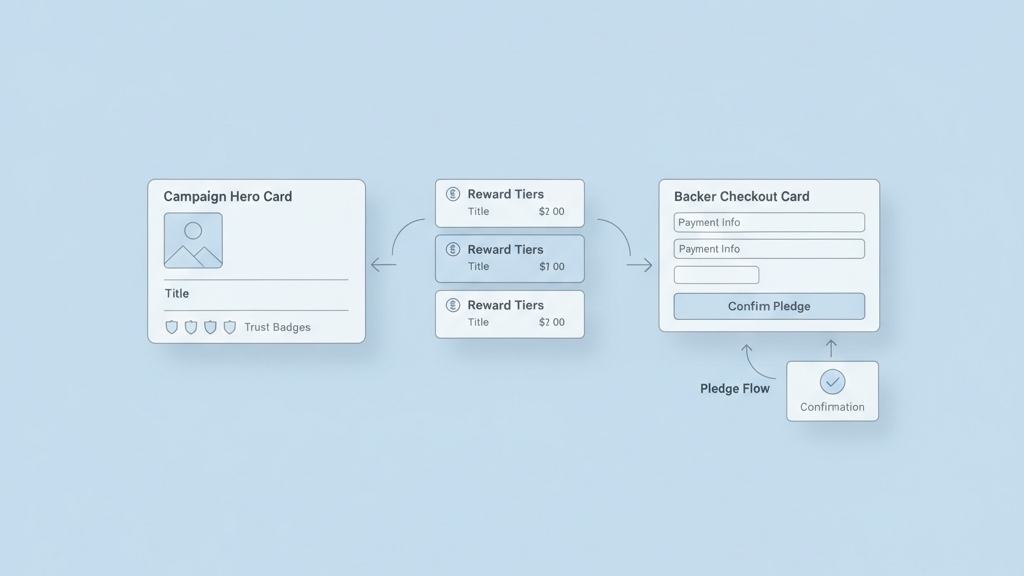
Early trust and clear backer flows define success for a crowdfunding launch. This guide walks startup founders and product managers through practical choices when building a crowdfunding platform MVP backer journeys and trust signals. You will see which pages to build first, how to map pledge flows, and what trust signals matter most to backers. I give clear trade offs that matter for an MVP. Many teams focus on features and miss simple trust cues that change conversions. Expect hands on advice, warnings about common mistakes, and ways to measure results fast. This is not a design manifesto. It is a pragmatic playbook for the first release that helps you ship a safe, testable experience and learn from real backer behavior. If you want a related deep dive, read Build A Lean Booking Product For Fast Launch.
Map The Core Backer Journey
Start by mapping the smallest path that results in a pledge. Keep the map linear so you can test it. Typical steps are discover campaign, read details, choose tier, checkout, and confirm. For an MVP cut optional branches like account creation or social sharing until you have steady traffic. Focus on signals that reduce fear and uncertainty along the path. Those signals include clear delivery estimates, refund terms, and a visible support channel. I recommend running a quick usability test with three people before you build. Many teams skip this and lose obvious friction. Use the map to pick the first screens to code and to set the analytics events you will need. If you need implementation support, explore FlutterFlow development.
- Define the minimal pledge path
- Remove nonessential branching
- Add trust cues at key steps
- Test the flow with real people
- Instrument events for conversion
Design Simple Reward Tiers
Reward tiers need to be scannable on mobile and desktop. Avoid long paragraphs in tier descriptions. Use one sentence for the core promise and one short detail line for fulfillment. Price and remaining quantity should be immediately visible. Highlight a recommended tier but do not force defaults. For an MVP you can limit the number of tiers to three to five. That reduces decision friction and simplifies inventory tracking. A compact design also makes A B testing easier later. In my experience founders often overload tiers with optional add ons early. That creates UI complexity and more edge cases in checkout. Keep the structure simple so you can measure which rewards convert. For a practical follow-up, see Building a Marketplace MVP: Why Startups Use FlutterFlow for Validation.
- Limit tiers to three to five
- Use concise tier descriptions
- Show price and availability
- Highlight a recommended option
- Avoid complex add ons early
Build Checkout For Trust And Speed
Checkout should be fast and transparent. Offer guest checkout first and delay account creation until after pledge confirmation. Show payment methods that your target backers trust. Display a clear summary on the same screen before payment. Include estimated delivery and a short refund policy snippet near the button. These are small trust signals that reduce cognitive load. Track abandonment at each stage so you know where to iterate. In my opinion slow or multi step checkouts kill momentum. Many startups underestimate the value of a smooth payment flow. For an MVP it is fine to use a third party processor that handles risk and compliance so you can focus on conversion. Teams moving from strategy to execution can review MVP development for startups.
- Support guest checkout
- Show order summary before payment
- Display delivery estimates
- Add a brief refund note near payment
- Use a trusted payment processor
Surface Trust Signals Early
Trust signals must appear before a backer commits. These include creator verification, platform badges, secure payment icons, and social proof like early backer counts. Place a compact trust strip near the top of the campaign page. Use real metrics when possible such as number of pledges and updates sent. Even a short line about manufacturing partners or sample photos improves perceived feasibility. Be honest about risks and challenges. Backers prefer transparency over polished promises. A warning here is useful. Overpromising is worse than sharing a clear risk plan. Test which signals move the needle with simple experiments and do not assume one signal fits all campaigns.
- Add creator verification
- Show secure payment icons
- Display backer counts and updates
- Share fulfillment partners
- Be transparent about risks
Measure What Matters
Good metrics guide early decisions. Track discovery to visit rate, pledge conversion, checkout abandonment, and pledge confirmation rate. Use session recordings and funnel analytics to spot blockers. Set short feedback loops with weekly reviews for the first month after launch. Choose one primary conversion metric and two secondary metrics to avoid analysis paralysis. Collect qualitative feedback from early backers via a simple follow up survey. That feedback often reveals misunderstandings that data alone does not show. Many teams drown in vanity metrics. Focus on actions that directly increase completed pledges and reduce refund risk. A related guide worth reviewing is How To Set Product Metrics And KPIs For Startups That Scale.
- Track funnel conversion rates
- Record sessions for qualitative insight
- Set weekly feedback loops
- Use one primary metric
- Survey early backers
Plan For Post Pledge Communication
A good post pledge experience builds long term trust. Send an immediate confirmation that outlines next steps and expected dates. Follow up with periodic updates about production milestones. Use clear templates so updates remain consistent and honest. Offer a support channel that is visible and responsive. Backers are forgiving of delays if they receive timely information. Without updates small doubts grow and refund requests rise. In my view communicating early and often is one of the cheapest ways to reduce churn. For the MVP you can automate basic messages and handle edge cases manually until volume grows.
- Send immediate confirmation
- Provide milestone updates
- Use consistent templates
- Offer a visible support channel
- Automate routine messages
Iterate With Targeted Experiments
Treat the MVP like an experiment platform. Run focused A B tests on single variables such as trust badge placement or checkout button text. Keep experiments short and limited to one hypothesis. Use control and variant groups and measure impact on your primary metric. Ramp successful changes across similar campaigns. Also test copy that clarifies risk and delivery. Small copy changes can move conversion more than new features. Be careful with too many concurrent tests. Many startups run overlapping experiments that produce noisy results. Prioritize tests that reduce uncertainty about backer behavior and trust.
- Run single variable A B tests
- Keep experiments short
- Measure impact on primary metric
- Apply wins across campaigns
- Avoid overlapping tests