
If you are a founder or product manager planning an education application MVP for interactive learning experiences this guide walks through pragmatic steps. We focus on quick validation and measurable learning gains rather than feature vanity. You will get advice on defining clear outcomes, choosing the right technical patterns, running fast user tests, and turning early feedback into a roadmap. Many startups miss the step of aligning learning design with metrics, so take measurement seriously from day one. This is written for teams in the USA that need a repeatable process that fits tight budgets and short timelines. If you want a related deep dive, read Process for Running Effective Early User Interviews for Product Teams.
Why Start With An MVP
An MVP forces clarity about the real problem you are solving for learners and teachers. Rather than building a full platform start with the smallest set of features that prove learning happens. Focus on a single learning scenario and a small cohort of users. This reduces technical risk and keeps costs lower while you learn about adoption and outcomes. Early studies are cheap and fast when you limit scope. Many teams try to serve all user types at once and burn runway. A sharp MVP helps you gather signals on content quality, engagement patterns, and where friction appears. Use those signals to choose what to build next. For a practical follow-up, see Real-Life Case Studies: The Power of MVP Development for Startups.
- Pick one learning scenario
- Recruit a small test cohort
- Measure outcomes not vanity metrics
- Keep scope tightly focused
Define Learning Outcomes And Metrics
Start by naming the learning outcome you will measure and a simple assessment that proves it. Outcomes can be skill based or knowledge based but they must be observable. Decide on a few metrics for the MVP such as task completion, mastery rate, time on task, and retention after one week. Instrument these metrics from day one so data is available during tests. Avoid adding too many indicators at first because that creates analysis paralysis. Many founders assume engagement equals learning but that is not always true. Pair engagement metrics with mastery checks to validate that interaction leads to learning gains.
- Write one clear learning outcome
- Create a short assessment
- Instrument core metrics early
- Pair engagement with mastery checks
- Avoid metric overload
Core Features For Interactive Learning
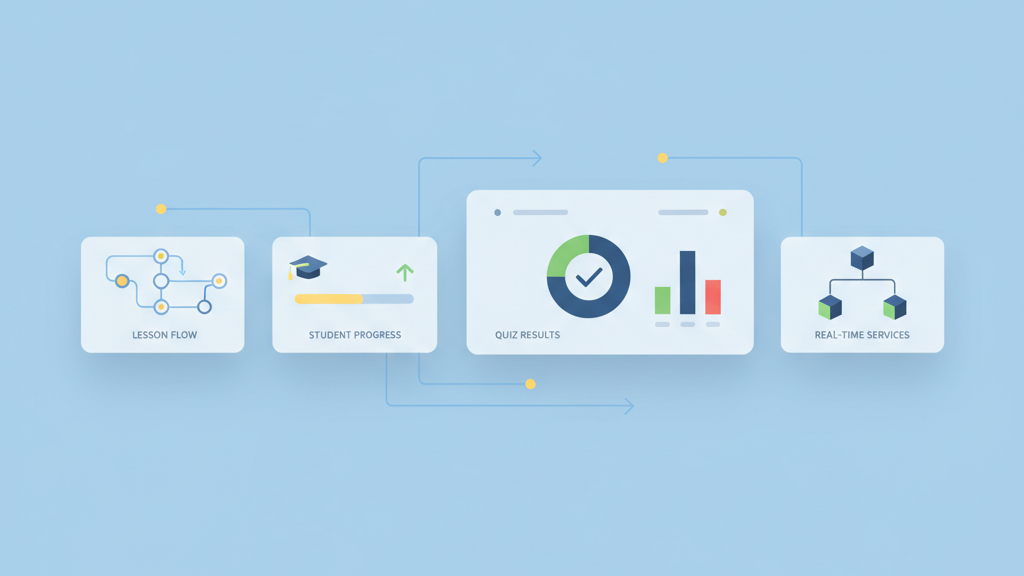
Choose features that directly support the learning outcome and give you clear signals. Common essentials include an interactive lesson player that supports media and interactivity, short formative quizzes, instant feedback, and a learner progress dashboard. Add a fast feedback loop for instructors or coaches so you can observe bottlenecks. Collaboration can be deferred unless it is central to the learning modality. Keep content authoring simple with templates so non technical staff can iterate on lessons. The goal is to validate that the experience teaches effectively before investing in heavy feature depth. If you need implementation support, explore Software maintenance and scaling.
- Interactive lesson player
- Formative quizzes with instant feedback
- Progress dashboard for learners
- Instructor feedback channel
- Simple content templates
Design For Rapid Feedback And Iteration
Design your MVP to allow rapid changes based on user tests. Use low friction content pipelines so lessons and assessments can be updated in hours rather than weeks. Prototype flows with simple wireframes and test them with real instructors and learners. Collect qualitative feedback during sessions to understand where learners get stuck. Set up quick A B tests for alternatives that matter to learning outcomes. Fast iteration is a competitive advantage because it lets you converge on what works before rivals scale. A practical warning, do not chase small UX nitpicks early, focus on major blockers that stop learning. Teams moving from strategy to execution can review MVP development for startups.
- Use wireframes and rapid prototypes
- Enable quick content updates
- Run short A B tests
- Collect qualitative session notes
Technical Stack And Architecture Choices
Choose technologies that match short term needs and future scale. For an MVP a managed backend that supports real time feedback and simple analytics is often faster than building custom services. Use modular components for lessons and assessment so you can swap engines later. Prioritize reliable data capture for event tracking and exports for analysis. Plan for basic access control and privacy compliance from the start especially when working with minors. Keep the initial architecture simple and well documented to reduce refactor costs. My opinion is that over engineering early is the most common waste of time.
- Prefer managed services for speed
- Modular lesson and assessment components
- Ensure reliable event capture
- Add basic access control and privacy
- Document the initial architecture
Launch Strategy And Early User Acquisition
A focused launch beats a broad launch. Pilot with a small set of schools or community programs that match your target learner profile. Give pilots a clear incentive and easy onboarding materials for instructors. Use direct outreach and partnerships rather than chasing paid channels at first. Gather qualitative teacher feedback and observe classroom dynamics when possible. Pricing experimentation can wait until you have clear signals about value. Many startups try to scale too quickly without validating teacher workflows. A deliberate pilot approach will surface adoption barriers and help you build a sales playbook.
- Run targeted pilots
- Provide instructor onboarding
- Use partnerships for early users
- Observe classroom dynamics
- Delay pricing experiments until validated
Measuring Success And Scaling
Define a growth runway based on learning gains and retention. Success measures for an education product mix learning outcomes, engagement, and churn. Set thresholds that tell you when to expand features or invest in infrastructure. When metrics are positive expand slowly and keep measuring. Plan for data driven content improvements and teacher training as you scale. A warning here, do not confuse higher usage with better learning. Scaling requires operational readiness for support and content quality checks. Use the MVP results to build a clear roadmap that ties each new feature to a measurable hypothesis about learning or retention. A related guide worth reviewing is How To Set Product Metrics And KPIs For Startups That Scale.
- Set outcome based thresholds
- Expand features only when metrics support it
- Prepare operations for scaling
- Keep linking features to hypotheses
- Monitor learning not just usage