
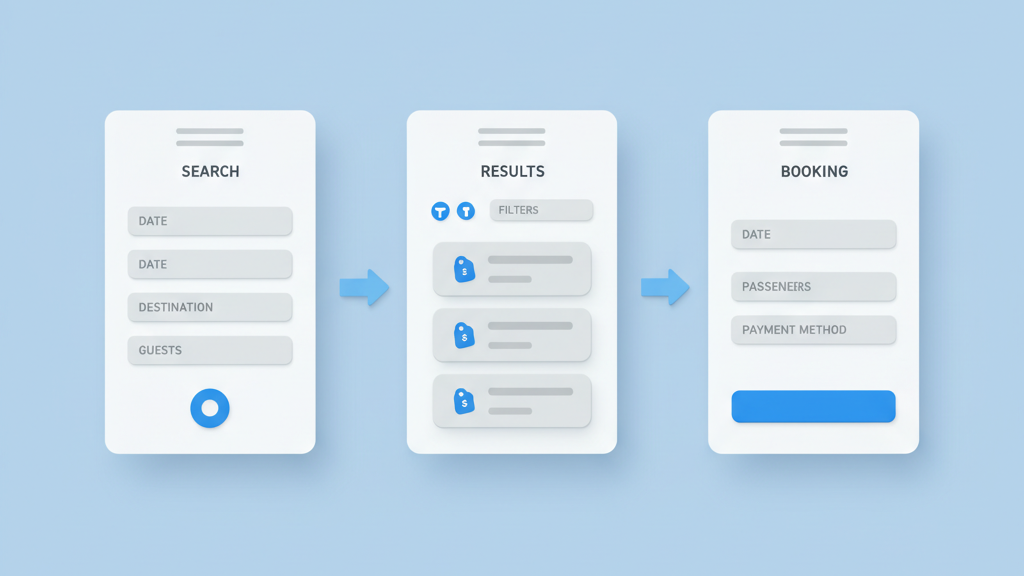
This post guides founders and product managers through a pragmatic approach to a FlutterFlow travel booking app MVP product strategy and validation service. I focus on simple bets that show whether travelers will pay or engage. The aim is not perfection. The aim is clear signals from prototypes and early funnels. Many startups miss the point and build features instead of tests. I will outline how to pick the core booking flow, define metrics that matter, and run fast validation experiments. Expect trade offs and quick decisions. This is for teams that need to learn before they scale.
Start With One High Impact User Flow
Choose the single booking flow that will prove demand. Most travel startups try to cover every route and use case. That wastes time. Pick one route or product that matches your strongest channel and highest margin. Map the steps from search to confirmation and cut everything that is not required to complete a reservation. Design the UI for clarity and speed. Build just enough back end to accept bookings and track payment intent. Early users forgive rough edges when the core value is clear. A focused flow helps you measure conversion and churn. It also keeps costs down. Keep the scope tight so you can run experiments in weeks not months.
- Pick one route or product
- Map search to confirmation
- Remove non essential features
- Track conversion at each step
- Aim for weeks not months
Define Metrics That Prove Product Market Fit
Decide what success looks like before you build. Vague goals lead to vague outcomes. Use metrics tied to revenue and engagement rather than vanity numbers. Measure completed bookings per visitor and repeat booking rate for early users. Track funnel drop off in the search and payment steps. Set clear hypotheses for price sensitivity and booking windows. Plan A B tests for messaging and pricing. Many founders ignore churn signals and miss the failure modes. Keep the metrics simple and review them daily while validating. The goal is to gather evidence fast so you can double down or pivot with confidence.
- Measure completed bookings per visitor
- Track funnel drop off
- Test price sensitivity
- Monitor repeat booking rate
- Review signals daily
Build Fast With FlutterFlow And Focused Integrations
FlutterFlow speeds up UI and iteration so you can ship prototypes quickly. Use it to stitch together search, results, and booking screens. Replace complex integrations with mocks until you validate demand. Connect to a payment gateway and a simple booking API to enable real transactions. Prioritize observable hooks for analytics and error logging. Keep data models minimal and avoid premature normalization. A lightweight stack reduces cost and speeds up fixes. I recommend launching with one payment option and one partner inventory source. Once you see reliable conversions you can expand integrations and refine UX.
- Prototype UI in FlutterFlow
- Mock complex integrations early
- Enable one payment option
- Add analytics hooks
- Keep data models simple
Use Validation Service Techniques To Run Tight Experiments
Validation is a discipline not a one off task. Treat the MVP as an experiment platform. Run targeted campaigns to a landing page or an early access list. Use demo bookings and refundable holds to test willingness to pay. Interview early users to capture buried objections and friction points. Run short A B tests on messaging and pricing to learn what resonates. Offer limited time incentives to test urgency. Document each experiment and the decision rule that ends it. Many teams fold results into product wish lists and never act. Be ruthless with learnings and change direction when the data says so.
- Drive targeted traffic to prototype
- Use refundable holds to test payment intent
- Interview early users
- Run short A B tests
- Document experiments and rules
Turn Signals Into A Scaling Roadmap
When metrics hit your thresholds, plan the next phase with clarity. Prioritize product work that improves conversion and reduces cost per acquisition. Expand inventory and payment options based on real demand. Invest in automation where manual processes block growth. Establish service level goals for reliability and support. Keep monitoring the same core metrics you used to validate fit. Do not overbuild features that have not shown value. Many teams scale scale without fixing their funnel and they amplify problems. A simple roadmap tied to proven signals keeps the company focused and capital efficient.
- Prioritize conversion improvements
- Automate manual blocks
- Expand inventory by demand
- Set reliability targets
- Keep proven metrics