
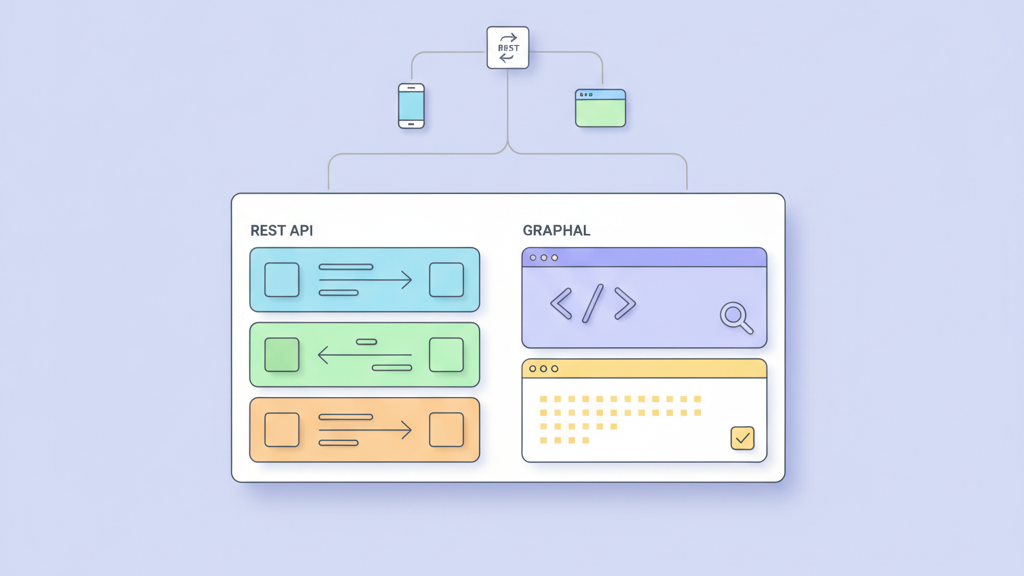
GraphQL vs REST APIs which is better for startups is the core question this guide answers. Startups need APIs that move product forward without wasting time or money. This intro lays out the trade offs and what to watch for. I will cover developer skills and hiring, network performance, caching, versioning, and costs. I will also give a simple checklist you can use in a planning meeting. Many startups miss the hidden costs of complexity and over engineering. My aim is to help founders and product managers pick the path that fits their roadmap and team. This is not a slogan battle. It is a practical look at when to pick one approach, and how to avoid common traps.
A Quick Verdict For Fast Moving Teams
For startups that need to push features quickly and validate product market fit, the choice often comes down to team skills and time to market. REST is simple and familiar. It works well when you have predictable endpoints and small teams. GraphQL shines when clients need flexible queries and when you want to reduce round trips. If your product will evolve rapidly with many frontend forms and dashboards, GraphQL can save time on client work. If your team is small and you need reliability with minimal tooling, REST is a safer bet. My opinion is that GraphQL is a powerful tool but not a silver bullet. Many founders underestimate the initial integration work. Choose based on who you can hire and how fast you must iterate.
- Pick REST for straightforward resources
- Pick GraphQL for flexible client driven data
- Consider team skills before choosing
- Avoid over engineering early
Developer Experience And Hiring
Hiring influences technical choices more than many founders realize. Developers tend to have more experience with REST because it has been the standard for years. GraphQL requires different mental models and tooling. You will need schema design and strong frontend backend coordination. Tooling can help but it is another thing to learn. If your hires are experienced with modern frontend frameworks they will pick up GraphQL quickly. If your backend team is small and prefers simple request handlers REST may reduce friction. Many startups miss that developer experience affects delivery speed not just code quality. Plan for onboarding time and include it in your roadmap. I recommend trying a small GraphQL prototype before committing if you are unsure.
- Audit your teams current skills
- Prototype before full migration
- Account for onboarding time
- Favor familiarity for rapid delivery
Performance And Network Costs
Network performance matters in early product testing and in production. GraphQL can reduce over fetching by letting clients request exactly what they need. That can cut bandwidth and improve perceived speed on mobile. REST can cause multiple round trips for complex screens which hurts latency. On the other hand GraphQL queries can become large and costly if clients request deep nested data. Caching is more straightforward with REST because each endpoint can be cached independently. GraphQL requires more deliberate caching strategies at the field or response level. Many startups forget to monitor query complexity which can raise server costs. Measure real world traffic and prototype expected queries to avoid surprises.
- Use real traffic to measure impact
- Watch for over fetching with REST
- Limit query complexity in GraphQL
- Plan caching early
Caching And CDN Strategies
Caching is often overlooked but it shapes cost and performance. REST maps nicely to CDN and HTTP caching because endpoints are stable resources. This makes caching a low friction win for public content. GraphQL does not map to HTTP caches as cleanly because many queries hit the same endpoint. You can still use caching at the field level or use persisted queries and caching proxies. That adds complexity but can pay off for data heavy applications. If your startup depends on fast read performance pick an approach that matches your caching plan. Beware of premature optimization. Many teams try to cache everything and create consistency problems later. Start with simple rules and evolve them with traffic patterns.
- Use HTTP caching for stable resources
- Consider persisted queries for GraphQL
- Start simple with caching rules
- Monitor cache hit rates
Versioning And API Evolution
APIs change as products change. REST uses versioned endpoints and that makes breaking changes explicit. GraphQL uses a single evolving schema which reduces endpoint churn. With GraphQL you can deprecate fields and keep clients running while you migrate. That is attractive for startups that ship user facing features often. However maintaining a growing schema requires discipline and clear ownership. Both styles require good change management and communication. Many startups ignore consumer contracts and then face regressions. My mild warning is to treat API changes as product changes. Add testers and release checks for any breaking change regardless of protocol.
- Plan change management early
- Use deprecation for GraphQL
- Version REST endpoints when needed
- Treat API changes as product work
Costs And Time To Market
Time to market is the metric that matters for many startups. REST can be faster to ship because it has fewer moving parts and more examples. GraphQL may require initial modeling and tooling which slows the first release but speeds later iterations. Hosting costs depend on usage patterns and query complexity. GraphQL can concentrate load on a few resolvers which can increase compute cost if not optimized. REST spreads work across endpoints which can be easier to scale horizontally. Many founders miss the ongoing maintenance cost of complex APIs. My recommendation is to estimate costs for the first year and for five releases, not just the initial build.
- Estimate first year and future costs
- Expect faster iteration with GraphQL after setup
- Expect faster initial builds with REST
- Optimize hotspots regardless of protocol
A Practical Decision Checklist
To decide pick criteria that match your product goals. First ask if you need flexible client driven queries. If yes then GraphQL is worth the setup cost. Second ask if you need simple stable endpoints that map to resources. If yes then REST keeps things simple. Third consider hiring and how quickly you must ship. Fourth think about caching and expected traffic patterns. Finally run a short spike and measure developer velocity and performance. This checklist reduces debates and focuses the team on measurable outcomes. My mild opinion is that most early stage products benefit from starting with REST and introducing GraphQL for parts that need flexibility. Many startups change architecture as they learn and that is fine.
- Check client data needs first
- Match choice to team skills
- Run a short technical spike
- Iterate the API architecture