
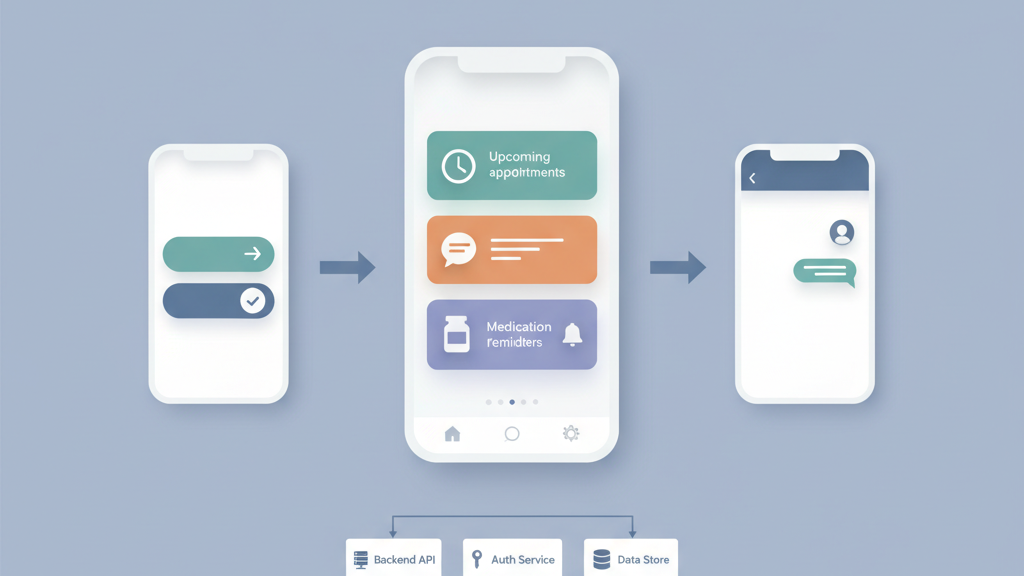
Launching a healthcare startup app MVP for patient engagement requires focus and restraint. Many founders try to solve every problem at once. Start by choosing one clear patient pain point and one measurable outcome. This guide walks through pragmatic steps from discovery to first user tests. You will see design tips that build trust and development choices that save time. I share common traps and a few opinions from the field. Warning, skipping early validation will cost time and credibility. Aim for a minimal product that proves demand and helps patients in a meaningful way. The work is hard but the path is repeatable. Keep stakeholders involved and measure what matters.
Start With Clear Patient Problems
The best MVPs start with a narrow problem that affects real patients and can be measured. Spend time interviewing users and clinicians to avoid false assumptions. Ask about daily routines and pain points rather than technology solutions. Use simple prototypes during interviews to surface reactions and to iterate faster. Quantify the problem with a baseline metric that you can improve with the MVP. Many startups skip this step and build features no one needs. Keep the scope tight and focus on a single persona and use case that delivers clear value on day one. This focus reduces technical risk and speeds up approvals for testing in clinical settings.
- Interview five to ten real users
- Define one core persona
- Pick one measurable outcome
- Prototype before building
- Avoid scope creep
Define Core Features And Workflows
Turn the problem into a few core features that deliver the outcome you chose. Map the user flow from first contact to the target outcome and remove anything that does not serve that flow. Focus on actions that patients will repeat such as check ins, reminders, or simple messaging. Keep settings and advanced options out of the initial release. Designers should create clickable flows that developers can implement quickly. Product managers must balance clinical guidance with usability. Clear workflows reduce ambiguity and speed up development. If a feature does not improve the chosen metric it should wait. This trimmed approach helps with early adoption and easier analytics.
- Map the end to end user flow
- Limit to three primary features
- Use clickable prototypes
- Prioritize repeatable actions
- Defer advanced settings
Design For Trust And Privacy
Trust matters more in health than in most consumer apps. Design decisions should make privacy and clarity visible. Use plain language to explain why you collect data and how it is used. Minimize data collection to what you need to measure outcomes. Visual cues and consistent UI reduce anxiety during onboarding and when sharing sensitive information. Work with a compliance advisor early to avoid rework. User testing often reveals small wording changes that greatly increase consent rates. Many startups treat privacy as an afterthought and then face adoption roadblocks. Addressing trust up front will improve retention and clinician referrals in the long run.
- Use plain language in consent screens
- Collect minimal required data
- Show clear privacy cues
- Test wording with real users
- Consult compliance early
Choose A Tech Stack For Speed And Security
Pick tools that let you ship quickly while meeting basic security needs. Use managed services for auth, hosting, and databases to reduce operational burden. Favor cross platform frameworks if mobile reach matters and you want fast iterations. Ensure encryption in transit and at rest from day one. Keep the backend simple with clear APIs and a small schema that matches your core features. Avoid building custom infrastructure that you cannot maintain. Technical choices should favor developer productivity without sacrificing patient data safety. This balance helps the team focus on learning from users rather than firefighting infrastructure problems.
- Use managed auth and hosting
- Favor cross platform frameworks
- Encrypt data in transit and at rest
- Keep APIs simple
- Avoid premature infrastructure complexity
Build Fast And Validate With Real Users
Release to a small group of early users and treat the MVP as an experiment. Collect quantitative and qualitative data to validate the hypothesis you set earlier. Use in app surveys, usage analytics, and short interviews to understand behavior. Be ready to iterate weekly on flows that confuse users. Keep deployments small and reversible to reduce risk. Many founders wait too long for a perfect product before testing. That delays learning. Rapid validation surfaces whether your core assumption holds and informs the next set of features. Focus on improving the key metric that defines success for your initial use case.
- Start with a beta group
- Measure both usage and feedback
- Iterate weekly on test findings
- Deploy small reversible changes
- Focus on the defining metric
Measure Engagement Metrics That Matter
Select metrics that show whether patients are engaging in the intended way and whether outcomes improve. Track engagement frequency, completion rates for tasks, and change in the baseline outcome you measured during discovery. Avoid vanity metrics that do not link to patient benefit. Tie analytics to user cohorts to see which segments respond best. Use event tracking that maps to your core workflow rather than tracking everything. Visualize trends and set simple thresholds that trigger product decisions. Good measurement lets you prioritize features that move outcomes and drop those that do not provide value.
- Track engagement frequency
- Measure task completion rates
- Link metrics to outcomes
- Use cohorts for analysis
- Avoid vanity metrics
Plan For Scale And Regulatory Steps
Once the MVP proves demand you need a plan to scale and to meet regulatory requirements. Document data flows, security controls, and consent records. Allocate time for audits and for integrating with clinical systems if needed. Build a road map that phases in features for clinicians and administrators. Budget for legal and compliance costs early to avoid surprises. Consider partnerships with established providers to gain trust and distribution. Many startups underestimate the work required to operate in healthcare. A clear scaling plan reduces risk and sets realistic expectations for investors and partners.
- Document data flows and controls
- Budget for audits and legal
- Plan clinician integrations
- Phase admin features
- Explore distribution partnerships