
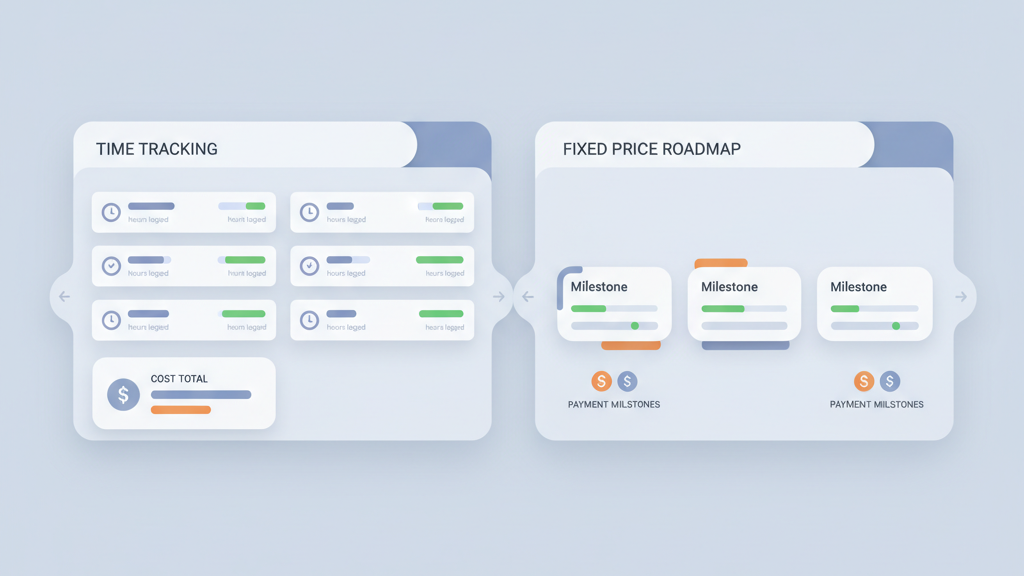
Deciding between hourly rate pricing vs fixed price MVP cost is one of the first trade offs founders face when hiring a development team. The choice affects budget certainty, speed, and the ability to pivot. Hourly work gives flexibility and supports discovery. Fixed price gives clarity and easier board conversations. Which model fits your startup depends on how well you can define features, how many unknowns remain, and how strict your runway is. I will walk through the pros and cons, estimation tactics, hybrid approaches, and contract practices that reduce surprises. This guide is for founders and product managers who need practical advice not theory. Many startups miss small contract terms that cause big problems later. Expect clear warnings, opinions, and templates for decisions you can use at the start of a build.
When To Pick Hourly Pricing
Choosing hourly pricing makes sense when requirements are unclear or likely to change. Startups often begin with research and many unknowns. Hourly work lets teams iterate, test, and shift priorities without renegotiating scope. You pay for time and output, and good teams report hours clearly. The downside is less cost certainty, and some founders dislike open ended bills. Many startups miss the discipline needed to control hours. You should set clear sprint goals, use short feedback loops, and require regular burn reports. A strong product manager helps manage scope and keeps teams focused. In my view hourly engagement suits experimental phases, prototypes, and heavy discovery. Expect more frequent check ins, and plan for scope reviews every two weeks. This approach wastes less time on wrong assumptions and yields faster learning.
- Break work into short sprints
- Require weekly burn reports
- Set clear sprint goals
- Limit open ended tasks
When To Use Fixed Price
Fixed price works when you can define scope and deliverables clearly upfront. Founders like fixed bids because they create budget certainty and simplify approvals. Fixed contracts force teams to estimate carefully and to think about minimum viable scope. They are best when requirements map to clear features, when visual design is stable, and when third party integrations are limited. The risk is hidden complexity or unknown integration costs. Many teams under estimate unknowns and then submit change requests. To succeed insist on a discovery phase or include a contingency buffer. In my opinion fixed price is great for well scoped MVPs that follow familiar patterns and when you have a steady product vision. Also agree milestones and acceptance criteria in writing. Many vendors will clip scope into phases to protect margin and you should review payment terms carefully. A clear backlog reduces disputes.
- Define feature list upfront
- Include contingency buffer
- Agree acceptance criteria
- Use phased payments
Estimating Time And Risk
Good estimates combine time based planning with explicit risk buffers. Start with task level breakdowns and get team input. Use relative sizing for unknown items and time based estimates for known work. Add a contingency that reflects technical risk, dependency risk, and scope risk. For early startup projects plan a larger buffer and revisit estimates after the first sprint. Many teams forget to account for discovery, feedback cycles, and refactoring. Also factor in product management, QA, and deployment time. I prefer to model three scenarios conservative, expected, and aggressive so stakeholders see the range of outcomes. This reduces surprises and makes trade offs easier to discuss during planning sessions. Agree on change control rules early and track actuals against estimates each sprint to improve future predictions.
- Estimate at task level
- Add risk based contingency
- Compare three scenarios
- Track actuals each sprint
Hybrid Models And Fixed Plus Time
A hybrid model blends fixed price and hourly work to balance certainty and flexibility. Start with a fixed discovery phase to define core scope. Follow with time boxed sprints billed hourly or on a rate card. This pattern keeps the initial budget bounded and allows iterative development. It also makes it easier to add features after validation without restarting negotiations. Many vendors offer fixed price for a first release and then switch to time and materials for ongoing work. The practical warning is to agree on who owns the backlog and how priorities will be set. Clear governance avoids scope drift and reduces billing disputes. Set service level expectations and reporting cadence to keep founders informed and to limit surprises.
- Run a fixed discovery phase
- Bill development hourly in sprints
- Agree backlog ownership
- Set reporting cadence
Budgeting And Stakeholder Communication
Budget conversations are often emotional and driven by fear of overspend. Startups should separate build cost from runway planning and operational costs. Present estimates as ranges and explain the assumptions behind each figure. Use scenario packaging to show what fits low, medium, and high budgets. Regularly update stakeholders when unknowns are resolved and when scope changes happen. Many founders fail to report burn rates that include vendor contingencies. Be transparent about trade offs and the impact of adding features on timeline and cost. My advice is to plan for user testing and early marketing costs in the same budget cycle so the product can launch with momentum. Also agree on reporting formats and a monthly rhythm so finance and product teams can reconcile expectations early.
- Show estimates as ranges
- Explain key assumptions
- Update stakeholders often
- Include testing and launch costs
Choosing A Vendor And Contracts
Selecting the right vendor matters more than picking a rate model. Look for experience with startup MVPs and with similar technical stacks. Ask for references and for examples of prior work that shipped on time. Discuss communication cadence and tooling before signing. Contracts should cover change control, acceptance criteria, IP ownership, and exit provisions. Many founders ignore the last part and then struggle to move code or teams. Negotiate a pilot or a short initial engagement to validate working styles. Also ask how the vendor tracks hours and reports progress. My opinion is that transparency beats low price in the long run. Review payment schedules and liability limits. Consider phased payments tied to deliverables for better alignment. This also reduces risk.
- Ask for startup references
- Request examples that shipped
- Negotiate pilot engagements
- Require clear handover terms
Measuring Value And Outcomes
Price is only meaningful when tied to outcomes. Define success metrics before development starts. Use measurable goals like activation, retention, or time to first value. Align pricing discussions with those metrics and decide what feature set is needed to hit goals. Track both leading and lagging indicators during initial releases. Many teams focus on scope and forget to validate product market fit. If a feature does not move the needle, stop investing and refocus. I think founders should insist on short experiments that prove value before expanding the scope. This approach saves money and improves product market clarity. Create dashboards that show cost per experiment and customer acquisition costs. Report these numbers with your development provider and use them to decide future investment.
- Define success metrics first
- Build dashboards early
- Measure cost per experiment
- Stop work that does not move metrics
Common Mistakes And How To Avoid Them
Startups often pick the cheapest vendor or the simplest pricing model and then face delays. Common mistakes include unclear requirements, missing discovery, and weak acceptance criteria. Another error is ignoring maintenance and operational costs after launch. These gaps lead to surprise invoices and broken timelines. To avoid them require a written backlog, agreed acceptance tests, and a plan for post launch support. Many founders think that an MVP is cheap and fast and then realise the hidden costs. My recommendation is to budget for a small maintenance window and to hire a vendor that offers clear transition plans if you need to change teams. Negotiate clear warranties and support SLAs. Also get a list of deliverables and a handover checklist before the final payment.
- Avoid the cheapest only
- Demand written acceptance tests
- Budget for maintenance
- Negotiate support SLAs