
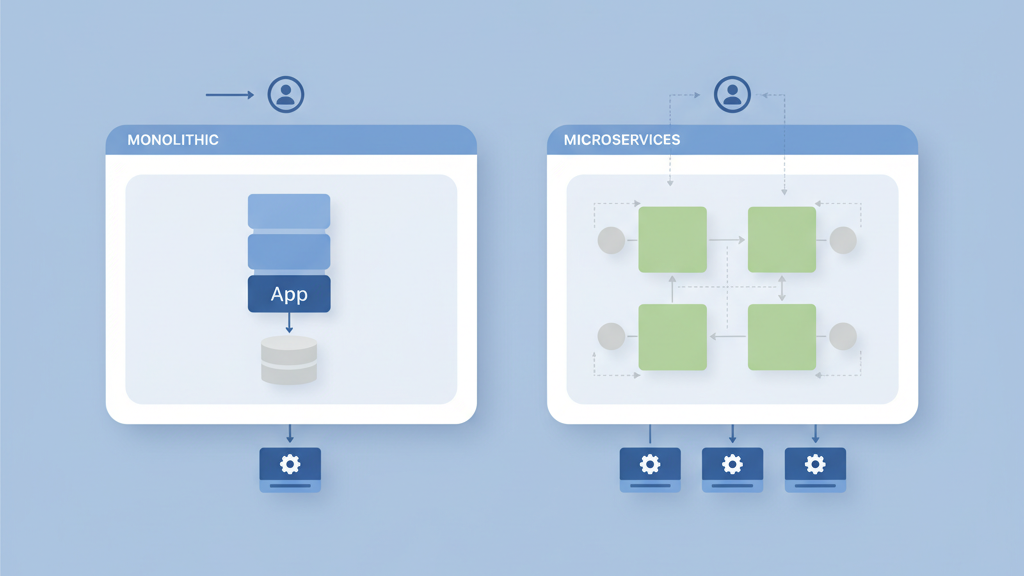
Microservices vs monolith architecture comparison for startups matters more than pundits admit. Founders face a tough trade off between speed and long term flexibility. This guide gives clear pros and cons, and a practical path to pick a model that fits your team and market. Many startups miss hidden costs of early complexity. I am mildly biased toward simplicity at launch, but I also know growth forces change. Read on to avoid common traps, and to build a plan that matches hiring, budget, and product goals. If you want a related deep dive, read Practical Product Steps For Founders: how to plan MVP features for startup founders.
Quick Overview And Core Trade Offs
Startups must choose a sensible starting point. A monolith bundles code and data in one deployable unit. It simplifies local testing and speeds early development. Microservices split functionality into small independently deployable services. They promise better scaling and team autonomy. The trade off is extra operational work and cross service testing. Many founders fall into analysis paralysis on this choice. My take is to prefer the simplest approach that supports your first paying customers. Focus on shipping core value. Build modular code within a monolith to make future splits easier. Keep documentation and interfaces clear. That reduces future migration pain and keeps velocity high.
- Prefer monolith for fast prototyping
- Design clear modules even inside a monolith
- Use microservices when you need independent scaling
- Avoid early distributed system complexity
Speed To Market And Early Costs
Time and money matter most in the first year. A monolith often wins here. You need fewer pipelines, fewer infra components, and simpler monitoring. That lowers cloud spend and developer hours. Microservices require service discovery, API contracts, network configuration, and more sophisticated CI pipelines. Those add cost and slow early feature delivery. Many startups underestimate those costs. My experience shows modest teams deliver new features faster in a single codebase. That said if your product requires distinct scaling profiles from day one, a microservice split can prevent waste later. Consider starting with a monolith and setting clear boundaries so you can extract services when traffic or team size justifies it. If you need implementation support, explore Backend API development.
- Measure time to ship a core feature
- Estimate extra infra and pipeline cost for services
- Start simple and extract later when justified
- Watch out for underestimated operational overhead
Scalability And Performance Realities
Scalability is often the loudest argument for microservices. They let you scale hot paths independently. That can save resources at scale. However most startups do not need that granularity early on. A well tuned monolith can handle many workloads while keeping latency low. Also network calls between services add complexity and failure modes. Microservices require more load testing and fault tolerance design. If you face a clear scaling bottleneck in one area, extract that area first. Premature splitting can introduce cross service latency that hurts user experience. My opinion is to monitor real traffic patterns and use pragmatic profiling before committing to a distributed architecture.
- Profile performance before splitting
- Optimize the monolith first for most startups
- Extract only true scaling bottlenecks
- Plan for network latency and retries when splitting
Operational Complexity And DevOps Burden
Operational work grows with the number of services. Each service needs observability, logging, tracing, deployment pipelines, and security reviews. This multiplies maintenance tasks for small teams. A monolith centralizes many of these concerns. It lowers maintenance overhead and reduces coordination needs. Microservices demand stronger DevOps practices and often a dedicated platform engineer. Many startups overlook this until outages spiral. That is a common cost that breaks budgets. If your team lacks mature DevOps skills, delay a distributed approach. Focus on automated tests and simple deployments first. You can adopt service patterns gradually as the team and budget scale.
- Assess your DevOps capacity honestly
- Automate deployments in the monolith early
- Add observability before splitting services
- Plan for security reviews per service
Testing, Reliability, And Release Strategies
Testing becomes harder with many services. Integration tests must cover cross service behavior. End to end tests grow slower and more brittle. A monolith can give faster feedback loops for feature teams. It allows comprehensive unit and integration tests inside one codebase. Microservices force you to adopt contract testing, consumer driven contracts, and independent staging environments. Those are doable, but they take time to master. My warning is not to assume distributed testing is a silver bullet. It is a different discipline that can reduce risk when done right. Start with strong automated tests in a monolith. Adopt contract tests and isolated staging as you break apart services.
- Invest in fast unit tests early
- Use contract tests before full extraction
- Keep end to end tests reliable and focused
- Do progressive rollouts for new services
Team Structure And Hiring Implications
Architecture choices influence hiring and org design. Microservices suit multiple independent teams that own bounded contexts. Each team needs full stack skills and a DevOps mindset. Small teams may struggle with service ownership overhead. A monolith fits lean teams and keeps context switching low. It also simplifies onboarding for new engineers. Many founders forget that hiring for distributed systems costs more and takes longer. If you cannot staff platform or SRE roles early, you will carry technical risk. My mild opinion is to let org needs follow product demands. Match architecture to team size and skill sets rather than to idealized patterns. For a practical follow-up, see Build A Lean Booking Product For Fast Launch.
- Align architecture with team size
- Hire platform skills before splitting widely
- Use modular teams on a shared monolith
- Avoid creating too many ownership boundaries early
Migration Risks And Managing Technical Debt
Moving from monolith to microservices is costly and risky. Data ownership disputes, API mismatches, and duplicated logic appear during migration. You must plan migrations in stages with clear interfaces. Many teams try to split by language or framework and end up with inconsistent behavior. That creates long term maintenance pain. My advice is to refactor inside the monolith to create clean boundaries. Extract services only when you can measure benefits and allocate time for migration testing. Keep a migration playbook with rollback steps. Technical debt is invisible until it blocks feature delivery, and that is a dangerous moment to change architecture. Teams moving from strategy to execution can review Software maintenance and scaling.
- Refactor and modularize before extracting
- Plan migrations in small, testable steps
- Maintain a rollback plan for each extraction
- Track duplicated logic as a migration signal
A Practical Decision Framework And Checklist
Use a checklist to avoid emotional choices. Start by asking if you have a clear scaling requirement that a monolith cannot meet. Next assess team skills and DevOps readiness. Estimate the total cost of ownership for extra services and pipelines. Prioritize customer facing features over architecture novelty. If you choose a monolith, enforce module boundaries and document APIs for future extraction. If you choose microservices, invest early in observability, CI automation, and contract testing. Many startups benefit from a hybrid path. Begin with the simplest approach and prepare for a deliberate split when metrics and team capacity justify it. This reduces waste and keeps focus on product market fit. A related guide worth reviewing is Uncovering the Untold Tactics: Navigating MVP Iteration for Product-Market Fit.
- Confirm real scaling needs with data
- Estimate DevOps and infra costs
- Start simple and document boundaries
- Set measurable criteria for extraction