
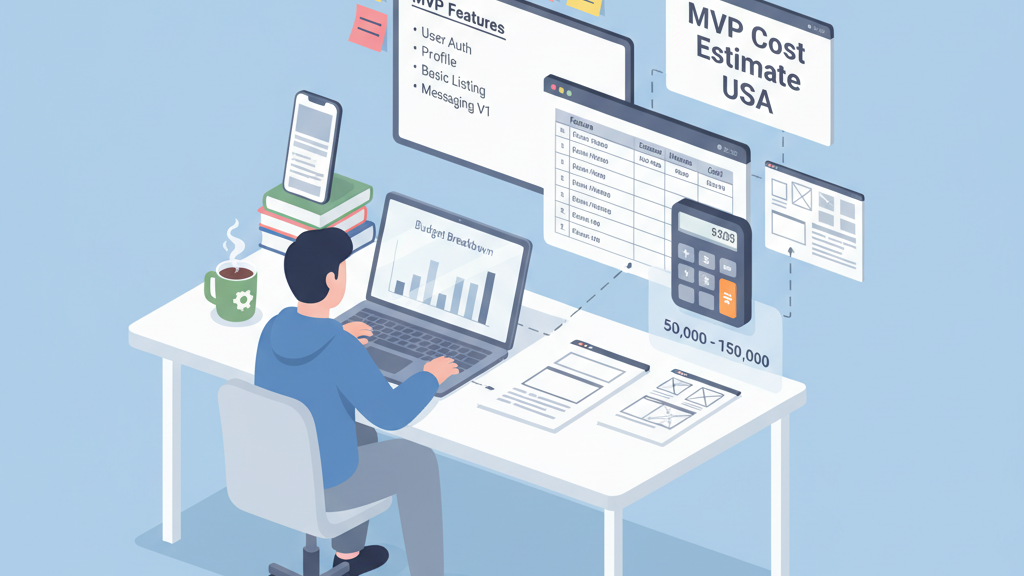
If you are a founder or product manager you need a clear MVP development cost estimate for startups USA to plan funding and timelines. This guide cuts through vague numbers and shows real drivers that change your bottom line. I explain typical price bands and trade offs for features, platforms, and teams. You will learn where to trim scope without killing product value. Many startups miss basic setup costs like hosting and compliance. Expect plain examples and quick rules of thumb you can use in investor decks and sprint plans. Use this as a practical checklist to get quotes and compare proposals. The goal is to help you turn an idea into a testing product with the least waste of cash and time.
Key cost drivers
Costs vary mostly by three things. Scope means how many screens and integrations you want. Complexity covers custom algorithms, security needs, and real time features. Team and hourly rates also make a big difference across the USA. A simple web MVP with basic auth and a few pages can be built faster than a multi tenant app with payment flows and admin panels. Integrations with third party APIs can add time but reduce rebuild work. Design fidelity changes both hours and testing cycles. Hosting and data costs grow with usage, so plan for staging and production budgets. Many founders assume development is the bulk of cost. In reality operations, compliance, and quality assurance add meaningful percentages. Know the drivers early. They are the levers you can use to control your estimate and avoid scope creep. If you want a related deep dive, read How to Calculate a Real Price Estimate for Web App MVP Development USA.
- Scope is the single biggest cost factor
- Complex features need more testing and time
- Third party integrations can save or add cost
- Design fidelity affects both hours and revisions
- Hosting and compliance add ongoing spend
Typical price bands for US startups
Expect wide ranges depending on the team you hire and the platform you choose. A very basic single platform MVP from a small agency or solo developer often falls between low five figures. A mid range MVP with polished UI and some integrations sits in the mid five to low six figures. Complex MVPs that require custom backend logic or heavy real time features usually reach mid six figures or more. These are not precise quotes but useful bands to prepare investors and internal budgets. Use them as starting points for conversations. Many founders aim too low and then stall when add ons push days into weeks. Budget for a buffer. A sensible contingency is ten to twenty percent of the initial estimate for unknowns. For a practical follow-up, see Budget Estimate for Cross Platform MVP Apps USA: A Startup Guide.
- Basic MVPs often cost low five figures
- Polished MVPs land in mid five to low six figures
- Complex MVPs can exceed mid six figures
- Include a 10 to 20 percent contingency
- Quotes vary widely by team location and skills
Timeline and milestone budgeting
Time drives cost. Shorter timelines force more people and higher burn rates. A fast paced MVP can be delivered in eight to twelve weeks if the scope is tight. A more deliberate build with user testing and iterations often takes three to six months. Break the project into clear milestones. Use discovery, prototype, alpha, and beta as checkpoints for payments and reviews. Milestone payments reduce risk for founders and help agencies prioritize. Many startups underestimate the time needed for user feedback and bug fixes. Allow extra sprints for polishing critical flows. Plan budget tranches to match milestones so you do not run out of runway mid build.
- Faster delivery costs more per week
- Eight to twelve weeks for tight scopes
- Three to six months for iterative builds
- Use milestone payments to manage risk
- Reserve extra time for user feedback
Choosing the right team
Team choice shapes quality and total cost. Freelancers are cheaper per hour but need more founder management. Offshore teams can cut rates while adding coordination overhead. US based agencies offer smoother collaboration and often higher predictability. Hybrid teams combine benefits but need clear leadership. Senior engineers reduce rework but command higher rates up front. Many startups find a product focused agency worth the premium when they need tight deadlines and good UX. Honest communication and a defined product owner role keep teams aligned. Ask for previous MVP case studies and references. A poor hire will cost more in delays than the initial savings you thought you gained.
- Freelancers need more founder time
- Offshore teams reduce hourly costs
- US agencies add predictability
- Senior hires reduce rework risk
- Check past MVP case studies and references
Platform choices and technical trade offs
Your platform decision affects cost and speed. Web first MVPs often require fewer platform specific screens and therefore less development time. Native mobile apps need platform expertise and can double the effort if you build for iOS and Android separately. Cross platform frameworks reduce initial cost but have trade offs in performance and native feel. Serverless backends speed up launches for low to medium scale and lower ops costs early on. Data heavy or highly secure apps may need custom infrastructure which raises cost. Many founders prefer to test product market fit on a web or progressive web app before investing in native builds. This pragmatic approach lowers initial spend and still validates core user behavior. A related guide worth reviewing is Native Apps vs Progressive Web Apps for Startups: Choosing the Right Path.
- Web MVPs are usually faster and cheaper
- Native apps increase development scope
- Cross platform frameworks lower initial cost
- Serverless can cut ops and infra work
- Test core value before building native apps
Ways to lower your estimate without killing value
You can reduce cost while keeping the testable product if you remove non essential features and automate manual work. Start with a clear core value proposition and remove anything that does not prove it. Use no code or low code tools for landing pages, payments, and simple workflows. Leverage existing APIs to avoid building from scratch. Focus on the smallest possible user journey that validates demand. Use iterative testing with prototypes before full development. Many startups miss this step and waste budget on unvalidated features. If you plan to scale, keep the initial architecture modular so you can replace parts later without a full rebuild. If you need implementation support, explore FlutterFlow development.
- Remove non essential features
- Use no code for simple workflows
- Leverage third party APIs
- Validate with prototypes first
- Keep architecture modular for future scaling
Sample estimate breakdown
A typical mid range MVP estimate shows how costs distribute across phases. Discovery and UX work often take ten to twenty percent of the budget. Design and frontend development commonly use twenty to thirty percent. Backend and integrations take thirty to forty percent. QA and testing and polishing can be ten to fifteen percent. Project management and communication add five to ten percent. Hosting and third party services are ongoing but start small. These slices help you spot where savings are possible. For example you can reduce design hours with simpler UI and lower backend complexity by using managed services. That trade off is my preference when speed matters and you plan iterations. Teams moving from strategy to execution can review Backend API development.
- Discovery 10 to 20 percent
- Design and frontend 20 to 30 percent
- Backend 30 to 40 percent
- QA and polish 10 to 15 percent
- Project management 5 to 10 percent