
This guide focuses on MVP price estimation for SaaS startups USA and it aims to help founders and product managers set realistic budgets. Cost talk is often skipped in early roadmaps and that causes delays and bad trade offs. I will walk through typical cost buckets, how different choices move price, and simple formulas you can use to build a first budget. Many startups miss setup and maintenance costs so expect a few surprises. This guide leans practical and opinionated where it helps. You will get clear actions to refine estimates and a framework to use with engineers and vendors. Expect pragmatic warnings and examples you can adapt for US markets. If you want a related deep dive, read How To Budget An MVP For Early Teams (enterprise app MVP pricing for small businesses USA).
Why accurate estimates matter
Getting a sensible cost estimate early changes strategy and focus. If you underprice the build many founders push scope and cut corners and end up with a fragile product. If you overestimate you may delay validation and waste runway. A clear budget helps pick which features to prove first and it helps talk to investors with confidence. In the USA market you must consider higher engineering rates and compliance work. Good estimates also create guardrails for hiring and vendor selection. I think many teams forget to revisit estimates after discovery and that is a mistake. Revisit numbers after user interviews and after a technical spike. That practice reduces surprises and keeps the team honest. A realistic first budget is not a promise it is a planning tool that evolves with evidence. For a practical follow-up, see Process for Running Effective Early User Interviews for Product Teams.
- Set estimates before hiring
- Use estimates to prioritize features
- Revisit numbers after discovery
- Plan for a buffer of unexpected work
Breaking down the cost categories
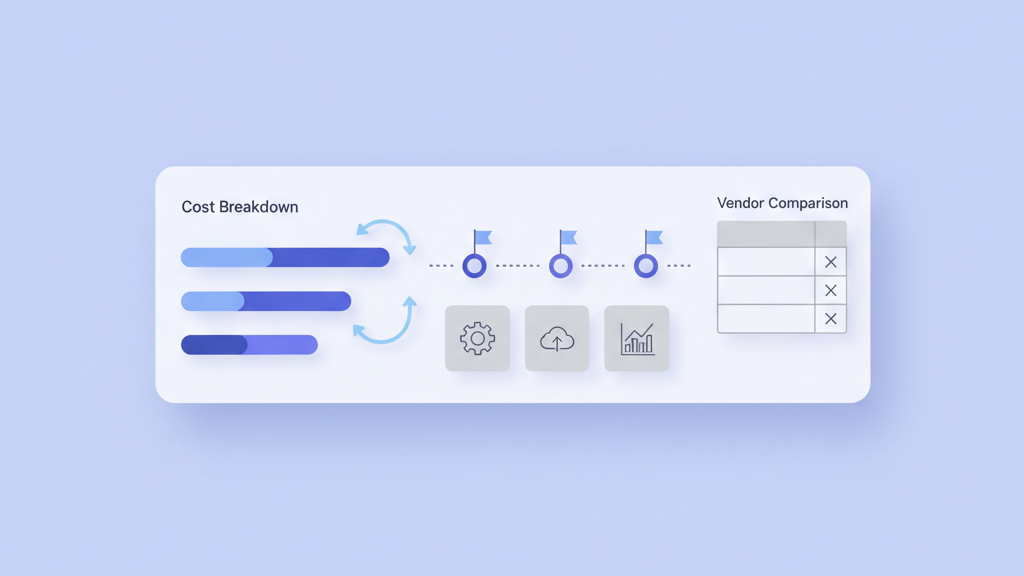
Costs fall into predictable buckets that you can model. Product design covers user research, wireframes, and UI work. Core development includes backend services, frontend interfaces, and API work. Infrastructure covers cloud hosting, databases, and monitoring. Security and compliance may add a noticeable premium in regulated niches. Integrations with third parties sit in a separate bucket and can be surprisingly expensive if APIs are immature. Finally support and maintenance start to accrue the day you launch and should be budgeted early. I prefer a simple spreadsheet that separates one time build costs and recurring monthly expenses. This structure makes it easy to test different scenarios by toggling hourly rates, team size, and launch scope. Many founders do not separate one time and recurring costs and that creates problems when projecting runway. If you need implementation support, explore Backend API development.
- List one time versus recurring costs
- Estimate design and discovery separately
- Include infrastructure and monitoring
- Account for integrations and security
Building a realistic budget
A realistic budget comes from combining scope control with local rate knowledge and time estimates. Start with a must have feature set that delivers the core user value and assign relative complexity. Convert complexity to time using conservative ranges. Apply local US rates for engineers, designers, and product leads and add overhead for project management and QA. I recommend a contingency buffer of at least 15 percent for minor unknowns and 30 percent for more aggressive timelines. Runway matters so map the budget against months of operation. This helps you decide if you should seek investment, slow the scope, or use contractors to reduce fixed costs. Many startups skip contingency or use optimistic timelines and then face scope creep that kills momentum.
- Define a must have feature set first
- Use conservative time ranges
- Apply US market rates to roles
- Add a contingency buffer
Hiring and rates in the USA
Hiring choices shape your price heavily. Senior US engineers cost more but they move faster and reduce rework. Junior hires lower the hourly cost but increase management overhead and risk. Contractors give flexibility and are good for short work bursts or spikes. Agencies add management but can provide full stack coverage and predictable delivery. Don’t forget payroll taxes and benefits when calculating a full time hire cost. If you engage remote talent outside the US you may save on hourly rates but add communication and timezone friction. For many early startups a hybrid approach works best. Use a small core team for product and architecture and hire contractors for isolated features. That approach saves cash and preserves control. A related guide worth reviewing is How to Choose the Best Tech Stack for Your Startup in 2024.
- Compare senior versus junior trade offs
- Consider contractors for short work
- Factor payroll taxes and benefits
- Use a hybrid team to balance speed and cost
Time to market and scope trade offs
Faster launches usually mean narrower scope and more focused validation. Choosing phone book features over polished bells speeds up delivery and reduces cost. However a minimal launch still needs good onboarding and reliability to collect honest feedback. Time boxed sprints help control scope and create predictable billing when using contractors or agencies. If market timing is critical you may accept higher cost for faster delivery. On the other hand a slower cadence can stretch runway and let you learn more from customers before committing to engineering. I believe founders should prioritize the smallest test that proves core value. Many teams try to prove too many things at once and that inflates both time and cost.
- Prioritize core value for launch
- Use time boxed sprints
- Accept trade offs for speed
- Avoid proving too many hypotheses at once
Hidden costs and maintenance
Hidden costs often derail budgets and they are easy to miss. Licensing fees for third party services, data storage at scale, and legal work for terms and privacy can add up. Bug fixes and tech debt also create ongoing expenses that many founders ignore until after launch. Monitoring and incident response will be required if you expect paying customers and that adds recurring costs. Training and documentation are often treated as optional but they reduce support load and speed onboarding. I advise allocating a maintenance budget from day one and tracking technical debt with the same rigor as feature work. It is not glamorous but it protects product quality and keeps support costs manageable. Teams moving from strategy to execution can review Software maintenance and scaling.
- Budget for third party licenses
- Plan for bug fixes and tech debt
- Include monitoring and incident response
- Invest in documentation early
How to use vendors and contractors
Vendors and contractors can be force multipliers when used correctly. Define clear deliverables and acceptance criteria and prefer short trials before committing to long contracts. Fixed price work is good for well defined tasks and predictable budgets. Time and materials is better for exploratory work or when requirements will change. Keep a small internal product owner to guide external teams and avoid handing off all product decisions. Vet references and review past work to assess fit. Many startups hire the first contractor who responds and then face delivery issues. That is a costly mistake. A light procurement process saves time and reduces risk without adding bureaucracy.
- Use fixed price for defined tasks
- Choose time and materials for discovery
- Keep an internal product owner
- Vet references and past work
A simple cost model and next steps
Build a simple model that people can read and update. Start with roles, hourly rates, and estimated hours per feature. Add infrastructure and third party costs as monthly lines. Create a launch scenario and a conservative scenario to compare outcomes. Share the model with engineering and finance to catch blind spots. Use the model to decide if you should cut scope, hire less, or seek a small bridge round. After you launch track actual spend and compare it to estimates every month. That discipline improves future estimates and helps justify decisions to stakeholders. Practical warning, many founders ignore post launch tracking and then pretend everything matched the plan. Do not fall into that trap.
- Model roles and hours per feature
- Compare launch and conservative scenarios
- Share the model with engineering
- Track actual spend after launch