
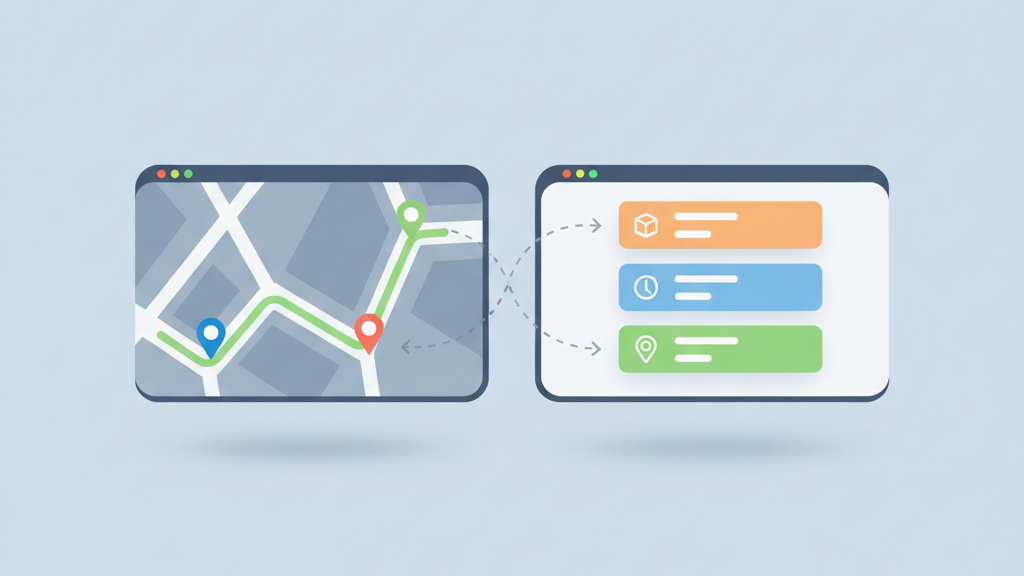
Building an on demand delivery startup app MVP for logistics means proving the idea fast and cheaply. Focus on the smallest set of features that prove demand and unit economics. Founders should pick a single corridor or customer segment, then build a tight flow for orders, dispatch, tracking, and payments. Many startups miss this and try to solve everything at once. This guide gives a pragmatic roadmap for founders and product managers in the USA who need to move from concept to pilot in weeks rather than months. If you want a related deep dive, read Building an on demand delivery app MVP logistics and workflows for startups.
Define The Core Problem
Start by writing a short problem statement that describes who has the pain and what they lose today. Focus on a single logistic use case, such as last mile deliveries for small retailers or time sensitive courier services. Map the end to end flow from order placement to delivery completion and note the main failure points. Talk to potential customers and drivers before designing features. Ask what they would pay for and why. Many founders assume broad demand and waste time building unused features. Narrow the scope to one city or route type for your first pilot and use that constraint to simplify decisions on matching, routing, and pricing.
- Pick one customer segment and one geography
- Map the end to end flow with failure points
- Validate willingness to pay with simple interviews
- Avoid building for national scale at first
Prioritize Core Features
For an efficient MVP pick a handful of core features that prove the business model. At minimum include order creation and management, driver assignment, live location tracking, proof of delivery, and payments. Build a simple admin interface for dispatchers to intervene. Skip complex features like dynamic pricing or ML based routing until you have real trips and metrics. Each feature should map to a metric you will track. Keep UI flows short and avoid unnecessary settings. A focused feature list reduces development time and keeps onboarding simple for drivers and customers. This approach helps you test unit economics and operational assumptions with real deliveries rather than speculation. If you need implementation support, explore MVP development for startups.
- Limit features to order, tracking, dispatch, proof of delivery, payments
- Make each feature support a testable metric
- Provide a simple dispatcher override interface
- Defer advanced routing and pricing to later
Choose A Lean Tech Stack
Choose technologies that speed development and lower hosting cost. Use a proven backend framework with real time support and a hosted database. For mobile choose a cross platform toolkit to share code between driver and customer apps. Pick a reliable maps provider with clear pricing for routing and geocoding. Use third party payment and SMS providers to avoid compliance delays. Design APIs that are small and versioned. Avoid custom infra for notifications and geofencing until you reach scale. The right stack helps you iterate on features and fix problems fast. Remember that tooling choices influence hiring and maintenance burden after launch, so prefer widely known frameworks and libraries. For a practical follow-up, see How to Choose the Right Tech Stack for Your MVP Development.
- Use a hosted database and managed backend services
- Pick cross platform mobile tooling to save time
- Choose a maps provider with transparent pricing
- Integrate third party payments and messaging
Design For Fast Validation
Design prototypes and run a pilot before heavy engineering. Create simple wireframes for customer, driver, and dispatcher flows. Build clickable prototypes and test them with real users and drivers. Run a limited pilot using manual dispatch or human in the loop automation to simulate features not yet built. Use this period to refine onboarding, pricing, and driver incentives. Collect structured feedback and quantify operational effort per trip. Many startups skip pilots and only learn problems after large scale launch. A short pilot exposes hidden costs and helps you decide which features to prioritize for the first engineering sprint.
- Validate with clickable prototypes
- Run a manual pilot to simulate features
- Measure operational time and cost per trip
- Iterate on onboarding and incentives
Build Iteratively And Measure
Organize work in short engineering sprints and deploy small releases often. Instrument the app so you collect key metrics like completion rate, average time per delivery, driver acceptance rate, and gross margin per trip. Use feature flags to test new flows with a subset of users. Prioritize fixes that improve completion and reliability over cosmetic changes. Keep a tight feedback loop between ops and engineering so you can resolve blocking issues in hours, not weeks. A measurable approach keeps the team focused and exposes false assumptions early. It also helps you present credible metrics to investors and partners when you need to scale the service.
- Use two week sprints and frequent releases
- Instrument core metrics for every delivery
- Use feature flags for controlled rollouts
- Prioritize reliability over polish
Plan Your Launch And Growth
Plan a launch that targets specific customer channels and pilot partners. Consider partnerships with local retailers or a single enterprise client to guarantee initial volume. Build simple incentives for drivers and customers that you can adjust quickly. Prepare a small marketing budget for local campaigns and measure cost per order. Train a small ops team to handle exceptions and driver onboarding. Have a plan for scaling driver recruitment once unit economics are proven. Many founders underestimate the cost and time of building operational capacity. A focused launch plan reduces wasted spend and speeds up learning about market fit. Teams moving from strategy to execution can review Software maintenance and scaling.
- Target a few channels or a pilot partner for launch
- Set adjustable incentives for drivers and customers
- Budget for local marketing and measure cost per order
- Staff a small ops team for exception handling
Estimate Costs And Timeline
Estimate realistic cost ranges for your MVP and plan milestones. Typical builds vary based on scope and region, but expect core software and initial integrations to take several months and require a small engineering team. Factor in costs for maps, payments, hosting, and customer acquisition. Allocate budget for operations, driver incentives, and legal or insurance needs. Create a timeline with clear acceptance criteria for each milestone and a go no go decision point for scaling. Warn the team about scope creep and avoid adding fancy features before you have stable metrics. A clear cost and timeline plan helps founders make trade offs and reduces the temptation to prematurely expand the product scope. A related guide worth reviewing is How to Plan Your MVP: Cost, Timeline, and Budgeting in the USA.
- Estimate months not weeks for a robust MVP
- Include third party and operational costs
- Set milestone criteria and go no go points
- Watch for scope creep and stick to metrics