
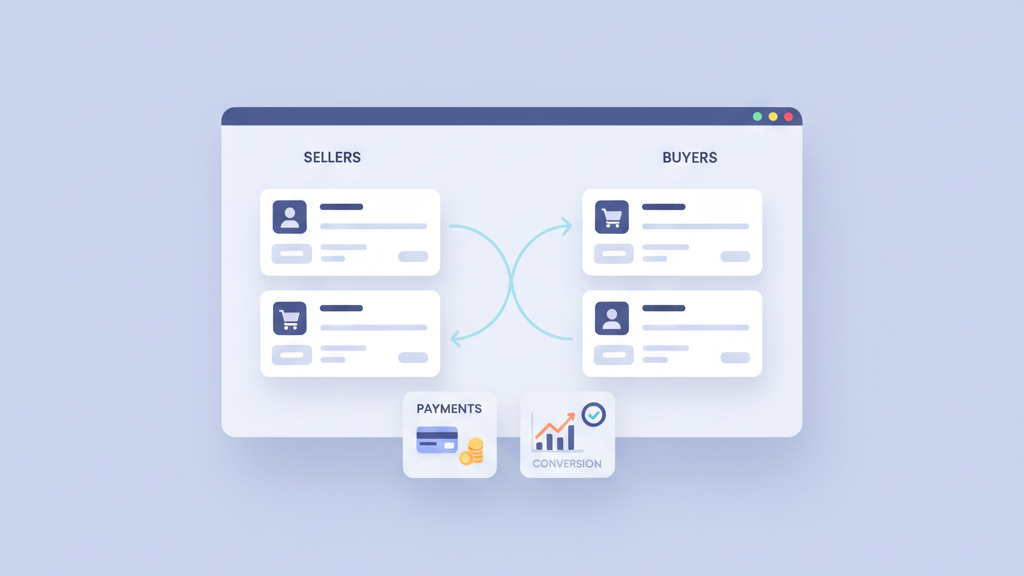
A two sided marketplace platform MVP for startups needs laser focus and early validation. Start with one clear value exchange and test it with a small set of users. Use manual work behind the scenes to simulate scale and learn real behavior. Keep engineering scope tight and prioritize trust and conversion moments. Many founders overbuild features before they prove demand. This guide lays out where to focus first, how to design minimal flows, and what metrics will tell you if the model can grow. The advice is pragmatic and aimed at teams that must move fast and conserve runway. If you want a related deep dive, read How To Set Product Metrics And KPIs For Startups That Scale.
Define Your Core Value Exchange
Start by naming the single exchange that creates value for both sides and write a short story about how it unfolds. Map the buyer intent and the seller incentive in plain terms. Choose a narrow use case where the match frequency and price points are predictable. Many startups miss this and try to serve every segment at once. Decide which trust signals are essential like reviews or identity checks. Plan simple payment paths that can be manual at first. Keep the scope constrained so you can run real experiments fast. Early qualitative feedback matters more than feature completeness. Use a handful of pilot users to validate time to match and willingness to pay. A clear value proposition makes subsequent design and engineering decisions straightforward and measurable. For a practical follow-up, see How to Choose the Right Tech Stack for Your MVP Development.
- Focus on one niche use case
- Map buyer and seller motivations
- List essential trust signals
- Plan simple payment flows
Design Minimal Core Flows
Design the smallest set of user journeys that prove the market dynamics. Prioritize onboarding, listing creation, discovery, match confirmation, and payment settlement. Each flow should be just enough to test a hypothesis. Use low fidelity wireframes to validate with users before building. Consider leaving some steps manual to reduce build time and validate assumptions first. For example accept bookings by email while you refine the matching algorithm. Focus on conversion points and friction that kills matches. Instrument those points for data collection from day one. Keep screens simple and avoid optional paths. Many teams build fancy dashboards before they fix the core loop. Fix the loop first and then add refinement. If you need implementation support, explore Backend API development.
- Map five core journeys
- Prototype before you build
- Manually handle edge cases
- Instrument conversion points
Choose Tech And Architecture
Pick a stack that supports rapid change and clear failure modes. Use managed services for payments, messaging, and identity to reduce compliance overhead. Consider serverless or container based hosting to save on ops time. Model your data around listings, users, transactions, and reviews with simple relations. Keep the product modular so you can replace parts without a rewrite. Do not over optimize for scale on day one. Implement feature flags and basic observability to roll back experiments quickly. Plan for a single source of truth for transactions and a reliable audit trail. Many founders underestimate the work around disputes and refunds so allocate some engineering time for those paths. Choose third party tools that are well documented and have good SDKs. A related guide worth reviewing is How to Choose the Right Tech Stack for Your Startup App.
- Use managed payments and identity
- Favor modular over monolith
- Add feature flags early
- Log transactions reliably
Launch With Lean Operations
Treat the early launch as an operations experiment more than a product release. Hire or assign a community manager to onboard initial users and gather feedback. Run manual quality checks and handle disputes personally to learn common failure modes. Use targeted outreach to get the right mix of supply and demand in your pilot markets. Set clear rules for who you invite and why, then iterate the criteria based on results. Track the time it takes to match and the drop off points. Use simple scripts and templates to scale outreach and support. Many teams expect organic growth and neglect initial activation funnels. Early paid or targeted outreach is often the fastest way to validate demand and tune the product. Teams moving from strategy to execution can review MVP development for startups.
- Start with a managed pilot
- Handle disputes manually at first
- Run targeted outreach campaigns
- Document common failure modes
Measure Growth And Unit Economics
Define a few core metrics that reflect health and scalability like time to match, take rate, gross merchandise volume, and retention by cohort. Measure customer acquisition cost per side and estimate lifetime value for each role. Watch conversion funnels closely and set clear thresholds for success before you scale. Run small budget experiments to see how CAC changes with different channels. Calculate the minimum viable take rate that covers operating costs after accounting for refunds and support. Many founders ignore unit economics until it is too late. Use these numbers to decide when to invest in automation or when to pivot the model. Keep reports simple and update them weekly so decisions can be data driven.
- Track time to match and retention
- Measure CAC and LTV per side
- Estimate sustainable take rate
- Run weekly data reviews