
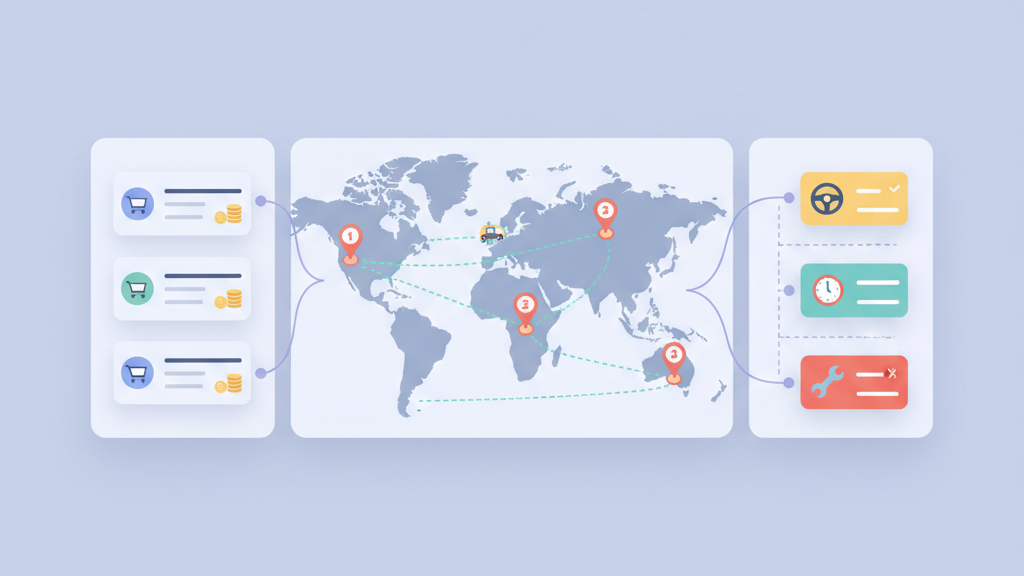
This guide walks founders through the essentials of on demand delivery app MVP logistics and workflows for a lean, testable product. I focus on the minimum pieces you need to prove value without overspending. You will get clear starting points for user journeys, driver operations, and routing. Many startups miss this and build features no one uses. The goal here is speed and learning. Build the smallest useful thing then iterate based on real data. If you want a related deep dive, read How to Build an On Demand Delivery Startup App MVP for Logistics.
Why start with a lean delivery MVP
A lean MVP forces clarity about what to learn first. Startups often try to match feature lists from big players. That wastes time. Focus on the user problem that justifies same day or scheduled delivery. Build a simple ordering flow, basic tracking, and a manual or semi automated dispatch process. Use real drivers or a partner to validate assumptions before automating. Collect conversion and fulfillment data to measure product market fit. Many startups miss this and assume more automation is always better. Start small, iterate, and measure the cost to serve each order. That metric will guide where to invest next. For a practical follow-up, see How To Validate Market Fit FlutterFlow travel booking app MVP product strategy and validation service.
- Define the one core problem you solve
- Keep ordering flow under three screens
- Measure cost to serve per order
Define core user journeys
Map the minimal user flows for customers, drivers, and admins. For customers, include onboarding, placing an order, real time updates, and simple support. For drivers, cover acceptance, pickup confirmation, navigation, and proof of delivery. For admins, include order routing, exception handling, and basic reporting. Use flow diagrams to spot handoff points and friction. Prioritize flows that influence repeat use and retention. Test each flow with real users and drivers in a controlled geography. You will learn more from three real deliveries than from a months long build without testing. Keep manual steps where automation is expensive and move them to automated processes only when volume justifies the cost.
- Map each user touchpoint end to end
- Prototype flows and test with real users
- Delay automation until volume justifies it
Essential logistics components
Choose the logistics pieces that impact cost and reliability most. Routing and ETA accuracy affect customer trust. Pickup and handoff protocols affect driver efficiency. Pricing and incentives affect acceptance rates and margins. Inventory and order batching matter only if your product needs them. For an MVP focus on deterministic routes in a small area to get predictable ETAs. Use a simple cost model that covers driver pay and platform fees so you can track unit economics. Build exception handling for failed pickups and returns. These components are not glamorous but they determine whether the service is sustainable. If you need implementation support, explore MVP development for startups.
- Prioritize routing and ETA accuracy
- Create clear pickup and handoff rules
- Track unit economics per route
Driver and partner workflows
Driver experience shapes reliability. Design an onboarding flow that verifies documents and explains expectations without friction. Build a compact app screen set for drivers with only the essential actions to accept a job, navigate, confirm pickup, and complete delivery. Consider partner integrations if using third party fleets. Create a protocol for exceptions and a fast support channel for drivers to report issues. Offer clear incentives for early adopters and first route completions. Remember that driver retention depends on predictable pay and predictable routes. Invest in simple dashboards that show daily earnings and completed trips. That transparency reduces churn and increases acceptance rates. Teams moving from strategy to execution can review Backend API development.
- Keep driver app screens minimal
- Provide quick support for exceptions
- Show daily earnings and trip history
Tech stack and architecture for speed
Choose a tech stack that lets you iterate rather than chase theoretical scale. Use managed services for payments, maps, and notifications to reduce build time. Keep the backend simple, with clear APIs for orders, drivers, and tracking. Build an admin web UI first to manage live operations before automating. Use modular design so you can swap components like routing or payments later. Implement basic observability to capture errors and latency. Your architecture should tolerate manual intervention in the short term. Manual controls buy time to learn. Avoid premature optimization for concurrency and scale. Most founders need to validate demand before those problems matter. A related guide worth reviewing is How to Choose the Right Tech Stack for Your MVP Development.
- Use managed services for core integrations
- Build an admin UI for live operations
- Design APIs to keep components modular
Testing, metrics, and operational feedback
Define a concise metric set that drives decisions. Track conversion, time to pickup, time to delivery, driver acceptance, and cost per delivery. Instrument events at key handoffs so you can diagnose failures quickly. Run small live pilots in a contained geography to collect representative data. Use qualitative feedback from customers and drivers to understand why metrics move. Set up a daily ops review to triage issues and capture improvement ideas. Many teams forget to close the loop and end up building features that do not solve the real problems. The goal of testing is a clear decision about whether to iterate, pivot, or scale.
- Track conversion and delivery times
- Capture driver and customer feedback
- Run daily ops reviews for early fixes
Launch plan and phased rollout
Rollout in phases to manage complexity. Start with a focused neighborhood or corridor to control variables. Use manual matching or batch dispatching early. Expand by geography only after you hit service and economic targets. Communicate clearly with early customers about expected service levels and limitations. Offer incentives for early adopters and referrals that match your unit economics. Plan for customer support and driver onboarding spikes after each expansion. Automate billing and payouts only after you validate volumes. A phased approach reduces risk and gives time for process improvements. I prefer steady expansion based on metrics rather than aggressive coverage chasing growth at all costs.
- Pilot in a small geography first
- Use manual dispatch until automated rules work
- Expand only after meeting service targets
Common pitfalls and how to avoid them
Founders often build for scale instead of building for learning. Big initial scope delays feedback and hides core problems. Another trap is trusting simulated data over live operations. Simulations miss noise from traffic, weather, and human behavior. Overcomplicating pricing and incentives before unit economics are clear causes margin leaks. Ignore vanity features that do not impact retention. Instead focus on repeatability and predictable delivery times. Automate only when data shows consistent patterns. Establish escalation paths for exceptions to avoid customer churn. These practices are practical and will save time and money in the long run.
- Avoid building for scale from day one
- Validate with live operations not simulations
- Keep pricing simple until margins are stable