
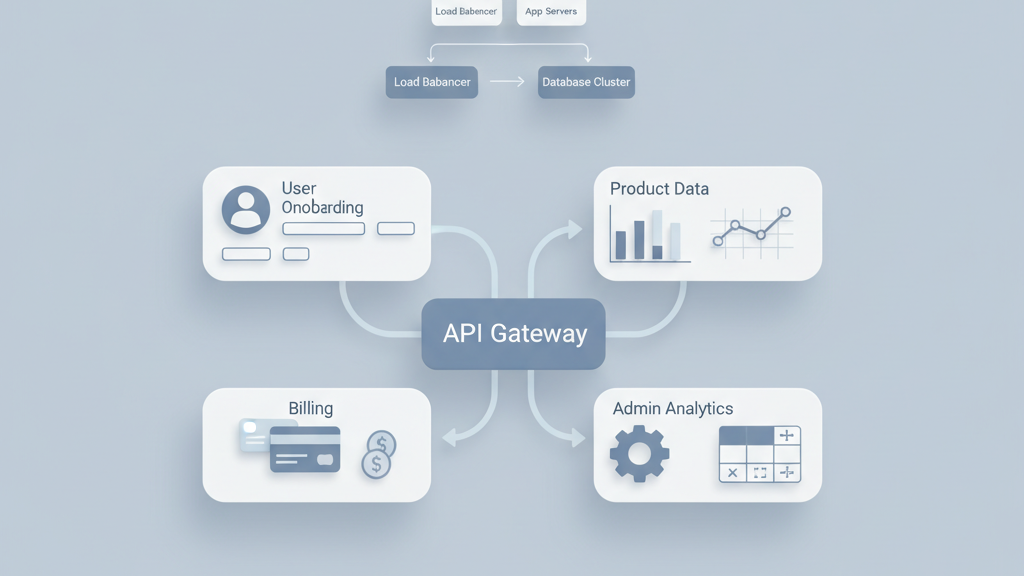
This guide walks startup founders and product managers through SaaS software MVP core modules and architecture in a clear way. I keep the advice practical and focused on what moves the product forward. You will see the essential modules to build first and how they fit into a simple architecture that scales. Many startups miss the difference between a prototype and a maintainable MVP. I share opinions on trade offs and warnings about common traps. The aim is to help you choose the right scope and avoid waste. Read on if you want to ship faster while keeping future growth in mind. If you want a related deep dive, read B2B Onboarding Software MVP Product Market Fit Steps That Actually Work.
Why a clear MVP architecture matters
A clear architecture reduces rework and keeps the team aligned. Startups often build features in isolation and end up with brittle code. Designing a simple layer for authentication, API, and data storage lets you swap or scale parts later. Think of the MVP as a stable skeleton not a toy prototype. This makes it easier to add paid features and integrations after product market fit. I prefer a modular approach where each core module has a single responsibility and clear interfaces. Many founders underestimate the cost of technical debt. Planning a basic architecture now saves months of work later and reduces risk when you add customers. For a practical follow-up, see Uncovering the Untold Tactics: Navigating MVP Iteration for Product-Market Fit.
- Define modules before coding
- Keep interfaces simple
- Plan for data migration
- Avoid premature optimization
User and authentication module
User management is the first core module to ship. It includes sign up, login, password resets, and profile data. Start with email and password and social login as optional. Keep the user model minimal and avoid storing unneeded fields. Implement role based access early if you expect admins and end users. Audit trails are useful but can be added later in a simple form. Many teams add complex user settings and stall the launch. Focus on secure authentication, simple session handling, and a clear API for other modules to query user status. I recommend using a proven library for password hashing and a simple token based session strategy to speed development.
- Start with email login
- Keep user schema minimal
- Add roles only when needed
- Use proven auth libraries
Billing and subscription module
Billing is a core module once you plan to charge customers. Integrate with a reliable payment provider and keep plans simple at launch. Avoid building complex metered billing in the first release. Offer a trial or a single tier to reduce friction. Make invoices and receipts automated to reduce support load. Design the module to emit clear events for other systems to react to. Many startups try to DIY every billing feature and then waste engineering time. Using a third party for payments and subscriptions lets you focus on product value. I find that a clear billing API helps product managers run experiments without deep engineering changes. If you need implementation support, explore Backend API development.
- Use a third party for payments
- Keep pricing simple at launch
- Automate receipts and invoices
- Emit billing events for integrations
Product data and content module
This module stores the core entities your users care about. Design a small set of normalized data models and avoid adding many derived fields early. Provide CRUD APIs and basic validation. Consider read and write patterns to choose databases and indexes. Many teams copy complex schemas from larger systems and get stuck. Start with a database that matches your access patterns and keep migration plans in place. Support bulk import and export for customer onboarding. A simple sync mechanism helps when you add integrations later. I recommend writing a few integration tests that cover common data flows to prevent regressions.
- Model core entities first
- Match database to access patterns
- Plan migrations early
- Support import and export
Integrations and API gateway
An API gateway gives you a single entry point for integrations and client apps. Keep the gateway thin and route calls to core modules by service name. Design consistent error codes and version your APIs to avoid breaking clients. Start with a few essential integrations such as email delivery and analytics. Many startups scatter integration code around and end up with brittle connections. Centralizing integration logic reduces duplication and makes it easier to monitor usage. I prefer async patterns for non blocking tasks and simple retries for transient failures. Make integration settings configurable so non engineers can toggle features during experiments.
- Use a thin API gateway
- Version public APIs
- Centralize integration logic
- Prefer async patterns
Admin and analytics module
Admin tools and basic analytics are key for running an MVP. Build an admin interface that surfaces user issues, billing status, and basic product metrics. Do not overbuild a full reporting suite at launch. Provide exportable views and a few dashboard cards that show activation, retention, and revenue. Many founders skip admin tools and then waste time on manual reports and engineers answering support questions. I recommend starting with a simple role restricted admin UI and a small analytics pipeline that can be extended after you confirm product market fit. This keeps operational cost low and improves response time for customer issues. A related guide worth reviewing is Building an Analytics Dashboard Software MVP for Product Managers: A Practical Guide.
- Build a lightweight admin UI
- Track activation and retention
- Provide exportable reports
- Restrict admin access
Scaling and infrastructure basics
Plan infrastructure for gradual growth not sudden scale unless you expect a viral launch. Use managed services to reduce operational burden. Start with a single region and add redundancy as customers grow. Use containerized deployments and automated CI CD to keep releases safe. Monitor key metrics like error rate, latency, and cost per request. Many startups over allocate resources and pay for unused capacity. I prefer autoscaling rules and a staged rollout strategy. Keep backups and a recovery plan documented. Simple infrastructure choices speed iteration and keep technical debt visible so you can address it incrementally. Teams moving from strategy to execution can review Software maintenance and scaling.
- Use managed services first
- Automate CI CD
- Monitor errors and latency
- Document recovery plans
Design and delivery roadmap
A clear roadmap ties modules to measurable outcomes. Define milestones that map to customer value not internal features. Prioritize onboarding completion, first billings, and retention after 30 days. Break work into small increments that deliver value and reduce risk. Many teams chase nice to have features and delay learning from users. I suggest time boxed sprints and regular demo cycles with stakeholders and early customers. Use release flags to test features with a subset of users. This lets you iterate without full launches and keeps product and engineering aligned on what matters.
- Prioritize customer outcomes
- Ship in small increments
- Use release flags
- Measure retention and activation