
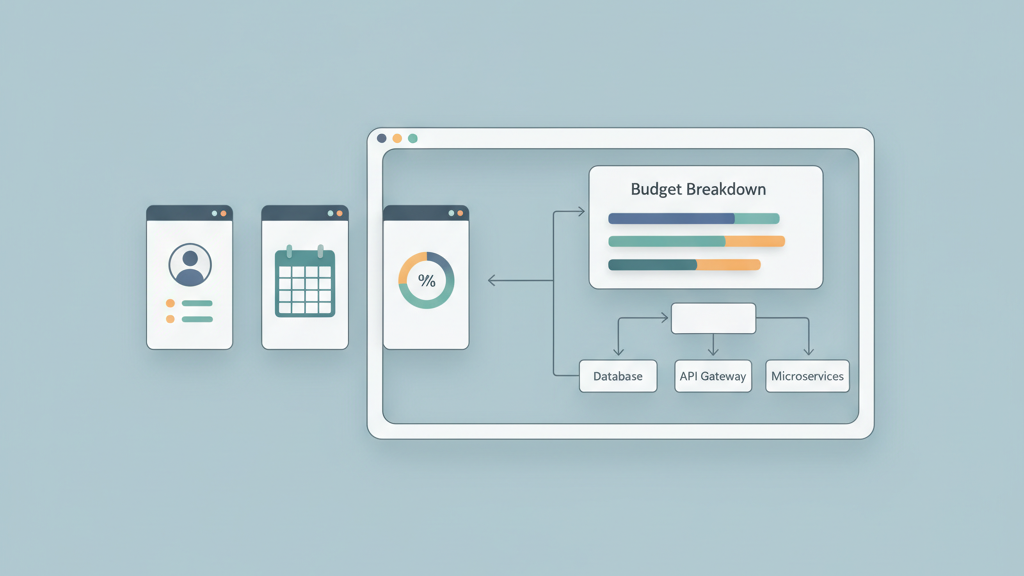
This USA startup app development cost estimate guide helps founders and product managers get realistic numbers and avoid wishful thinking. I focus on the practical steps that drive price. You will learn which features matter most, where teams add cost, and how to test assumptions early. Many startups miss hidden fees like integrations, compliance, and ongoing maintenance. This guide is not a magic formula, but it gives a clear framework to build budgets, compare proposals, and make trade offs with confidence. If you want a related deep dive, read How to Calculate a Real Price Estimate for Web App MVP Development USA.
How to think about app cost
Cost is a function of scope, quality, and team. Start by defining outcomes not features. A long list of nice to have items will blow budgets. I suggest mapping core user journeys and ranking them by impact. This keeps early scope tight and measurable. Estimate in layers, from a basic prototype to a minimum viable product and then to a scaled product. Each layer adds complexity and cost. Remember that integrations and regulatory work often add hidden hours. Many founders underbudget testing and iteration. Plan for a three to six month feedback loop and include buffers for rework. This mindset helps you choose the right trade offs and avoid late surprises. For a practical follow-up, see Estimating Costs For Your Minimum Viable Product Price Estimate For Founders.
- Define outcomes first
- Map core user journeys
- Estimate in layers
- Budget for integrations
- Include testing buffers
Typical cost breakdown by phase
Breaking cost into discovery, design, development, and operations makes estimates clearer. Discovery includes research, user interviews, and technical scoping. Design covers UX and UI work. Development is where most time goes and where hourly rates matter most. Operations covers hosting, monitoring, and maintenance. Each phase has deliverables and risks. Put contingency on development and operations. For startups I recommend a short discovery to de risk assumptions and a focused development sprint for the core flow. This reduces wasted work and speeds up learning. My experience is that most budgets fail because teams skip discovery or try to build too many platforms at once.
- Separate discovery from development
- Allocate most budget to development
- Plan ongoing operations costs
- Add contingency to risky areas
- Use short sprints to validate
Platform choices and their impact
Choosing platforms changes cost and speed. Native mobile development requires separate iOS and Android work unless you accept feature gaps. Cross platform frameworks save initial time but can increase long term effort for complex native features. Web first can be faster to market for many startups and supports progressive web apps. Backend choices matter too. Serverless can reduce ops work but may be expensive at scale. Self hosted servers require more maintenance but can be cheaper for predictable load. My opinion is to pick the simplest stack that supports the core product and avoid premature optimization. Many teams pick trendy tech that increases hiring cost and slows development. A related guide worth reviewing is Native Apps vs Progressive Web Apps for Startups: Choosing the Right Path.
- Weigh native against cross platform
- Consider web first for speed
- Match backend to expected load
- Avoid trendy tech without need
- Think about hiring and maintenance
Team composition and hiring models
Your team model affects both hourly rates and coordination overhead. An in house team offers control but increases fixed costs. Freelancers are flexible and good for short bursts. Agencies provide process and predictability but can be pricier. Hybrid models let you keep product direction internally while outsourcing implementation. For technical founders a small core team plus contractors often hits a good balance. Regardless of the model, invest in clear specs and communication rituals. Many projects slow down because requirements are vague. I advise setting milestones tied to measurable results and leaving room for iteration after each milestone.
- Choose model based on control needs
- Use freelancers for short phases
- Pick agencies for predictability
- Keep a small internal core
- Set milestone based payments
Feature level cost examples
Some features cost much more than they seem. Social logins and basic profiles are low cost. Real time chat and video calls add backend complexity and higher hosting costs. Payment processing needs compliance work and secure flows. Offline sync and complex state management require careful engineering. Admin dashboards and analytics often take more work than expected because of data modeling and reporting needs. Machine learning features increase cost and time for data collection. Use feature tiers to decide what goes into the first release. A small set of high value features is usually better than many incomplete ones. Warning many founders add features that should wait.
- Start with low cost high impact features
- Defer real time and ML features
- Plan for payment compliance
- Expect admin tools to need effort
- Use feature tiers for scope control
Ways to reduce cost without killing quality
Cutting cost does not mean cutting quality. Focus on the core value and reduce polish elsewhere. Use design systems and reusable components to speed development. Automate testing for critical flows to avoid expensive bugs later. Choose mature third party services for things like authentication and payments to avoid custom builds. Time box work and insist on minimum lovable product features. Consider phased launches in limited markets to validate demand before scaling. My experience shows that deliberate constraints improve product clarity and reduce waste. Many startups waste money by chasing feature parity with larger competitors instead of validating real user need. If you need implementation support, explore Backend API development.
- Use reusable components
- Automate critical tests
- Rely on mature third parties
- Time box features
- Launch in phases
Typical timelines and milestones
Timelines vary but predictable milestones keep teams aligned. Discovery is often two to four weeks. An MVP for mobile or web can take three to six months depending on scope. Add another three to six months for refinement and scaling work. Each milestone should have clear acceptance criteria and a plan for user testing. Avoid vague deliverables like polish or improvements without measurable goals. Frequent demos and short feedback loops reduce rework. Many founders expect faster delivery than is realistic. Setting conservative timelines with clear checkpoints builds trust with investors and users.
- Set short discovery windows
- Expect three to six months for MVP
- Define acceptance criteria
- Use frequent demos
- Plan time for refinement
Final checklist before you ask for quotes
Before requesting estimates prepare a one page brief that outlines problem statement, core user journeys, key integrations, compliance needs, and expected launch metrics. Include wireframes or simple flows to reduce assumptions. List third party services you prefer and any hard constraints like platforms or languages. Ask vendors to price phases separately and to state risks and unknowns. Compare proposals on deliverables and not just hours. A cheap estimate without clarity is usually more expensive in the long run. Many startups forget to budget for post launch work and monitoring. This checklist helps you get apples to apples proposals and avoid costly surprises. Teams moving from strategy to execution can review Software maintenance and scaling.
- Create a one page brief
- Include user flows or wireframes
- Ask for phased pricing
- Require risk statements
- Budget for post launch work