
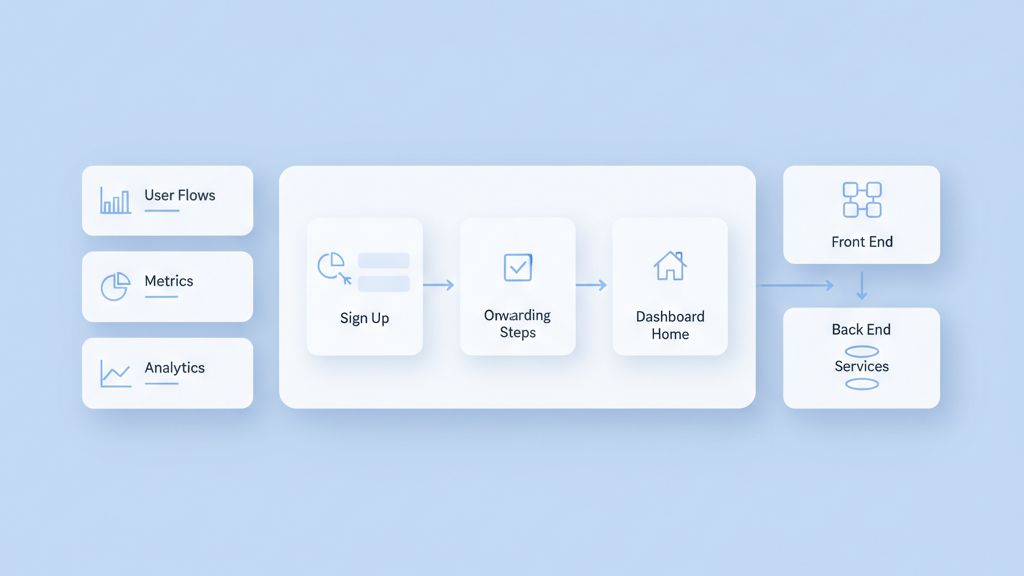
This guide outlines a step by step MVP development process for startups to help founders validate ideas, reduce risk, and move from prototype to first paying users.
Validate The Problem
Every startup should start by testing the problem and the customer assumptions. Run quick interviews, small landing pages, and ad tests to see if people care. Focus on a narrow use case that solves one urgent pain. Many founders try to boil the ocean, and that wastes time and budget. Use simple metrics like signup rate, click through, and time on task to decide if demand exists. Document core user journeys and the scenarios that matter most. This early research will save months of wasted engineering effort and sharpen your product focus. Treat the initial model as a learning tool. Plan to pivot or prune features based on evidence. Be ruthless about what is essential for an initial release.
- Talk to real prospects early
- Run a landing page test
- Measure simple demand metrics
- Map the key user journey
Define Core Features
After you validate demand, narrow the scope to the smallest set of features that deliver value. Map user flows and mark the must have screens. Then write a clear definition of done for each feature so the team shares the same expectations. Pick three success metrics that matter most. Common choices include activation rate, retention at seven days, and time to first value. Keep the backlog lean and avoid feature creep. Many startups confuse nice to have with necessary and lose focus. Resist adding polish until the core flow works reliably. Define version milestones and plan for quick releases. Use experiments to test assumptions behind each feature. This keeps the initial build focused and reduces time to a usable product. If you want a related deep dive, read How To Set Product Metrics And KPIs For Startups That Scale.
- Limit scope to must haves
- Define acceptance criteria
- Choose three meaningful metrics
- Keep the backlog lean
Prototype And Test UX
Create simple prototypes to test the assumptions behind the core flows. Use paper sketches, clickable wireframes, or low fidelity tools to simulate the experience. Run five to ten usability sessions with real users in the target segment. Observe rather than ask too many leading questions. Look for moments where users hesitate or express confusion. Those are the places that need redesign. Iterate the flows and test again quickly. Prototype tests are cheap compared to coding and they reveal missing edge cases and inaccurate language assumptions. Hand off validated designs to engineers with annotated flows and acceptance criteria. Many teams skip detailed annotations and then waste time on rework. Keep design reviews tight and focused and lock the core experience before heavy engineering starts.
- Build low fidelity prototypes
- Run short usability sessions
- Observe user hesitation
- Annotate flows for engineers
Pick Tech And Architecture
Choose a tech stack that fits speed and future needs. Prefer well supported frameworks and managed services that accelerate delivery. Keep the architecture simple and modular. Design clear API boundaries and separate the user facing UI from backend services. This separation lets you iterate on each layer independently and scale parts that need more resources. Plan for data models that can evolve without a large migration. Avoid optimistic guesses about scale. Many founders pick exotic tech that slows hiring and increases risk. Document deployment and rollback steps. Set up continuous integration and automated tests from the first sprint. These steps reduce surprises and give the team confidence to ship often while balancing short term speed with maintainability. If you need implementation support, explore Backend API development.
- Choose proven frameworks
- Design modular APIs
- Plan evolvable data models
- Automate builds and tests
Ship With Agile Iterations
Run short sprints with clear goals and a tight definition of done. Prioritize the backlog using the expected learning value of each item rather than story points alone. Keep cross functional teams small and empowered to make decisions. Hold brief daily syncs to remove blockers and weekly demos to gather feedback. Ship increments that users can try as early as possible. Each release should test a hypothesis or deliver measurable value. Track cycle time and deployment frequency. Use feature flags to roll out changes safely and to run A B experiments. Many teams assume each release must be perfect. That is a mistake. Aim for small reversible changes and rapid learning to improve product market fit faster. For a practical follow-up, see Uncovering the Untold Tactics: Navigating MVP Iteration for Product-Market Fit.
- Run short focused sprints
- Prioritize by learning value
- Use feature flags
- Ship small reversible changes
QA And Security Basics
Quality matters even for an MVP. Build automated tests around core flows and regressions. Add smoke tests to catch deployment failures early. Integrate basic security checks and dependency scans into the pipeline. Keep user data encrypted and follow privacy rules that apply in your market. For founders building in regulated spaces consult with legal early. Many startups overlook compliance until a problem appears, and that causes costly rework. Create a simple incident response plan and backups for critical data. Use monitoring and real user metrics to spot issues before customers complain. Plan regular code reviews and threat modeling sessions. Consider a third party audit when handling sensitive payments or health data.
- Automate core flow tests
- Run dependency scans
- Encrypt user data
- Prepare incident plans
Launch And Growth Experiments
Prepare a launch checklist that goes beyond PR and app store assets. Include onboarding flows, analytics, support playbooks, and rollback plans. Run small paid campaigns to test acquisition channels and measure cost per activated user. Try referral programs and partnerships in parallel. Use cohort analysis to see who finds value and why. Run controlled experiments on onboarding copy, pricing, and feature access. Many growth tactics look attractive but waste budget. Start with one channel and double down on what scales. Track unit economics early. If acquisition costs exceed lifetime value the project will struggle. Coordinate customer support with product fixes so issues get closed quickly and early users stay engaged. Teams moving from strategy to execution can review Mobile app development.
- Prepare a full launch checklist
- Test one channel then scale
- Measure unit economics
- Coordinate support and product
Measure Learn And Iterate
Make measurement the backbone of your process. Define key metrics and build dashboards that show activation, retention, and revenue trends. Use qualitative insights from support and interviews to explain quantitative shifts. Run experiments with clear hypotheses and pre defined success criteria. When results are ambiguous run longer tests or split cohort analysis to reduce noise. Decide what to build next based on learning velocity and expected impact. Prioritize technical debt that blocks growth. Schedule regular product review sessions that include engineering, design, and customer success. Many teams skip post mortems and then repeat avoidable mistakes. Treat each release as a chance to learn and to improve how you make product decisions. A related guide worth reviewing is How to Manage Engineering Tradeoffs: A Process to Prioritize Technical Debt in Early Stages.
- Build simple action oriented dashboards
- Combine qualitative and quantitative data
- Prioritize by learning velocity
- Hold regular cross functional reviews