
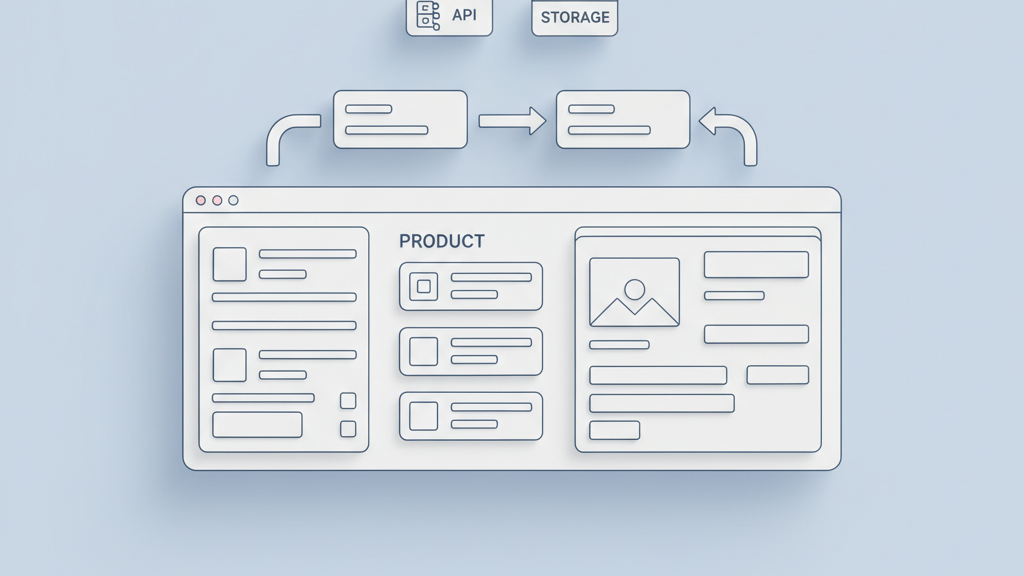
This guide walks founders and product managers through a d2c ecommerce application MVP product catalog strategy that balances speed and future growth. Read this if you want a clear set of trade offs and an actionable plan to deliver a usable catalog fast.
Why A Focused Catalog Matters
A product catalog is the backbone of any direct to consumer store. It is more than a list of products. It shapes search, filters, recommendations, and checkout flows. For an MVP you must pick the features that prove customer demand and that reduce decision friction. Aim to validate core product market fit before building complex variants, shipping rules, or sophisticated personalization. Many startups miss this and end up with a sprawling catalog that is costly to maintain. Start with the minimal data set that supports discovery, selection, and purchase. That approach speeds development and keeps early analytics clear. Keep a short roadmap for which catalog features to add after the first revenue signals arrive. If you want a related deep dive, read Uncovering the Untold Tactics: Navigating MVP Iteration for Product-Market Fit.
- Define what discovery looks like
- List fields needed for purchase
- Avoid variant explosion early
- Plan a short roadmap
Set Clear MVP Scope For Catalog Data
Deciding which product attributes to include is a practical trade off. Too few fields limit conversion experiments. Too many fields slow down data entry and increase integration work. For an MVP pick required fields for search and checkout, and optional fields for marketing tests. Include title, short description, price, main image, SKU, stock status, and one category tag at a minimum. Add weight and dimensions only if shipping tests need them. Keep SEO fields minimal unless you have content resources. Use a single source of truth for these attributes to avoid drift across feeds. This makes it easier to onboard sellers or suppliers later. Keep the schema flat at first and avoid deep nested options until you validate the need. If you need implementation support, explore MVP development for startups.
- Start with essential attributes
- Keep schema flat
- Defer complex variants
- Use one source of truth
Design A Practical Data Model
A good data model supports search, filters, and future integrations without being rigid. Model products, SKUs, and basic relationships separately. Treat SKUs as the purchasable unit and products as the grouping for discovery. Avoid mixing pricing logic into product records. Keep stock and pricing as separate records that can change independently. Use simple normalized tables or documents that map cleanly to your chosen database. Design IDs and slugs to be stable and exportable for analytics. Include a small audit trail for changes so you can trace why items changed after launch. This design lowers technical debt and keeps the catalog resilient as you add channels or marketplaces in the future.
- Separate product and SKU
- Keep pricing separate
- Use stable IDs
- Add a simple audit trail
Prioritize UX For Discovery And Conversion
User experience drives how customers find and buy products. Even for an MVP a focused UX increases conversion. Design for simple filters, clear product cards, and a fast path to buy. Reduce cognitive load with one primary image and a clear price block. Use progressive disclosure for details so the initial page stays light. Build a quick mobile first flow because most early D2C traffic is mobile. A small investment in search relevancy tuning pays off. Many founders underestimate the impact of tiny UX choices. Test a couple of layout variations with real users and track completion rates. Iteration after launch is fine, but solid first impressions matter. For a practical follow-up, see Build A Lean Booking Product For Fast Launch.
- Design mobile first
- Use progressive disclosure
- Tune search relevance
- Measure completion rates
Integrations And API Strategy
Your catalog will need to talk to checkout, inventory, analytics, and marketing tools. For an MVP prefer a small set of stable REST endpoints and a clean internal API contract. Do not overengineer a public API unless you plan partners in the first months. Build webhooks for stock updates and orders so external systems can react. Use middleware adapters to isolate third party formats from your core model. This lowers the cost of swapping services later. Keep integration points shallow and well documented so engineers can onboard quickly. Plan simple error handling for bad feeds and make data validation visible so issues get fixed fast. Good integration design prevents a lot of late stage migration pain. Teams moving from strategy to execution can review Backend API development.
- Expose a small set of APIs
- Use webhooks for updates
- Isolate third party formats
- Document error handling
Inventory And Pricing Rules For Launch
Inventory and pricing drive both customer experience and operational complexity. For an MVP keep rules simple. Use binary stock status and soft allocation if you want to avoid complex reservations. Offer one pricing model in the first release to reduce edge cases. Add discounts as simple override records that can be applied manually or by a campaign tag. Capture enough metadata to reconcile sales with inventory without building complex fulfillment logic. Many teams try to replicate enterprise grade rules too early. That creates bugs and slows time to market. Focus on repeatable, auditable flows that operations can manage with minimal tooling. You can automate later when volumes justify it. A related guide worth reviewing is How To Budget An MVP For Early Teams (enterprise app MVP pricing for small businesses USA).
- Use simple stock states
- Avoid complex reservations
- Implement one pricing model
- Keep reconciliation simple
Measurement And Iteration Plan
You will learn by measuring a few core metrics. Define conversion rate from discovery to cart, add to cart rate per card layout, and revenue per SKU. Track time to first purchase and returns rate if applicable. Instrument product views and filter usage so you know which attributes matter. Use analytics events with stable names and a light schema so data stays consistent. Plan quick experiments and a reporting cadence to make decisions weekly. Many startups wait too long to add tracking and lose early signals. A clear measurement plan helps you prioritize catalog improvements and marketing spend. Iterate on the smallest change that can validate a hypothesis.
- Track discovery to cart conversion
- Instrument filter usage
- Use stable analytics events
- Run weekly experiments
Common Pitfalls And Launch Checklist
Before launch run a short checklist that exposes common catalog failures. Check that search returns expected results for top queries, verify image loading and fallback behavior, confirm SKU level pricing matches cart totals, and validate stock updates under simulated orders. Test feeds from suppliers and ensure your import trims bad records. Verify analytics events fire and that error logs are monitored. Many teams skip load tests for catalog endpoints and face slow pages during the first spikes. Prepare a rollback plan for bad product imports and a manual edit path for urgent fixes. A practical checklist reduces fire drills and helps you focus on growth after launch.
- Validate search and filters
- Test image fallbacks
- Confirm SKU pricing integrity
- Prepare a rollback plan