
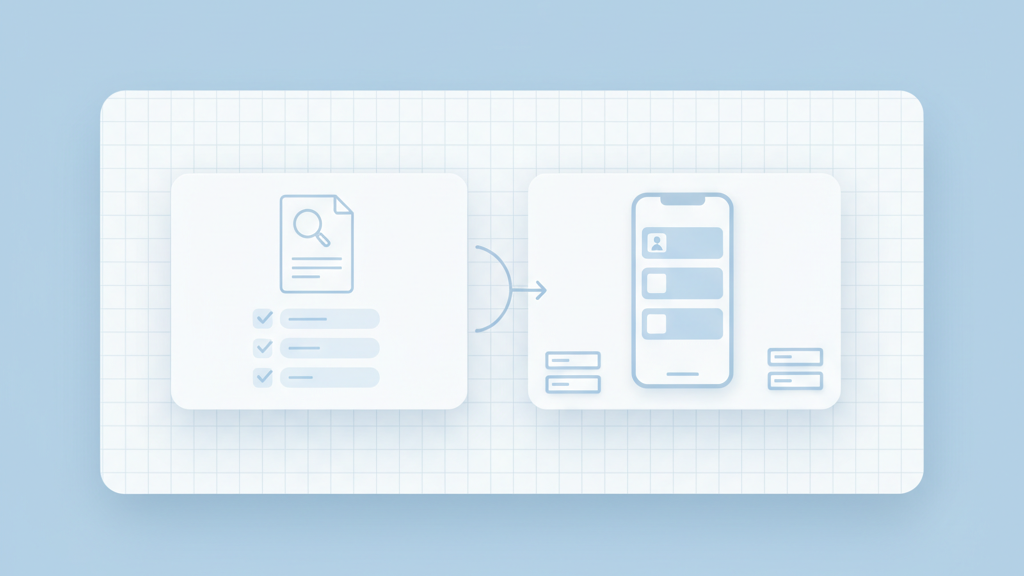
Choosing between a POC and an MVP shapes your first months of product work. MVP vs POC which is better for founders is a common search, and the answer depends on risk, timing, and learning needs. This guide walks through technical trade offs, team needs, and the business signals to watch. Many startups miss the basic goal which is fast validated learning. I give pragmatic steps you can use this week to change course without blowing the budget. Expect clear examples, simple rules, and a short decision tool at the end. If you like quick recommendations I tend to favor the approach that answers the riskiest assumption first, even if that feels uncomfortable. That rule will show up in most sections, and it often saves time and money. If you want a related deep dive, read MVP Development for a Networking App Like LinkedIn – The Smart Startup Approach.
Quick Overview
Founders face two short tests early on. A proof of concept proves a technical idea can work at all. A minimum viable product proves real users will use and pay for a value proposition. The tests look similar but they answer different questions. A POC is usually small and focuses on feasibility. An MVP is broader and focuses on demand and user behavior. Picking the wrong test wastes time, frustrates the team, and delays feedback. This section frames the trade offs so you can match a test to your riskiest assumptions. Expect concrete examples later on and a simple guide to choose quickly. I will argue that a clear hypothesis and a short timeline beat perfection in the early days. Many startups miss that key point and build too much before they learn. If you need implementation support, explore MVP development for startups.
- Map your top three assumptions quickly
- Score each assumption for impact and uncertainty
- Choose the test that targets the highest score
- Time box tests and set clear success metrics
Proof of Concept Explained
A proof of concept focuses on a single technical or scientific hurdle. It proves feasibility not market demand. A POC is often a prototype that demonstrates a component under near ideal conditions. It might be a script that processes a hard data set, or a bench test of a sensor. The value of a POC is speed and clarity. You get an answer to a hard question without building user interfaces or full systems. Many founders use POCs to de risk pitches and to get early engineering buy in. The practical warning here is to avoid turning a POC into a product. That usually happens when stakeholders fall in love with the prototype and ask for more features instead of planning a follow up MVP.
- Limit POC scope to one technical question
- Use throwaway code to save time
- Keep the team small and focused
- Set success criteria before you start
Minimum Viable Product Explained
An MVP is a product with the minimal feature set to test real user behavior. It needs enough polish to be credible to early adopters. The goal is to observe retention, engagement, and willingness to pay. Build instrumented flows to capture key metrics and feedback. An MVP is not a final product but it must solve the core job to be useful. Focus on the simplest path that delivers value. In my view an effective MVP prioritizes measurable outcomes over features. Many teams confuse more features with better testing which is a mistake. A disciplined MVP helps you learn quickly and move to product market fit faster. For a practical follow-up, see Uncovering the Untold Tactics: Navigating MVP Iteration for Product-Market Fit.
- Design for the core user action first
- Instrument the product to capture key metrics
- Test pricing with real offers when possible
- Use interviews to add context to metrics
When To Choose A POC
Choose a POC when technical uncertainty is the blocker to any forward motion. If the idea relies on new algorithms, unstable integrations, or novel hardware then feasibility matters before you test users. A POC keeps costs low and gives a quick yes or no. Set a short timeline and a single metric for success. If the core technology cannot be demonstrated in a few weeks rethink the idea or adjust scope. The common mistake is to skip a necessary POC because the team prefers product work. This often leads to late stage failures where the architecture cannot support the product. The warning is clear, prove the hard technical assumption first when feasibility is unknown. Teams moving from strategy to execution can review Software maintenance and scaling.
- Run a POC when technology is the main risk
- Keep timelines very short
- Document results and next steps
- Treat the POC as disposable
Cost Time And Scope
Budget and runway shape which test you choose. A POC is cheaper and faster because it limits scope. An MVP requires investment in UX, stability, and measurement which increases cost. Decide which question matters most and allocate funds accordingly. If your runway is tight focus on the test that will most likely kill the idea if wrong. If you have more time you can run parallel low cost market tests such as landing pages or ads. Keep the team small and use contractors for specialist work. The practical warning is to avoid expanding scope mid test which eats budget and delays learning. Plan a follow up step for both outcomes to avoid confusion after the test completes.
- Align budget with the riskiest assumption
- Use contractors for short specialized work
- Measure cost per validated learning
- Avoid scope creep during tests
Technical Risk And Validation
Validation is about proving assumptions with data. Technical risk demands engineering experiments. Market risk demands user facing tests. Map both and choose the test that answers the riskiest unknown first. Use feature toggles, mocks, and service stubs to isolate pieces of the system you do not need to test. Focus on one hypothesis at a time and avoid complex integrated experiments that muddy results. Instrument everything so you can compare outcomes across tests. A clear technical validation plan includes success criteria, test inputs, and expected outputs. Many startups skip rigorous validation and rely on anecdotes which leads to poor product choices later. A related guide worth reviewing is How To Validate Market Fit FlutterFlow travel booking app MVP product strategy and validation service.
- Isolate the component you need to validate
- Use mocks to simplify experiments
- Instrument tests to collect clear metrics
- Validate one hypothesis at a time
Team And Resource Considerations
Your team shapes feasible experiments. Small teams do better with tight POCs that need deep technical knowledge. Product heavy teams can run MVPs that gather market feedback. Also consider hiring timelines and learning curves. Sometimes a short hire for a POC is cheaper than training existing staff. Set roles clearly so decisions move fast and handoffs are clean. Protect engineers from feature creep during a POC and protect product from premature technical debt during an MVP. Communication matters so set daily or biweekly checkpoints. The mild opinion here is that founders should keep the decision making centralized early on to avoid paralysis. That speeds learning and reduces waste.
- Match test type to team strengths
- Use short term hires for specialist work
- Set clear roles and checkpoints
- Document interfaces for handoffs
A Simple Decision Framework
A short framework helps founders decide without analysis paralysis. Step one write down your top three assumptions. Step two rate them for impact and uncertainty. Step three pick the test that reduces the highest risk first. If the highest risk is technical run a POC. If the highest risk is market demand run an MVP. MVP vs POC which is better for founders ultimately depends on this simple mapping. Many founders skip the assumption mapping and end up building features that do not answer core questions. The practical warning is to time box the experiment and set an exit rule based on metrics. Commit to a pivot or a shut down if results are negative rather than expanding work.
- List your top three assumptions first
- Score each for impact and uncertainty
- Pick the test that targets the top score
- Time box experiments and set exit rules