
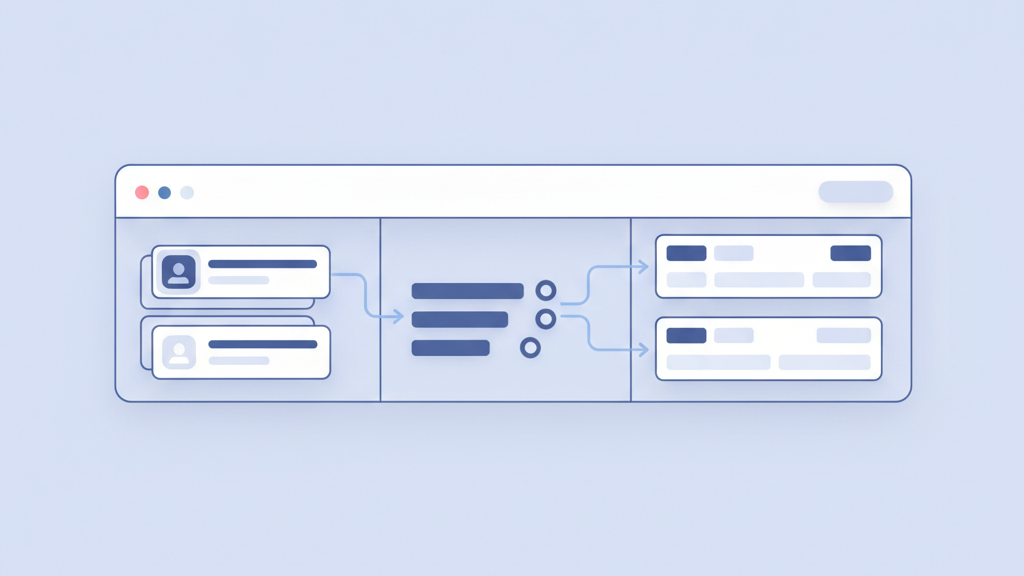
This guide explains how to prioritize product features using simple framework that fits early stage teams. I show a practical flow from inputs to scoring to a lightweight roadmap. You will get a repeatable approach to pick experiments and move faster. If you want a related deep dive, read How FlutterFlow on demand delivery app MVP build and validation service Helps Startups Move Faster.
Why A Simple Framework Beats Complex Scorecards
Many teams default to complex scoring models that promise rigor but slow decisions. I prefer a simple framework because it forces tradeoffs into plain language. Startups need speed more than perfect math. A lightweight model keeps conversations focused on outcomes, not on spreadsheet hygiene. This makes it easier to test assumptions and to iterate after real user feedback arrives. The goal is not to eliminate judgment. It is to make judgment visible and repeatable. You should pair this with short validation cycles and clear success metrics. Many startups miss this and keep extending the deliberation phase. My mild opinion is that a compact model helps founders ship more often. If you are building a product with limited resources, choose clarity over complexity and prioritize features that unlock user value early. If you need implementation support, explore Mobile app development.
- Keep the model short and visible
- Expose key assumptions per feature
- Favor learning over perfect estimates
- Limit criteria to three to five axes
Gather Inputs That Matter
Start by listing candidate features and the user problems they solve. Gather inputs from customer interviews, analytics, support tickets, and sales. Keep the list focused and avoid infinite wish lists. For each feature capture the expected benefit, the major assumptions, and the approximate effort. You do not need a perfect estimate. Rough bands are fine. The point is to surface the biggest risks and the potential upside. Many founders skip customer research and rely on opinions. That is a mistake. Validation helps you cut noise. Use one page or a simple spreadsheet so the team can scan quickly. This also makes tradeoffs easier to communicate. Practical warning, do not let feature parity with competitors drive every decision. Focus on measurable outcomes, not vanity metrics. Set a hypothesis for each feature so you know what to learn. For a practical follow-up, see How To Set Product Metrics And KPIs For Startups That Scale.
- Interview users for real problems
- Pull metrics to spot user friction
- Capture effort in rough bands
- Write a hypothesis for each feature
- Avoid long wish lists
Score With Clear Criteria
Define a small set of scoring criteria that reflect your goals. Pick three to five axes such as user value, revenue potential, technical risk, and strategic fit. Keep each axis simple and give clear anchors for low medium and high. Do not over engineer weights. Equal weights often work fine for early stages. The score should help start conversations not end them. A numeric score is a tool to rank ideas for experiments. Use the results to pick a few experiments to run in the next two to four weeks. Always log the key assumptions behind a high score so you can test them quickly. Many teams forget to revisit scores after new data arrives. That erodes trust in the model. Keep the scoring visible to the whole product team. A related guide worth reviewing is B2B Onboarding Software MVP Product Market Fit Steps That Actually Work.
- Choose three to five axes
- Use simple low medium high anchors
- Log assumptions with every score
- Update scores when you learn new data
Turn Scores Into A Lightweight Roadmap
After scoring, translate the top items into a short roadmap that focuses on experiments. Limit the roadmap to the next two cycles. Describe each item as an experiment with a clear outcome and a way to measure success. Include a rough owner and an estimated time box. This keeps work scoped and avoids sprawling projects. Prioritize items that unblock user value quickly. Communicate the roadmap in a single slide or a simple board so stakeholders can react. Many companies make the roadmap a promise. That is a common mistake. Treat it as a hypothesis and update it often when you learn new facts. A humble roadmap reduces politics and increases speed. Set a regular review cadence to rescore items based on new outcomes. Practical warning, do not over commit the engineering team.
- Limit the roadmap to two cycles
- Describe items as experiments
- Add an owner and a time box
- Share a single slide or board
- Review and update regularly
Common Pitfalls And How To Avoid Them
Watch out for common traps that ruin even simple models. First, do not turn the framework into a bureaucratic gate. If approvals start to multiply you will slow down. Second, avoid treating scores as truth. They are a starting point for tests. Third, do not ignore operational costs like maintenance and support. Those will eat margins later. Fourth, beware of feature ideas that solve internal needs only. They often create internal complexity. Keep a clear opinion on user value. Fifth, resist the seduction of parity chasing. Copying competitors rarely creates sustainable advantage. Finally, document decisions and the learning from experiments. That makes future prioritization faster and less subjective. Many startups skip documentation and later regret it. Use short templates for decision notes to make it painless. My opinion is that consistent small habits beat occasional big reviews. Teams moving from strategy to execution can review Software maintenance and scaling.
- Do not create approval bottlenecks
- Treat scores as hypotheses
- Include operational costs
- Avoid internal only features
- Document decisions and learnings