
If you are building a real estate marketplace platform MVP listings and search you need a clear plan that balances speed and quality. This guide walks founders and product managers through the core trade offs for lists and search, plus pragmatic tech choices. Many startups miss the data shape and search trade offs early. I prefer simple models that let you iterate on matching and pricing without a heavy initial index. Expect to make small compromises on features at launch and plan to iterate based on actual usage data. If you want a related deep dive, read Building a Real Estate Marketplace Platform MVP With Listings Search.
Defining The Listings Model
Start by keeping the listings model narrowly focused on what matters for discovery and conversion. Store only the attributes you will use for search and display at launch, like location coordinates, price, bedrooms, type, status, and primary media link. Avoid heavy nested objects and long history logs in the main index. Use a separate audit store for changes and versioning. Design the publish workflow to support basic validation and thumbnail creation. Plan for incremental enrichment so you can add more fields later. This approach reduces initial complexity and speeds up testing. Many founders try to capture every detail from day one and end up delaying launch. For a practical follow-up, see Building a Marketplace MVP: Why Startups Use FlutterFlow for Validation.
- Model only search and display fields
- Keep coordinates and price indexed first
- Separate audit logs from the main index
- Support incremental enrichment of listings
- Validate and generate thumbnails on publish
Search Core Features
Focus search on the few interactions that drive user value. Offer text plus faceted filters and a geo radius option. Prioritize relevance for price and location, and add simple sorting by newest or best match. Keep NLP features out of the first release unless you have a clear source of queries to tune against. Make sure your search returns consistent results for the same filter set and that paginated results remain stable. Build analytics to capture what users search for and where they drop off. That data will tell you which signals to invest in next. A little humility helps here, because full featured search is easy to overbuild without proving demand. A related guide worth reviewing is Protecting Users Early On: best practices for securing early product user data.
- Start with text search and faceted filters
- Add geo radius and basic sorting
- Defer complex NLP until you have query data
- Ensure result stability across pages
- Track search analytics from day one
Data And Performance
Design for scale by separating the read index from the transactional store. Use a lightweight search engine for queries and a relational store for canonical data. Keep your index refresh schedule short enough to feel real time but long enough to avoid constant full reindexes. Cache popular queries and use precomputed aggregations for counts. Monitor query latency and error rates closely. You will likely need to tune shard keys or partitioning based on geography and listing density. Plan a fallback path if the search cluster is degraded so the app can still show recent listings from the primary store. Performance surprises are common so instrument early and iterate quickly. If you need implementation support, explore Mobile app development.
- Separate search index from the canonical store
- Cache hot queries and precompute counts
- Tune partitioning by geography
- Set sensible index refresh windows
- Implement fallbacks for degraded search
MVP UX And Flows
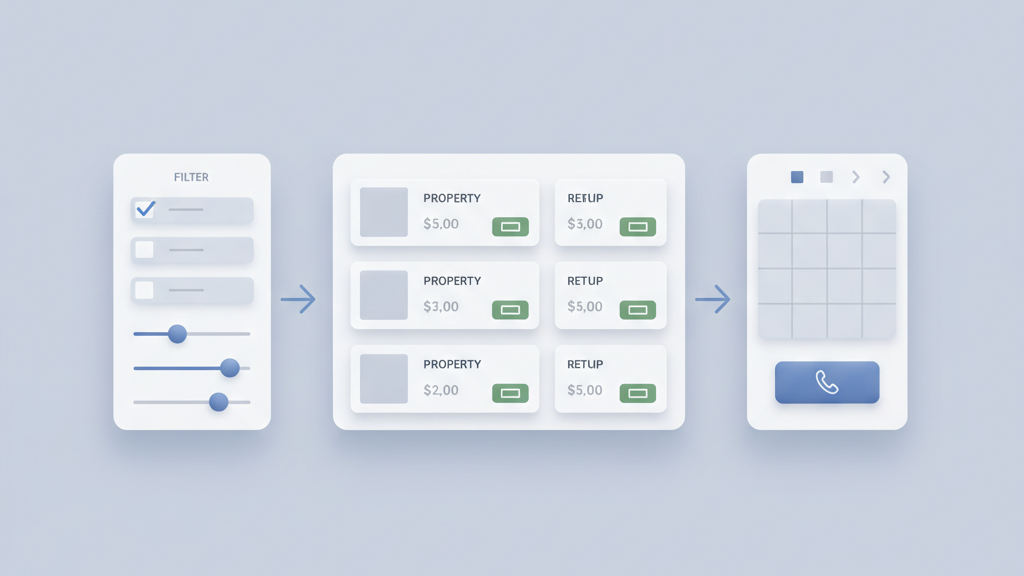
Keep the user flow tight and measurable. Start with a simple home search, result list, and detail view. Make filtering visible and reversible. Put primary actions like contact or schedule clearly on the detail screen. Use progressive disclosure so advanced filters do not overwhelm new users. Add onboarding cues for first time visitors to show how to refine results. Track event funnels for search to result click to contact. Those metrics will guide which parts of the UX need investment. In my experience a small set of well polished flows beats a large set of half built screens every time.
- Design a three step flow home search result detail
- Show filters prominently with clear reset
- Use progressive disclosure for advanced filters
- Place primary CTAs clearly on details
- Instrument funnels for every major action
Launch And Iteration Plan
Plan the launch around measurable hypotheses you can test quickly. Define success metrics for search relevance, time to contact, and conversion rate. Launch to a limited region to reduce data skew and to validate matching logic. Iterate by running A B tests for ranking tweaks and by surfacing new signals such as agent response time. Communicate a roadmap that highlights what will change based on user feedback. Many teams forget to budget for quick fixes after launch. Schedule time for at least three rapid cycles of improvements in the first quarter after launch, and be ready to roll back changes that hurt key metrics. Teams moving from strategy to execution can review MVP development for startups.
- Set clear success metrics before launch
- Start with a limited geographic pilot
- Run A B tests for ranking and filters
- Plan at least three rapid post launch cycles
- Be ready to roll back harmful changes