
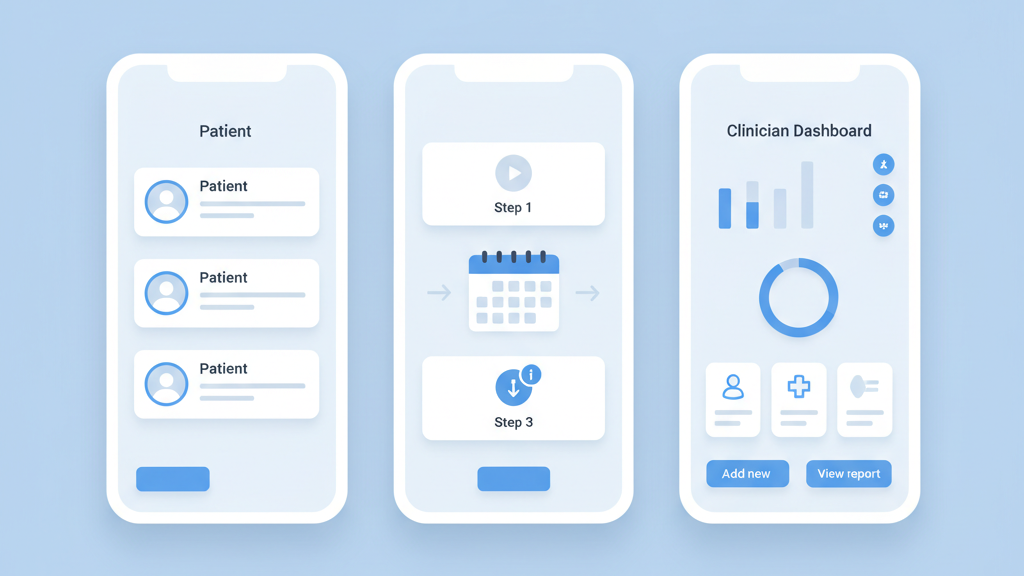
This guide helps USA founders pick and work with a FlutterFlow healthcare app MVP development agency. It covers discovery, compliance, design, and launch steps. Many startups miss uptime planning. Use this to avoid common traps and move faster.
Why Choose a Specialized Agency
Choosing a specialized partner matters when you build a clinical grade prototype. A team that knows low code tools and healthcare rules will move faster and avoid rework. They will understand privacy rules and basic interoperability expectations. They will also bring realistic timelines and trade offs that matter for founders. In my view boutique teams offer better alignment than generalist shops for early stage apps. Many founders assume a generalist can adapt quickly. That often costs time and creates technical debt. A focused agency will propose clear scope slices, testing plans, and a rollout path that fits pilot partners. Expect practical advice on device support, offline sync, and data retention. Good partners will push back on features that add risk without clear value. That is valuable. Plan for a short validation cycle with measurable metrics and a plan to iterate based on user feedback. If you need implementation support, explore Software maintenance and scaling.
- Look for healthcare experience
- Ask about live pilots
- Require data privacy practices
- Prefer small focused teams
- Demand clear scope slices
Defining MVP Scope That Matters
Defining an MVP is about isolating the smallest useful product that tests your core hypothesis. Start by mapping the user flow end to end. Then remove non critical screens and features. For a clinical workflow that might mean focusing on a single condition or a single clinician type. Keep authentication simple but secure. Plan integrations only when they unlock user value. Many startups try to include too many connectors and then fail to finish. A good agency will help you prioritize use cases and create measurable success criteria. They will create a roadmap that shows where complexity grows. You should see feature groupings that can be delivered in two to four sprints. Insist on demos each sprint and on data that proves users completed the intended task. That keeps teams honest and prevents scope creep. If you want a related deep dive, read Protecting Users Early On: best practices for securing early product user data.
- Map a single end to end flow
- Limit integrations early
- Define success metrics
- Split work into sprints
- Insist on live demos
Compliance and Security Basics
Healthcare apps must treat data with caution from day one. Even for pilots you should adopt secure patterns for authentication and data storage. Ask agencies about encryption in transit and at rest. Verify access controls and logging plans. A strong partner will show how to anonymize test datasets and run threat assessments. Do not assume a platform takes care of everything. The low code layer can help with speed but you still need policies and technical controls. Document how you will handle breach notifications and data deletion requests. Many teams overlook audit trails until a client asks for them. That creates painful rework. My advice is to build compliance into the MVP with minimal viable controls that meet regulator expectations and can scale with your product. For a practical follow-up, see How To Set Product Metrics And KPIs For Startups That Scale.
- Use encryption for data
- Plan access and audit logs
- Anonymize test data
- Prepare breach procedures
- Validate platform controls
Designing Clinical UX for Real Users
Design in healthcare must be clear and forgiving. Clinicians work under time pressure and patients may be stressed. Prioritize minimal cognitive load and clear affordances. Use large touch targets, clear feedback, and progressive disclosure to hide complexity until needed. Run quick usability sessions with a few real users early. That feedback beats assumptions and reveals hidden workflows. Designers who know clinical interfaces will ask about edge cases such as interrupted sessions and consent changes. They will plan for error states and safe defaults. Avoid design choices that look modern but reduce clarity. Many startups chase slick visuals and then lose usability. A good agency balances polish with practical workflows and includes accessible design for varied user abilities.
- Test with real clinicians
- Prioritize clarity over flash
- Design for interrupted sessions
- Use accessible layouts
- Plan error states
Technical Architecture and Integrations
Even with low code you need a clear architecture. Decide where business logic lives and how data flows between mobile, backend, and third party services. Keep a thin backend for orchestration if you plan integrations. That makes it easier to swap components later. Define APIs and use standard formats to lower integration risk. Plan for queuing and retry logic when network conditions break. Many pilot projects fail because they assume constant connectivity. Also think about observability and error reporting. A good agency will include monitoring and simple dashboards so you can see usage and failures. This reduces firefighting after launch. Keep the initial architecture modular and document your choices so handoffs to engineers are straightforward if you scale beyond the low code layer. Teams moving from strategy to execution can review Backend API development.
- Keep business logic modular
- Define API contracts
- Plan for offline and retries
- Add monitoring early
- Document architecture
Testing, Pilot Launch, and Metrics
Testing for a healthcare MVP must combine functional checks with real world pilots. Create test plans for critical flows and then run a small pilot with supervised users. Capture both quantitative metrics and qualitative feedback. Look for task completion rates, time on task, and error frequency. Also collect user stories about pain points and workarounds. Pilots reveal unexpected needs and risk areas. Many teams fail to instrument the app and then cannot measure impact. A reliable agency will include analytics and a plan for rolling updates. They will help you interpret pilot data and translate it into prioritized fixes. Use pilots to validate business assumptions and to create a repeatable onboarding playbook for future customers. A related guide worth reviewing is Building a Marketplace MVP: Why Startups Use FlutterFlow for Validation.
- Run supervised pilots
- Capture quantitative metrics
- Collect qualitative feedback
- Instrument key flows
- Use pilots to refine onboarding
Hiring and Working With Your Agency
Working with an external team takes active management. Set expectations on communication, decision timelines, and ownership. Ask for a single point of contact and weekly demos. Use short cycles with clear deliverables. Review code or design artifacts regularly and keep a running risk log. Consider a phased contract with options to extend based on milestones. This reduces wasted spend and keeps the team focused. My view is that founders should stay involved in prioritization and validation. Delegation helps but do not hand off product judgment. Many projects drift because founders stop making trade offs. A strong agency will help you stay pragmatic and will push back when a feature adds cost without value.
- Define communication cadence
- Use milestone based contracts
- Keep founders in prioritization
- Request weekly demos
- Maintain a risk log