
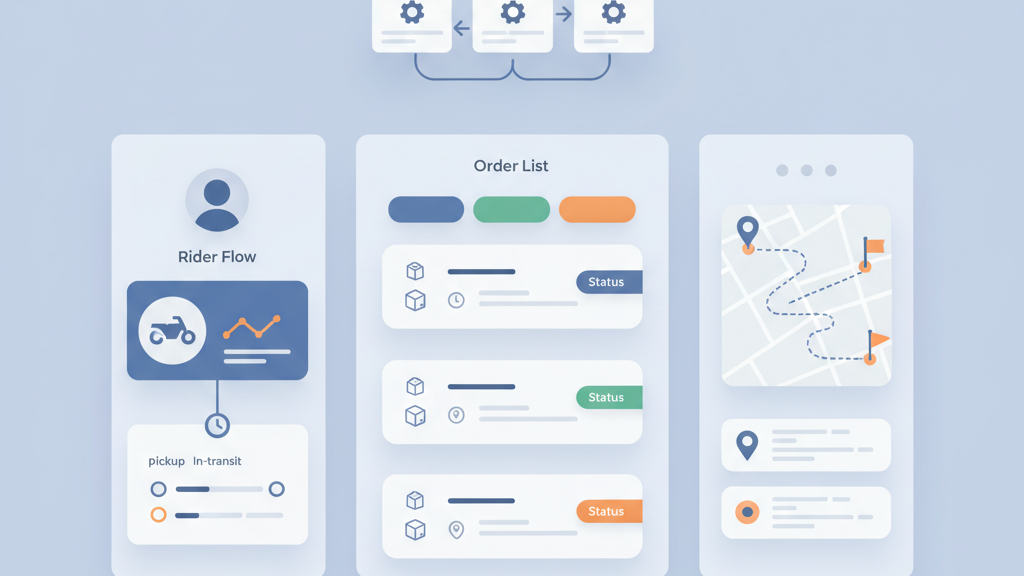
We built this guide for founders who need a fast path to test delivery ideas. The FlutterFlow on demand delivery app MVP build and validation service is a pragmatic route to pack core features into days rather than months. Many startups miss simple validation steps and waste months on polish. This piece shows what to focus on, where to save time, and how to set metrics that actually matter. If you want a related deep dive, read How To Ship Fast: FlutterFlow IoT app MVP development and integration service for startups.
Why a Focused MVP Beats Feature Lists
A focused MVP helps you learn faster. Founders often try to pack every idea into version one. That wastes time and blurs what customers really need. A delivery app needs only a few things to prove demand. You need ordering, basic tracking, payment options, and a way to match drivers. Everything else is noise. Use the MVP to test price sensitivity, delivery radius, and order cadence. Pick two metrics that decide if you keep building. Many teams fail by tracking vanity metrics. Track conversion and repeat orders instead. Keep the scope tight and use fast iterations. If you need implementation support, explore FlutterFlow development.
- Define two core metrics to validate
- Strip features to the essential flow
- Avoid spending on visual polish early
- Build only what proves demand
Map Your Core Delivery Workflows
Mapping workflows brings clarity to development and validation. Sketch the life of an order from checkout to drop off. Include edge cases like failed payments, missing addresses, and driver cancellations. These maps help you design testable hypotheses and keep engineers aligned. Focus on happy path first but list three likely failures and a recovery strategy for each. This reduces rework and prevents surprise technical debt. Use simple swimlanes for user, driver, and admin roles. That gives you a clear set of APIs and screens to build. Good maps also speed up usability testing and make it easier to explain the product to early testers and investors. Teams moving from strategy to execution can review MVP development for startups.
- Draw the happy path first
- Document three common failures
- Assign owner for each workflow
- Use maps to define APIs
Design a Practical UX in FlutterFlow
Design choices matter more than visual flair in an MVP. FlutterFlow helps you move from idea to clickable app quickly. Prioritize clarity and speed for screens that matter most. Use standard patterns for checkout and tracking so users do not learn new interactions. Keep controls large enough for quick taps and avoid deep navigation. Test flows with five to ten users to catch obvious pain points. Small usability wins raise conversion significantly. Also plan simple onboarding that explains the core value in one sentence. I recommend iterative wireframes and live prototypes to validate assumptions before investing in custom components. For a practical follow-up, see Validate Your Fintech Idea Faster With FlutterFlow.
- Use common UI patterns
- Prototype before finalizing screens
- Test with five to ten users
- Keep onboarding to one sentence
Build With Reusable Components
Reusable components cut development time and keep the codebase manageable. In a no code or low code tool, design components for orders, rider cards, and status badges that you can clone across screens. This approach saves time when you add a new feature or fix a bug. It also makes A B testing easier since you can swap components without rewriting flows. Keep each component small and focused. That reduces the chance of hidden coupling. Document props and expected data shapes so handoffs to engineers are clean if you move to custom code later. Reuse is not a buzzword here. It is a practical way to accelerate iterations and lower long term costs.
- Create small focused components
- Document expected data shapes
- Clone components across screens
- Plan for future custom code handoff
Integrate Payments and Maps Carefully
Payments and maps are core to delivery apps but they add complexity. Use established providers and test them early. Payment setup can block launches if you leave it to the end. Map and routing decisions affect delivery cost and time. Start with a single payment provider and one map service to reduce integration work. Implement a simple fallback for failed payments. For maps, use basic routing that gives ETA and distance estimates. Validate the accuracy in the launch area and adjust parameters rather than chasing perfect precision. Many startups over engineer routing logic at first and regret the extra time. Keep it simple and measurable.
- Pick one payment provider
- Test maps in your launch area
- Implement payment fallbacks
- Measure ETA accuracy early
Test and Validate Fast With Real Users
Validation needs actual orders and repeat usage. Soft launches give you real signals without massive spend. Recruit early users from local communities and incentivize feedback. Use simple surveys and short interviews after the first two orders. Track time to complete an order and where users drop off. Run experiments on price and delivery windows to see what affects conversion. Don’t wait for perfect polish to start testing. A functional product with known issues gives more value than a refined demo that never reaches customers. Practical warning many startups delay testing and miss the chance to pivot early.
- Run a soft launch in a small area
- Collect qualitative feedback after orders
- Measure conversion and repeat rate
- Experiment on price and time slots
Use Metrics That Guide Decisions
Choose metrics that tell you what to do next. Conversion from browse to order is a direct sign of product market fit. Repeat order rate shows whether customers like the service. Customer acquisition cost and margin per order tell you if the business is viable. Track driver wait times and on time deliveries to assess operational quality. Avoid vanity metrics that feel good but do not change decisions. Set weekly targets and act on deviations quickly. If a metric moves in the wrong direction run a short experiment to find a fix. I think clear metrics and fast experiments make the difference between an idea that dies and one that scales.
- Prioritize conversion and repeat rate
- Track acquisition cost per order
- Monitor driver wait and on time stats
- Run short experiments on bad trends
Plan The Roadmap After Early Validation
After you validate core demand you need a sensible roadmap. Use early signals to prioritize features that increase retention or reduce cost. Common next steps include delivery fleet management, dynamic pricing, and deeper restaurant integrations. Decide which features are strategic and which are nice to have. Keep roadmap items small and measurable. Allocate a small budget for platform reliability and invest in analytics that help you scale operations. Also plan how to evolve from a no code solution to custom code if needed. Many teams underestimate the cost of migrating later. A clear staged plan keeps engineering focused and investors reassured. A related guide worth reviewing is How To Budget An MVP For Early Teams (enterprise app MVP pricing for small businesses USA).
- Prioritize retention and cost reduction
- Break features into measurable milestones
- Budget for reliability and analytics
- Plan migration from no code to custom code