
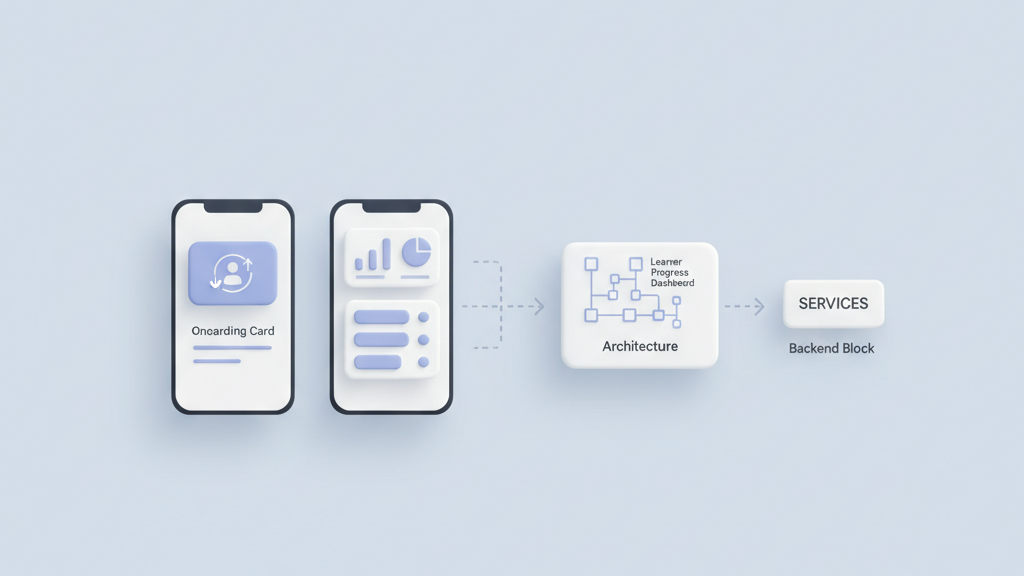
This guide walks startup founders and US product managers through a pragmatic roadmap for building an eduTech MVP with FlutterFlow eduTech app MVP product strategy for US product managers at the center. It focuses on speed, learner outcomes, and measurable validation in real classrooms. You will see how to scope features, pick simple integrations, and run tests that matter. The aim is not to build a finished product on day one. The aim is to learn fast and keep costs low while proving product market fit. Many startups miss this and end up building features no one uses. Expect clear trade offs, practical warnings, and a bias toward shipping rather than polishing forever. If you want a related deep dive, read How To Validate Market Fit FlutterFlow travel booking app MVP product strategy and validation service.
Start With A Narrow Learner Problem
Begin by naming a single learner pain point you can solve in one to three weeks. Pick a specific audience and a clear outcome. For example focus on middle school math practice or onboarding for adult upskilling. Keep the scope narrow so you can build a testable feature set in FlutterFlow. Sketch the user flow and high level acceptance criteria. Talk to at least five potential users and one educator before writing a single screen. That will avoid building for assumptions. Practical warning many teams skip rapid user calls and end up iterating on the wrong thing. A focused problem lets you measure success with simple metrics and move to the next experiment quickly.
- Choose one clear learner outcome
- Define measurable acceptance criteria
- Interview a small group of users early
- Limit features to testable hypotheses
- Create a one page user flow
Define MVP Scope And Core Journeys
Translate your learner problem into three to five core journeys that users will take. Core journeys are onboarding, content discovery, content consumption, and progress tracking. For each journey map the key screens and data needs. Prioritize flows that produce signals you can measure like completion rates or repeat visits. Avoid building customization engines or admin consoles in the first iteration. Those can come later when you have real users. Use the maps to estimate effort in FlutterFlow and to spot data points you need from the backend. Keep the scope tight and assign a single owner to each journey to speed decision making and reduce rework.
- Map three to five core journeys
- Prioritize measurable user actions
- Estimate effort per flow in FlutterFlow
- Defer advanced customization
- Assign journey ownership
Design Fast With FlutterFlow
Use FlutterFlow to turn your maps into interactive prototypes quickly. Start with basic UI patterns and reuse components across screens. Focus on flows that prove learning value rather than pixel perfect visuals. Leverage FlutterFlow features like visual layout, bindings, and Firebase integration to reduce code work. Keep state management simple and avoid complex custom code until you validate the core experience. Run internal usability tests and iterate on flow speed and clarity. Exporting code is an option for later but do not make it a blocker. The goal is to validate assumptions about learner behavior and to collect real usage data before investing in custom engineering. If you need implementation support, explore FlutterFlow development.
- Prototype core flows first
- Reuse components across screens
- Use Firebase for quick backend
- Keep state management simple
- Test flows before coding
Choose A Simple Backend And Data Flow
Pick a backend that lets you move fast and scale later. Firebase Firestore works well for many eduTech MVPs because it integrates with FlutterFlow and handles auth and real time data. Define a minimal data model that captures user profiles, content units, progress events, and basic analytics. Plan integration points for third party content or assessment engines with simple REST APIs. Avoid building a heavy custom backend unless a critical requirement forces it. Keep data contracts small and version them. Plan for exportable data so you can analyze results with spreadsheets or business intelligence tools as you learn from pilot users. Teams moving from strategy to execution can review Backend API development.
- Use Firebase Firestore for speed
- Keep the data model minimal
- Plan simple API integrations
- Version data contracts
- Enable exportable analytics
Validate With Real US Educators And Students
Run short pilots with real classrooms or learning cohorts in the US to validate your hypotheses. Set clear goals for each pilot such as improving engagement or completion by a target percentage. Provide a quick onboarding for teachers and a support channel for students. Collect qualitative feedback through short surveys and structured interviews and collect quantitative signals like session length and completion rate. Be prepared to iterate on content cadence and question difficulty. Practical warning pilots can reveal mismatches between assumed and real learner behavior so treat feedback as data not criticism. Use pilot outcomes to decide whether to expand scope or pivot.
- Run time boxed pilots
- Define pilot success metrics
- Provide simple teacher onboarding
- Collect qualitative and quantitative data
- Treat feedback as learning signals
Measure What Matters And Plan Growth
Define a tight set of metrics that tell you if the product is delivering learning value and if users are retaining the product. Core metrics include activation rate, lesson completion, weekly active users, and retention after the first week. Tie these metrics to experiments you can run in FlutterFlow like changing onboarding copy or content order. Map how improvements in these metrics will influence revenue or conversion if you plan monetization. Set up lightweight dashboards and automate exports from your backend. Mild opinion focus on retention and learning signals over vanity metrics. Those metrics show if the product actually helps learners. For a practical follow-up, see How To Set Product Metrics And KPIs For Startups That Scale.
- Track activation and retention
- Measure lesson completion rates
- Run experiments tied to key metrics
- Automate dashboard exports
- Prioritize learning signals
Common Pitfalls And Practical Fixes
Expect friction in three areas design assumptions backend scale and stakeholder alignment. Design assumptions fail when prototypes do not match classroom practice so test early with teachers. Backend scale becomes a problem when you assume rapid growth instead of validating slow traction first. Stakeholder misalignment happens when founders and product managers have different success criteria. Fixes are straightforward run early teacher trials, design for graceful degradation under load, and document success criteria for each milestone. Many teams mistakenly add features to please investors instead of users. Mild opinion focus on measurable user outcomes not feature checklists. These fixes help you reach product market fit faster. A related guide worth reviewing is Uncovering the Untold Tactics: Navigating MVP Iteration for Product-Market Fit.
- Test designs with teachers early
- Plan for graceful degradation
- Document milestone criteria
- Avoid feature bloat to impress investors
- Prioritize measurable outcomes