
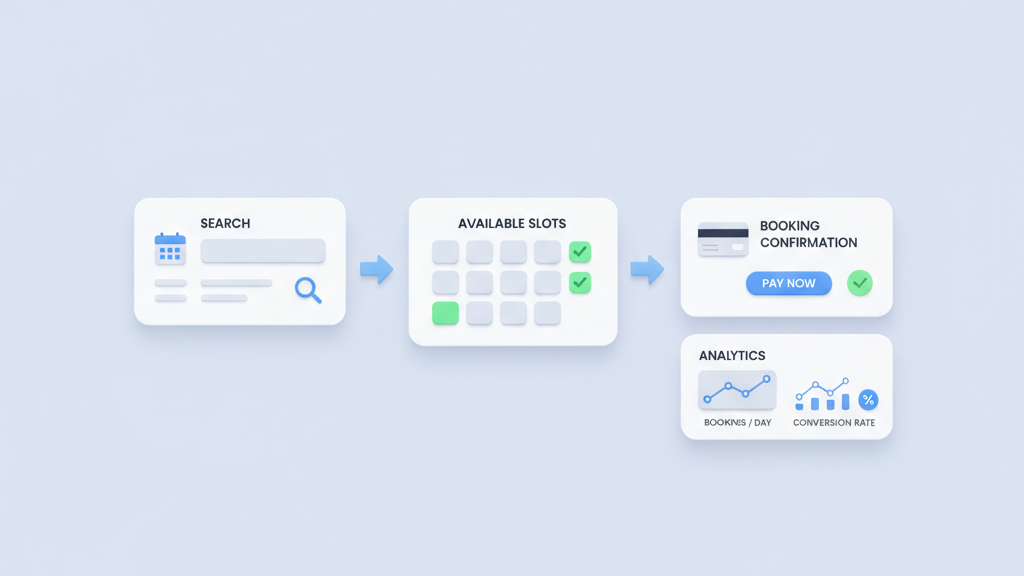
This guide walks startup founders through booking platform MVP minimum features for launch and why each item matters. It focuses on the smallest set of features that still delivers value and validates demand. You will get a pragmatic checklist, implementation notes, and common trade offs. Many teams try to ship too many features and then learn too late. This piece helps you avoid that trap by focusing on user flows, payment basics, and data needed to measure product market fit. It is written for founders and product managers who need to decide what to build first and what to defer. If you want a related deep dive, read Uncovering the Untold Tactics: Navigating MVP Iteration for Product-Market Fit.
Focus On One Clear Use Case
Start by choosing one core booking use case and stick to it. If you try to support all scenarios you will slow development and dilute learning. Define the exact customer and the specific reason they book. Then map the simplest end to end flow from discovery to confirmation and follow up. Keep the interface plain and limit options that cause decision paralysis. Many startups miss this and then build features nobody uses. A narrow focus helps you ship faster and gather clear signals about demand. Use quick prototypes with real users to validate assumptions before you invest in integrations. The goal is not a perfect system but a reliable loop that can be improved after you learn from real bookings.
- Pick one customer segment
- Map a single end to end flow
- Avoid optional configurations
- Validate with prototypes
- Measure real bookings
Design A Tight Booking Flow
A smooth booking flow is the heart of a lean platform. Prioritize search or discovery, availability display, selection, confirmation, and a simple receipt. Each step should have minimal fields and clear failure states. Offer a guest booking option to reduce friction and require account creation only when it unlocks value. Show available slots in a simple list or calendar and make the next action obvious. Keep form fields to the essentials and validate inputs early to avoid wasted submissions. Add email confirmations and a basic cancellation path. Many founders underestimate the cost of a confusing flow so test with five real users before launch. Usability wins are often the fastest way to raise conversion without adding heavy features. If you need implementation support, explore MVP development for startups.
- Limit fields to essentials
- Support guest checkout
- Show clear availability
- Provide instant confirmation
- Test with real users
Build Minimal Backend And API Contracts
A reliable backend is key but it does not need to be complex at first. Implement simple APIs for listings, availability, bookings, and receipts. Keep data models small and consistent and document the contracts clearly. Design idempotent booking endpoints to avoid duplicate reservations from retries. Use a single source of truth for availability and avoid eventual consistency traps in the first release. Pick a database and queue approach that you know well and that supports atomic operations for seat or slot reductions. Mock external integrations during early testing to isolate issues. Many teams over engineer here so start with the smallest architecture that keeps bookings correct and observable.
- Create clear API contracts
- Use idempotent booking endpoints
- Keep data models small
- Avoid eventual consistency for availability
- Mock external services early
Integrate Payments And Basic Fraud Controls
Payments are essential for most booking platforms but you can keep the initial setup simple. Start with a single trusted payments provider and support the common card flows. Capture only the data you need and comply with basic payment rules. Implement immediate charge on booking or authorization depending on your cancellation policy. Add simple fraud checks like velocity limits and email or phone verification when risk is higher. Record payment and refund events in a durable ledger for reconciliation. Many startups delay payments to avoid complexity but that often prevents real validation of willingness to pay. A single provider and simple policies are usually enough to get valid signals from early customers.
- Use one payments provider
- Decide charge versus authorization
- Log payment events
- Add basic fraud limits
- Keep compliance simple
Ship A Practical Admin Dashboard
Founders need a lightweight admin console to manage listings and handle customer issues. Build a dashboard that shows live bookings, cancellations, and pending payments. Include tools to edit availability and to issue manual refunds. Make search and filters usable so support teams can find records quickly. Provide CSV export for basic accounting needs. Keep the admin UI functional rather than pretty and focus on the workflows your team will use in the first three months. Many teams overlook admin needs and then waste hours on manual fixes. A small set of reliable admin actions will reduce support overhead and improve trust with early customers.
- Show live booking list
- Allow availability edits
- Support manual refunds
- Include CSV export
- Build useful search
Prioritize Mobile First And Usability
Most users will book from a phone so design mobile first and keep interactions simple. Use large tappable targets and avoid dense menus. Optimize load speed by deferring non critical assets and caching static content. Keep forms short and use native pickers for date and time where possible. Test on several devices and network conditions to catch real issues. Accessibility basics help too and often improve conversion for everyone. Many founders treat mobile as an afterthought and then see lower conversion rates. A focused mobile experience will often outperform a feature rich desktop version in the early days. Teams moving from strategy to execution can review Mobile app development.
- Design for mobile first
- Use native date pickers
- Defer non critical assets
- Test on slow networks
- Keep forms short
Measure Launch Metrics And Validation Signals
Before you build more features decide what success looks like and instrument for it. Track conversion from discovery to booking, drop off at each step, payment success rates, and churn in the first 30 days. Capture simple qualitative feedback at key moments to understand why people cancel or convert. Use analytics to guide decisions and not to justify inertia. Set clear thresholds that will trigger further investment or pivot. Many startups collect lots of data but fail to pick actionable metrics. Focus on a few core indicators and make them visible to the whole team. This lean approach helps you prioritize the next features that will actually move the needle. For a practical follow-up, see How To Set Product Metrics And KPIs For Startups That Scale.
- Track conversion rates
- Measure drop off by step
- Record payment success
- Collect qualitative feedback
- Set clear decision thresholds
Plan A Scalable Roadmap After Launch
After you validate the core flow create a roadmap that sequences improvements by impact. Prioritize items that reduce support cost, increase conversion, or open higher value segments. Consider integrations next like calendar sync, richer payments, or provider onboarding tools. Design the system so you can add concurrency and more complex pricing without a rewrite. Keep technical debt visible and schedule time to address it once you have steady revenue. Many teams either try to scale too fast or never evolve beyond the MVP. A pragmatic roadmap helps you grow with control and keeps the product aligned with customer feedback. A related guide worth reviewing is B2B Onboarding Software MVP Product Market Fit Steps That Actually Work.
- Prioritize impact driven features
- Address technical debt early
- Sequence integrations logically
- Plan for concurrency increases
- Align roadmap with feedback