
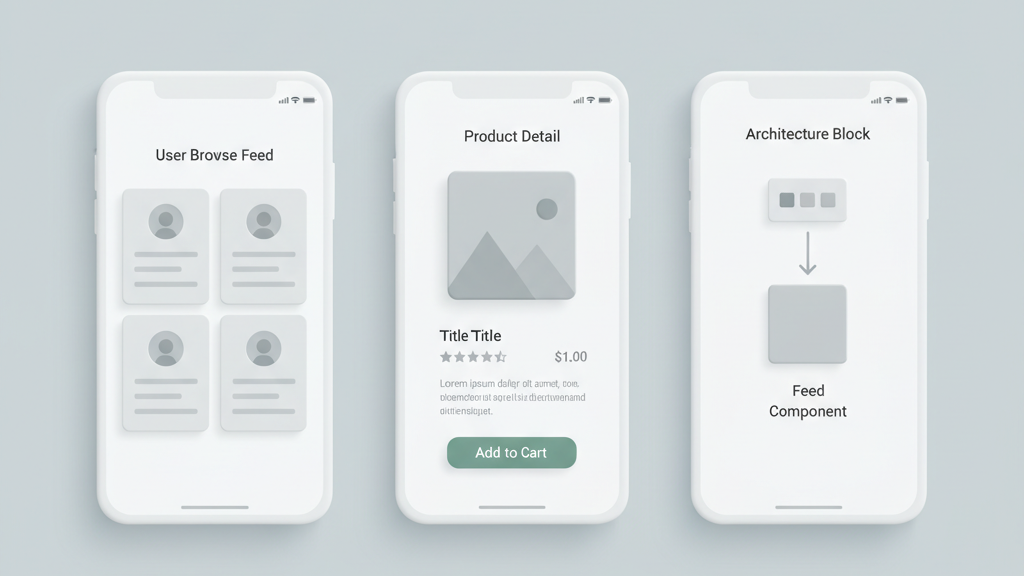
This post shows how to validate a marketplace idea fast using FlutterFlow marketplace app MVP validation and go to market strategy. It covers lean hypotheses, prototype testing, early metrics, and a repeatable plan for launch. Many startups miss clear validation steps. The goal is to help founders and product managers avoid long development cycles by testing the riskiest assumptions first.
Frame The Core Hypothesis
Start with one clear hypothesis about the marketplace that you can test with a minimal build. Define the value exchange between buyers and sellers and pick the smallest feature set that proves that match making works. Many founders try to validate too much at once. Focus on one primary metric that shows real demand. That metric could be successful intents to transact, time to match, or willingness to pay. Sketch the user flows on paper or in a simple wireframe and note the assumptions that must be true for the product to work. This makes it easier to design experiments that isolate individual risks and to limit scope when you build in FlutterFlow or another rapid prototyping tool.
- Pick one measurable hypothesis
- Limit features to match making
- Sketch flows before building
- List the key assumptions
Choose The Right MVP Approach
Decide whether to build a clickable prototype, a no code MVP, or a hybrid proof of concept. FlutterFlow is great for mobile interfaces and can deliver a working marketplace flow quickly. Use no code to validate demand and user behavior before investing in custom backend work. Many teams skip this step and waste time building features no one uses. For an initial run focus on onboarding, listing creation, search, and a mock booking or purchase path. Track how users move through these screens and where they drop off. Prioritize features that improve conversion and reduce friction and leave advanced features for later.
- Use FlutterFlow for rapid mobile builds
- Start with core listing and discovery
- Avoid full backend at first
- Measure conversion by step
Design Experiments And Metrics
Design experiments that map directly to your hypothesis and define success criteria upfront. Choose a primary metric and two supporting metrics that show healthy growth. For example use completed matches as primary metric and onboarding completion plus repeat visits as supports. Instrument your FlutterFlow prototype with simple analytics or manual tracking to capture these metrics. Run qualitative sessions to understand user intent and pain points. A small sample of engaged users often reveals bigger issues than large but shallow tests. Use A B tests sparingly and only after you have baseline data. Practical warning many startups misread vanity metrics and think they validated demand when the result was noise.
- Pick one primary metric
- Add two supporting metrics
- Use qualitative tests early
- Avoid vanity metrics
Build Fast And Iterate
Ship the smallest version that can produce your primary metric and get it in front of users quickly. Use FlutterFlow to iterate on UI patterns and flows without heavy engineering overhead. Keep builds small and release often so you can learn from behavior. Gather session recordings, heat maps, and direct feedback to decide what to fix next. Iterate on conversion blockers first and then on retention levers. Many founders keep building features that do not move the needle. Set a cadence for experiments and commit to quick pivots based on results. That discipline reduces wasted effort and shortens time to product market fit.
- Release small frequent builds
- Fix conversion issues first
- Use recordings and feedback
- Pivot quickly on data
Prepare For Early Go To Market Tests
Plan low cost acquisition experiments that match your target customer profile. Try community channels, niche ads, and partnerships to find early supply and demand. Use landing pages and targeted messaging to test willingness to engage and to capture leads. For marketplaces test supply side economics early by recruiting a few reliable providers or sellers and offering incentives to be early users. Document operating workflows that support the MVP such as manual curation or dispute handling. These workflows can be automated later but are crucial during early validation. Practical warning do not assume that early channel success will scale without cost analysis and conversion tracking.
- Run niche acquisition tests
- Recruit early supply manually
- Use landing pages for messaging
- Document manual workflows
Measure Unit Economics And Retention
Once you have engagement run simple unit economics to validate the business model. Calculate acquisition cost per user, gross margin per transaction, and expected lifetime value from early retention curves. Use cohorts to spot whether retention is improving with product changes. If the economics look weak consider raising prices, lowering acquisition costs, or increasing transaction frequency. Many founders ignore unit economics until after scale and then face hard choices. Early focus on retention and frequency will tell you if the product has sustainable demand. Use these insights to decide whether to invest in scaling or to iterate further on the core experience.
- Compute basic unit economics
- Track cohorts for retention
- Adjust price or acquisition as needed
- Test frequency improvements
Scale The Product And Launch Plan
With validated demand and acceptable unit economics plan a phased launch that scales supply and demand together. Migrate critical backend services from no code to more robust systems only when needed. Prepare a go to market plan that sequences channels by cost and conversion. Invest in onboarding and support processes that keep early users happy. Set measurable milestones for scale and automate manual operations in stages. Keep your roadmap focused on reducing friction for the core transaction. A clear plan that ties product work to acquisition and retention metrics prevents misaligned teams and wasted feature development.
- Sequence channel scaling
- Migrate backend by need
- Automate operations gradually
- Tie roadmap to metrics