
Many founders dive straight into building without validating their assumptions. This approach leads to waste. Market research driven app MVP development for founders is about gathering data before writing a single line of code. We focus on solving real problems for real users. This guide explains how to turn raw data into a functional product that people actually want to buy. Success in the software world is rarely about the best code. It is about the best understanding of the customer.
The Foundation of Product Validation
Startup failure often traces back to one root cause. Founders build products that nobody wants to buy. It sounds simple. Yet, many smart people fall into this trap every year. Market research driven app MVP development for founders helps mitigate this risk by providing a clear map of user needs. This process starts with identifying a real pain point that users are willing to pay to solve. It is not about your personal intuition. It is about objective data collected from potential customers. Many startups miss this and focus on building features they think are cool. This usually results in a bloated product that fails to gain traction. We believe that a successful MVP is a learning tool. It is not the final version of your software. You must approach the early stages with a willingness to be proven wrong. If your research shows that users do not care about your main idea, that is a victory. You saved yourself months of work and thousands of dollars. Use this initial phase to narrow your scope. Focus only on the essential problems. This disciplined approach is what separates successful tech founders from those who burn through their seed funding without finding a market fit. You are not just building an app. You are building a business case. Every data point you collect serves as evidence for future investors and partners. Without this evidence, you are just guessing in a very expensive way.
Key Research Methods for Early Stage Startups
Effective research requires a mix of qualitative and quantitative data. You should start with user interviews. These conversations provide deep insights into the emotional drivers behind a purchase. You can hear the frustration in a users voice when they talk about current solutions. Many founders make the mistake of asking leading questions. They want to hear that their idea is great. You must resist this urge. Ask about their past behavior instead. Surveys are also useful for gathering data from a larger group. They help you validate if the problems you heard about in interviews are common across the wider market. Another critical step is competitor analysis. You need to know what else is available to your users. Do not just look at direct competitors. Look at how people solve the problem manually today. Sometimes a simple spreadsheet is your biggest rival. We recommend using a structured approach to document every finding. This data will form the backbone of your product requirements document. Many founders skip the documentation phase because they think they can keep it all in their heads. This is a mistake. Written data allows you to share your vision clearly with developers and designers. It ensures everyone is working toward the same goal. A well researched plan makes the actual development process much smoother and faster. You will spend less time debating features and more time building value:
- Conduct at least fifteen one on one user interviews
- Analyze existing manual solutions to find gaps in functionality
- Run targeted surveys to measure the size of the total market
- Create detailed user personas based on actual feedback
- Map the current user journey to identify primary friction points
Defining Your Minimum Viable Features
Once you have your data, the next step in market research driven app MVP development for founders is defining the feature set. This is where most people struggle. There is always a temptation to add just one more thing. You must be ruthless here. A true MVP should only contain the features that solve the core problem you identified. If you try to do everything at once, you will end up doing nothing well. Your research should tell you exactly which features are mandatory. Everything else belongs in a backlog for later versions. Think about the simplest way to deliver value. If your app is a delivery service, the core value is getting an item from point A to point B. It does not need a social feed or a loyalty program on day one. It just needs a way to order and a way to track. Focusing on this narrow scope allows you to launch faster. Speed is your biggest advantage as a startup. The sooner you launch, the sooner you get real world data. This data is far more valuable than any hypothetical research. You are building a foundation that you can expand over time. Do not let feature creep kill your momentum before you even reach the app store. We often tell our clients that if they are not a little embarrassed by their first version, they probably launched too late. This is a common sentiment in the tech world for a reason. It keeps you focused on what matters most to the user right now.
Common Research Traps to Avoid
There are several traps that can ruin your research efforts if you are not careful. One of the most common is the confirmation bias trap. This happens when you only look for data that supports your original vision. You ignore the red flags and the users who tell you they would not use the product. It is a dangerous way to work. Another issue is targeting the wrong audience. If you interview your friends and family, they will probably tell you your idea is amazing. They want to be supportive. This feedback is useless for building a business. You need to find people who have the problem you are trying to solve. They should be strangers who have no reason to be nice to you. Their honesty will be your best asset. We also see many founders skip the step of asking about budget. It does not matter if people like your app if they are not willing to pay for it. You must understand the economic value of the solution you are providing. If the problem is not painful enough for a user to open their wallet, you might need to rethink your approach. Avoid these common mistakes to keep your project on track:
- Avoid asking friends and family for product feedback
- Watch out for participants who give only positive answers
- Do not ignore negative data points or user frustrations
- Stop focusing on demographics alone and look at behaviors
- Never assume that a problem exists without talking to users
- Be wary of users who say they might use it in the future
Turning Research into a Functional Roadmap
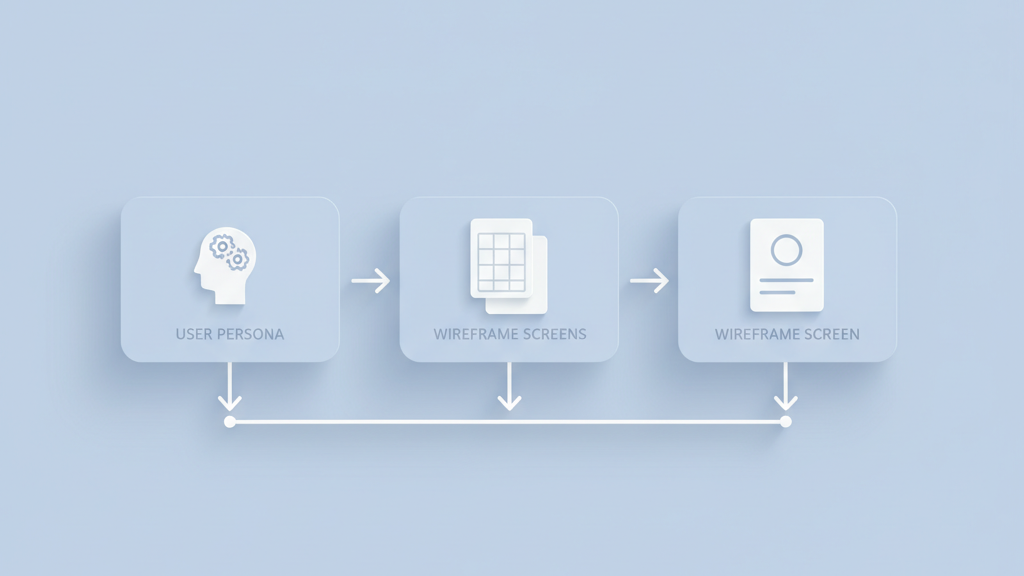
The final stage of this process is translating your research into a functional design and roadmap. This is where the work of Indent Technologies begins. We take the insights you gathered and turn them into a user interface that feels intuitive. A good design should reflect the priorities of your users. If your research showed that speed is the most important factor, the UI should be minimal and fast. If the users are older and less tech savvy, the layout needs to be clear and simple. We use wireframes to test these concepts before any code is written. This allows us to make changes quickly and cheaply. It is much easier to move a button on a design file than it is to change a database structure later. This transition from research to development is a critical moment. It requires a tight feedback loop between the founders and the engineering team. We ensure that every button and every screen serves a purpose defined by your market research driven app MVP development for founders strategy. By the time we start the actual build, we have a high level of confidence in the product. This confidence allows us to move fast and deliver a product that is ready for the real market. You will have a clear understanding of your users and a product that is designed to meet their specific needs. This sets you up for long term growth and success in a competitive landscape.