
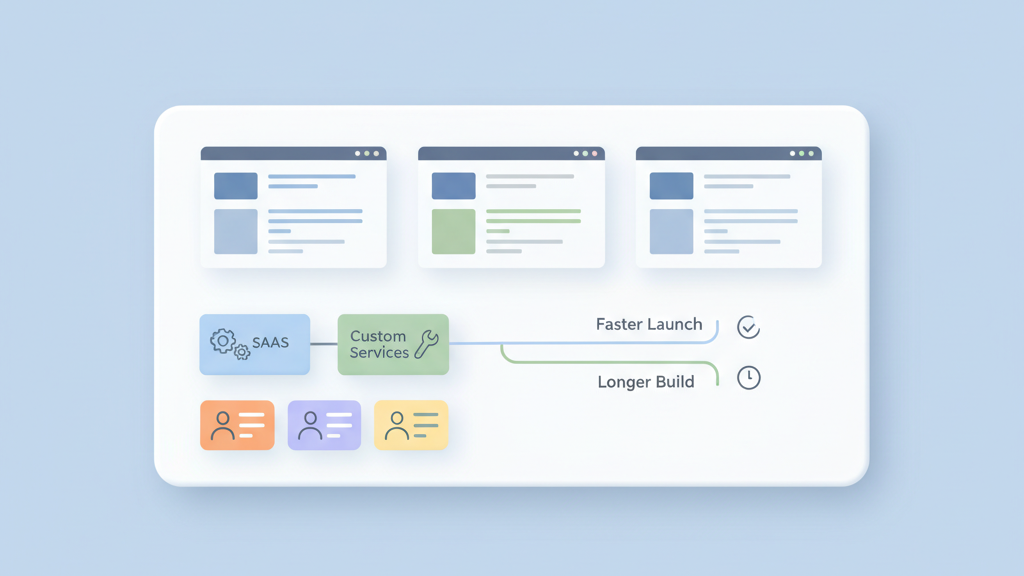
Choosing between SaaS MVP vs custom software MVP for founders is one of the first hard choices for a new product. This guide lays out trade offs in time, cost, control, and validation. Many startups confuse speed with product quality. I think pragmatic validation beats perfect architecture early on. Expect a few practical warnings along the way. This is for founders and product managers who need a decision framework, not a vendor pitch. Read on for a structured way to weigh options, test assumptions, and pick the path that matches your market and constraints. If you want a related deep dive, read Building an Analytics Dashboard Software MVP for Product Managers: A Practical Guide.
When To Choose Each Path
Founders should start by matching outcome to choice. If you need to test demand quickly and you can accept common features, a SaaS MVP is usually faster. If your idea needs deep workflow changes, proprietary integrations, or unique performance, custom work may be the only option. Consider customer expectations and regulatory needs. Many startups miss compliance and then pay later. Think about channels and selling motion too. Enterprise sales can demand custom connectors and security reviews. Consumer or SMB marketplaces often accept off the shelf solutions at first. Also weigh your runway and hiring risk. Custom builds can extend timelines and burn cash. A clear hypothesis and measurable metrics help avoid expensive detours. If you need implementation support, explore Web app development.
- Match speed to market need
- Check regulatory and security demands
- Assess required integrations
- Consider sales motion and customer size
Cost And Time Trade Offs
Budget and timeline shape many decisions. A SaaS MVP typically reduces initial build cost and shortens time to first users. You can reuse existing building blocks and avoid heavy hiring. Custom software often needs design, architecture, and engineering that add weeks or months. That can be fine if your business model needs unique logic or if pricing supports longer development. Hidden costs matter. Many founders forget ongoing maintenance, third party fees, and technical debt. Also plan for iteration. The fastest launch can be the cheapest way to learn. But be honest about future scale. Rushing a prototype without an upgrade path creates expensive refactors later. For a practical follow-up, see Micro SaaS Software MVP For Niche Productivity Tools That Work.
- Estimate total cost not just initial build
- Plan for maintenance and upgrades
- Use fast launch to validate demand
- Avoid building unrecoverable technical debt
Technical Control And Scalability
Control over the stack is the main strength of custom builds. If you need specific databases, unique APIs, or specialized security, custom work gives that power. A SaaS approach trades some control for managed services and faster updates. That is not always bad. Many startups scale fine on standard platforms for years. But if you expect high concurrency, strict latency, or heavy data processing, plan for a custom path from the start. Also think about portability. Vendor lock in can limit future options. A pragmatic pattern is to start with composable SaaS parts and swap to custom components selectively as load or complexity grows.
- List non negotiable technical requirements
- Design for portability if locking is risky
- Monitor performance needs early
- Migrate components when justified by metrics
User Experience And Differentiation
Product differentiation usually lives in the user experience. A custom MVP lets you craft unique flows and micro interactions that matter to customers. SaaS templates can feel generic, but they speed up feedback cycles. If your advantage is a novel UI or workflow, custom design might be essential. If your edge is pricing, distribution, or convenience, a standard SaaS layout can support testing those assumptions quickly. Pay attention to onboarding and retention metrics. Many founders underestimate how a small friction point kills activation. Build the simplest thing that proves your unique value and measure whether users prefer it. Teams moving from strategy to execution can review Mobile app development.
- Prioritize onboarding and activation
- Test core interactions with real users
- Keep design focused on one differentiator
- Use metrics to guide further polish
Risk Management And Validation
Risk reduction should be the main goal of an MVP. Use experiments that minimize time and cash before you commit. A SaaS MVP fits lean validation because you can reuse services and adjust features fast. Custom builds can validate deeper technical hypotheses that off the shelf tools cannot. Split your risks and run parallel experiments when possible. Many founders forget to validate pricing and sales motion early. Customer interviews and selling trials reveal demand faster than polished features. Keep exits in mind. If you aim for acquisition, ensure your architecture and IP strategy line up with buyer expectations. A related guide worth reviewing is Steps to Create a Lean Prototype for Startups That Validate Fast.
- Design experiments to minimize cost per learning
- Validate pricing and sales motion early
- Split technical and market risks
- Record customer feedback systematically
Hiring And Vendor Choices
Your team and vendor mix determines feasible options. If you lack senior engineers, SaaS and low code options reduce hiring pressure. If you have domain experts and a strong tech lead, custom work becomes more viable. Choose vendors for transparency and speed. Avoid long fixed contracts that limit pivots. Many startups get locked into a freelance hour bank only to find deliverables do not match needs. Prefer short milestones and real demos. Also set clear ownership of code and IP. A cautionary note is to check references and sample work before committing. Hiring is often the slowest part of scaling the product.
- Prefer short vendor milestones
- Hire for outcome oriented skills
- Require code and IP ownership clarity
- Use trials to test vendor fit