
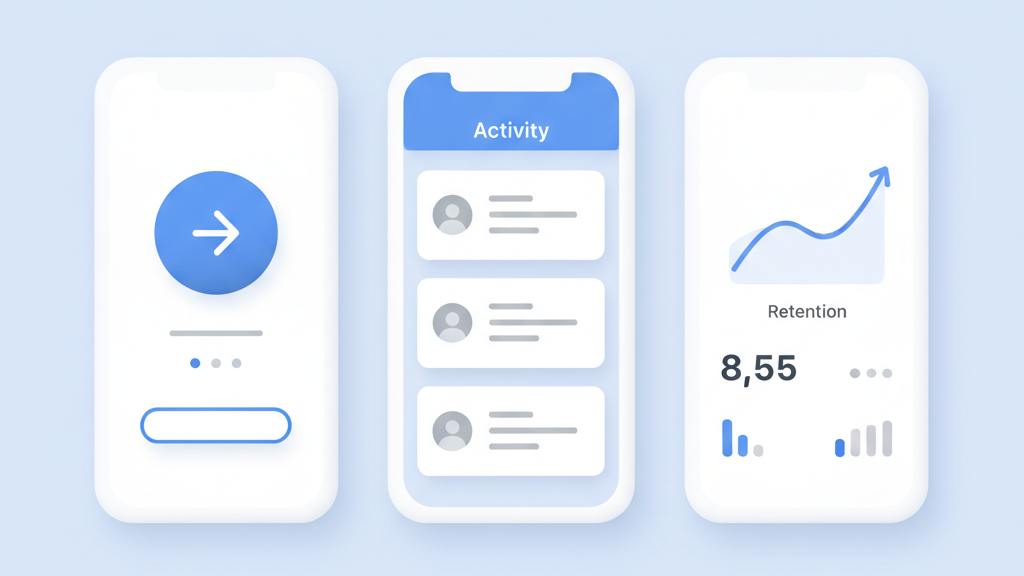
Launching a social networking app is easy. Building a social networking app MVP focused on user retention is the hard part. This guide strips out fluff and shows pragmatic choices that matter for early traction. We cover product decisions, essential metrics, onboarding flows, and retention patterns that matter in the first 90 days. You will learn where to spend limited engineering time and which experiments move the needle. Many startups miss the simple gains that come from designing for repeat visits. If you are a founder or product manager you will find checklists, trade offs, and sample analytics to try quickly. Expect to leave with a clear plan for your next sprint and a list of hypotheses to test for lasting engagement. If you want a related deep dive, read Designing a Subscription Based SaaS App MVP for B2B Onboarding.
Define Core Value And Early User Jobs
Retention begins with clarity on what users return for. Start by defining the core value in one sentence and list the early user jobs that deliver that value. Avoid packing many features into the MVP. Focus on the smallest loop that creates a habit. Create a hypothesis for why a user would come back the next day and the next week. Use interviews and quick tests to validate those assumptions. Many founders mistake features for value. A narrow, well tested loop wins over a broad but shallow feature set. Build the minimal experience that lets you observe real user behavior and iterate fast based on signals not opinions. For a practical follow-up, see Steps to Create a Lean Prototype for Startups That Validate Fast.
- Write a single sentence value statement
- List one to three user jobs to solve first
- Avoid multi feature MVPs
- Validate with interviews and simple prototypes
Design Onboarding For Quick Aha Moments
Aha moments must arrive within minutes. Design an onboarding that helps new users reach meaningful activity fast. Remove friction points like long forms and deep setup. Use progressive disclosure to reveal features after the first success. Guide users to complete one action that is core to your product and that can be repeated. Track completion of that action as a primary onboarding metric. Many teams underestimate the power of a single good first task. Test one variant of onboarding, gather data, then iterate. Keep the language simple and show why the action matters. Consider using lightweight defaults so users can skip optional choices and still experience value immediately.
- Prioritize one core first action
- Use progressive disclosure
- Measure onboarding completion rates
- Test short onboarding variants
Build Social Mechanisms That Drive Return Visits
Social features are the levers that turn one time users into habitual users. For an MVP pick mechanisms that amplify personal relevance. Try one or two of these in early experiments social feeds, direct interactions, or small groups. Design signals that invite responses and signal activity from other users. Notifications should be targeted and actionable so they bring people back. Avoid spray and pray notifications. Early social systems work best when connections are meaningful. Encourage light weight interactions that lead to deeper engagement. Track the percentage of users who interact with others within the first week and optimize that metric. Many startups add social features too late or make them too generic, losing the chance to form the habits that matter.
- Start with one social mechanism
- Make interactions personally relevant
- Send targeted actionable notifications
- Measure first week interaction rates
Instrument Events And Retention Metrics
You cannot improve what you do not measure. Define a short list of events that map to your core value. Track acquisition channels and cohort retention for the first 30 and 90 days. Use funnel analysis to find where users drop off and set small experiments to fix the largest leaks. Capture qualitative feedback alongside quantitative events to understand why metrics move. Keep the analytics simple at first and avoid vanity metrics. Focus on retention curves, time to first key action, and repeat usage frequency. Many teams drown in dashboards. Start with a few trusted metrics that guide product decisions and tie experiments directly to those numbers. Instrumenting early gives you the data to prioritize work that actually boosts retention. A related guide worth reviewing is How To Set Product Metrics And KPIs For Startups That Scale.
- Track a small event list tied to core value
- Analyze cohort retention at 30 and 90 days
- Run funnel analysis to find leaks
- Combine qualitative feedback with metrics
Optimize For Discoverability And Feed Relevance
A timely and relevant feed keeps users coming back. For an MVP use simple ranking signals and learn from engagement data before building complex algorithms. Prioritize freshness, reciprocity, and inferred interest from a few actions. Offer ways to surface content from close connections and recommended items from shared interests. Provide clear affordances for users to tune their feed and dismiss unwanted items. Fast iteration cycles on feed logic pay off more than perfect models at launch. Test small changes and measure the impact on session length and return rates. Many startups wait too long to let real data shape feed choices. Start simple, gather signals, then invest in smarter ranking as you scale. If you need implementation support, explore MVP development for startups.
- Use simple feed ranking rules early
- Prioritize freshness and reciprocity
- Let users tune what they see
- Iterate on feed logic quickly
Experiment With Lightweight Growth Loops
Growth loops help retention when they are tightly coupled with product value. Build lightweight loops that encourage users to invite others, share content, or contribute to a community activity. Design the invitation flow to minimize friction and highlight benefits for both parties. Test referral incentives as experiments not core dependencies. Also try content seeding and timed events to create reasons to return. Measure the percentage of new users who arrive from existing users and the retention difference between those cohorts. Beware of growth tactics that increase sign ups but hurt long term retention. Many founders chase volume over quality. Focus on loops that strengthen the user experience and encourage repeat interactions.
- Build simple invite and share flows
- Experiment with referral incentives
- Create timed events or campaigns
- Measure referral cohort retention
Plan For Scaling And Technical Trade Offs
Technical choices early on affect product speed and the ability to iterate. For an MVP choose architecture that allows quick experiments and cheap rollbacks. Use modular services or feature flags to test new features without full rollouts. Optimize for developer velocity not micro optimizations. Prepare basic observability and error tracking so you can respond to issues that harm retention. Many teams over engineer for scale before proving retention. That wastes time and budget. Aim for a platform that supports growth experiments and can be hardened when a retention pattern proves repeatable. Keep technical debt visible and scheduled for cleanup as your validated features become core parts of the product. Teams moving from strategy to execution can review Software maintenance and scaling.
- Favor developer velocity over premature scaling
- Use feature flags for experiments
- Implement basic observability and error tracking
- Schedule technical debt cleanup