
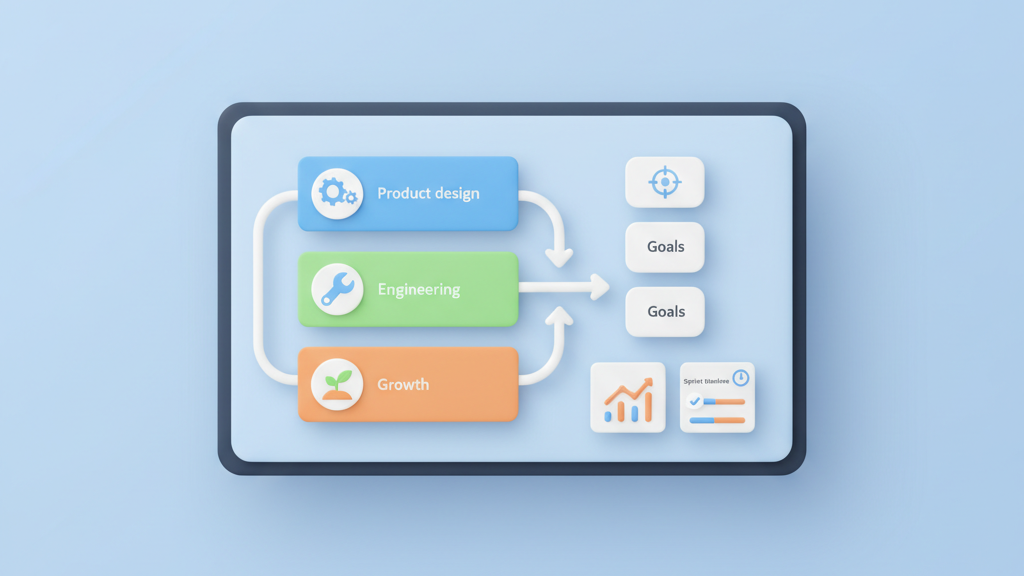
Building a startup team is noisy and fragile. This post collects best practices for building cross functional startup teams that actually ship value. I focus on practical rules that founders and product managers can use right away. Many startups ignore team design until it costs time and money. If you want a related deep dive, read Protecting Users Early On: best practices for securing early product user data.
Define Clear Outcomes
Every team needs a north star that is obvious to everyone. Start with outcomes not roles. Define a small set of measurable goals that map to customer value. Use customer metrics sales velocity activation or retention to keep discussions grounded. Write success criteria that are testable and time boxed. Share the criteria with engineering product design and growth early. Many startups miss this step and end up debating ownership for months. A clear outcome reduces handoffs and prevents feature bloat. Treat goals as living artifacts and review them weekly. If a goal no longer moves customer value then retire it quickly. This keeps small teams focused and gives hiring clear signals about needed skills. In practice this helps founders prioritize scarce resources and speed up learning. If you need implementation support, explore MVP development for startups.
- Pick two to four measurable goals
- Tie each goal to customer behavior
- Share success criteria early
- Review and retire goals weekly
Hire for T Shaped Skills
Staff for complementary skills not identical resumes. Look for people who bring deep expertise plus the ability to contribute outside their core area. Favor curiosity and communication over perfect technical pedigree. Early hires should be comfortable shipping work at the edges of their discipline. Use simple trial projects to reveal collaboration habits and feedback patterns. Many candidates perform well in interviews and fail in real team dynamics. A short cross functional assignment can show how someone negotiates trade offs and balances speed with quality. Aim for a mix of builders and integrators. Avoid hiring clones of the founder. Diversity of thought speeds problem solving. In my experience a well balanced first team can cut months off the product market fit journey. For a practical follow-up, see Uncovering the Untold Tactics: Navigating MVP Iteration for Product-Market Fit.
- Test collaboration with short assignments
- Hire curious people who learn fast
- Balance specialists and generalists
- Avoid hiring founder clones
Set Lightweight Processes
Processes should protect time not create bureaucracy. Pick a few rituals that keep work visible and learning frequent. A simple planning cadence weekly check ins and short demos reduce surprises. Define quick decision rules for small bets. That lets the team move without seeking approval on every change. Use write once docs linked to living backlogs to capture trade offs and assumptions. Many startups overprocess early and lose speed. Keep retrospectives short and focused on one experiment outcome. Measure the cost of meetings by outcome not by attendance. If someone can not justify the time spent ask for a change. Lightweight processes scale better because they focus on outcomes and not task lists. This approach helps product managers and engineers make faster course corrections. Teams moving from strategy to execution can review Mobile app development.
- Limit rituals to the essentials
- Use decision rules for small bets
- Keep retrospectives short
- Capture trade offs in living docs
Design Communication Rituals
Good communication reduces misaligned effort. Set explicit rules for async updates and when to switch to live discussion. Use structured status cards and short recordings to reduce meeting load. Reserve live syncs for decisions that require rapid trade offs. Encourage asynchronous critique to give designers and engineers time to respond thoughtfully. Many teams mistake noise for collaboration and confuse volume with progress. Train people to write clear summaries with the question they expect the reader to answer. Create a single source of truth for customer insights and test results. Celebrate small wins and call out failed experiments with the same candor. This builds trust and keeps teams moving without heavy coordination overhead. Make norms explicit and revisit them quarterly to match team growth.
- Define async first rules
- Use short status cards
- Reserve live time for decisions
- Revisit norms quarterly
Measure and Iterate
Set a small set of leading indicators for learning and product health. Track both customer behavior and team health to avoid burnout. Run fast experiments and capture results in a shared report. Use a clear definition of success for each experiment and agree on the minimum data needed to stop or scale. Many founders fear running public failures and therefore avoid risky tests. That is short sighted. Public experiments can speed learning and attract early users who value transparency. Review metrics weekly and use them to guide hiring and roadmap choices. Stop projects that do not move the needle. Small course corrections are better than big pivots late in the process. Pair metric reviews with short action lists and assign owners for each item. A related guide worth reviewing is How To Set Product Metrics And KPIs For Startups That Scale.
- Track leading indicators weekly
- Define success for each experiment
- Publish results in one report
- Assign owners for follow up