
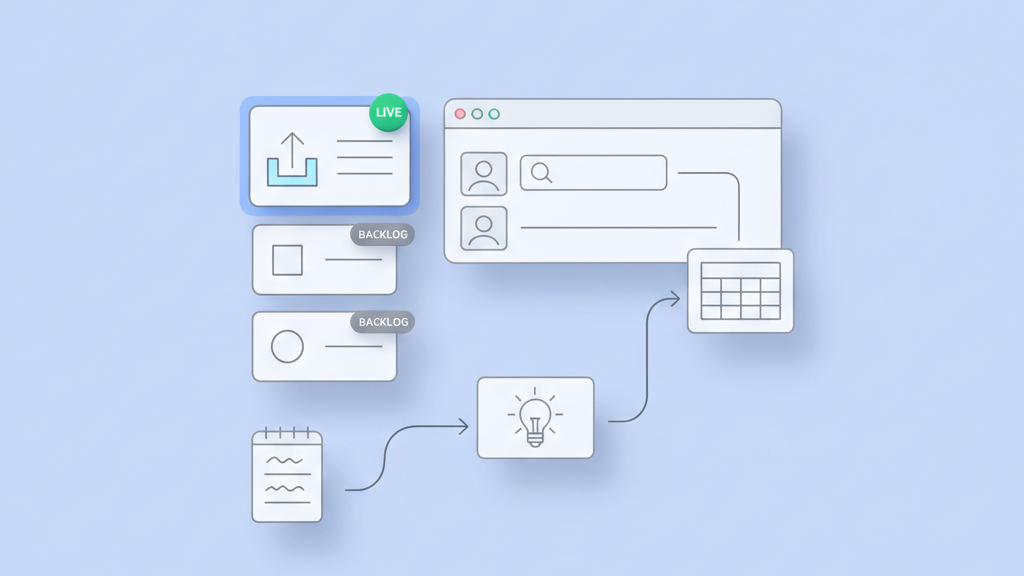
This guide to defining minimum lovable product features gives founders and product managers a clear path to pick work that matters. You will see how to find simple wins that teach quickly and reduce waste. Many teams confuse shipping more with shipping better. This guide favors focused effort and repeated learning over broad incomplete lists. If you need implementation support, explore MVP development for startups.
Why Start With Lovable Moments
Launching with a small set of well chosen features can change your odds. Focused choices help teams move faster and learn what users truly value. The trick is to pick features that solve a real pain and also create delight. Many startups miss this and end up shipping a thin product that no one loves. Start with clear user outcomes, not technical tasks. Map expected user flows and cut anything that does not help a first time success. Keep interactions simple and emotional where possible. A small set of polished moments will teach you more than a broad surface of unfinished features. Treat core experiences as experiments that must prove value. This approach reduces wasted work and strengthens your brand early. It also helps funding conversations because you can show real user love. Teams moving from strategy to execution can review Mobile app development.
- Define the one user outcome to prove
- Pick moments that create delight quickly
- Trim peripheral features that do not help first success
- Treat core features as measurable experiments
Use Research To Prioritize
Good choices come from real signals, not guesses. Start with interviews and session recordings to hear the words users use and to watch where they get stuck. Quantitative data helps but do not skip qualitative work. Look for repeated complaints and workarounds. Create a simple impact versus effort chart and be honest about costs. Many teams prioritize by enthusiasm or by who shouted loudest. That is a mistake. Prioritize by how much a feature moves the target metric for first time value. Validate assumptions with quick prototypes before coding. Keep research lightweight and continuous so you can update priorities after new learnings. Good prioritization halves wasted effort and raises the chance your product will actually be loved. If you want a related deep dive, read How to Prioritize Product Features Using Simple Framework That Scales.
- Interview at least ten target users
- Observe real tasks in product sessions
- Map impact versus effort for each idea
- Prototype before committing to dev
Define The Core Experience
The core experience is what users remember and share. Write a short narrative that shows how a target user discovers value in the first five minutes. Focus the story on intent and outcome rather than features. Design the smallest flow that delivers emotional payoff and repeat that flow until it works reliably. Include edge cases that break first time success and remove them or defer them. Use onboarding to guide first tasks but avoid heavy tutorials. Many teams overdesign onboarding and underdeliver the experience itself. Polished micro interactions matter more than many large untested screens. Make every tap count and keep the path to success visible. This clarity will guide design and engineering decisions and reduce scope creep. For a practical follow-up, see The Role of User Experience Design in Building Successful MVPs: A Closer Look.
- Write a five minute user story
- Build the smallest flow that proves value
- Design for the first successful task
- Remove edge cases from first shipments
Build Fast Experiments
Treat early features as hypotheses to test. Use low fidelity prototypes when possible and flag what you want to learn from each test. Define a success metric and a timeline. Fast feedback beats perfect engineering in early stages. Many startups freeze on design choices and waste months before seeing users. Prefer modular builds so you can swap things without huge rewrites. Use feature flags to roll back quickly and to test variations. Keep releases small and purposeful. Record qualitative reactions and quantitative signal together. After each experiment decide clearly to iterate, pivot, or kill the idea. This ruthless focus keeps teams aligned and reduces long term cost.
- Define a hypothesis and a success metric
- Prototype quickly with the cheapest tool
- Use feature flags for safe experiments
- Review results and decide fast
Measure Love And Iterate
Metrics reveal whether your small set of features actually resonates. Track first time success, retention for the core flow, and referral signals. Combine these metrics with qualitative feedback from support and interviews. Avoid vanity metrics that sound good but do not reflect user value. Many founders chase raw signups while ignoring active use. Create a dashboard that focuses on moments that matter and check it weekly. Use cohorts to see if changes improve the experience for new users. Iterate on the highest impact areas and keep the product lean. Over time you can widen scope but only after core love is proven. This staged approach reduces risk and builds a product people will recommend. A related guide worth reviewing is How To Set Product Metrics And KPIs For Startups That Scale.
- Track first time success and short term retention
- Use cohorts to compare changes
- Combine quantitative data with voice of user
- Focus iteration on the highest impact flows