
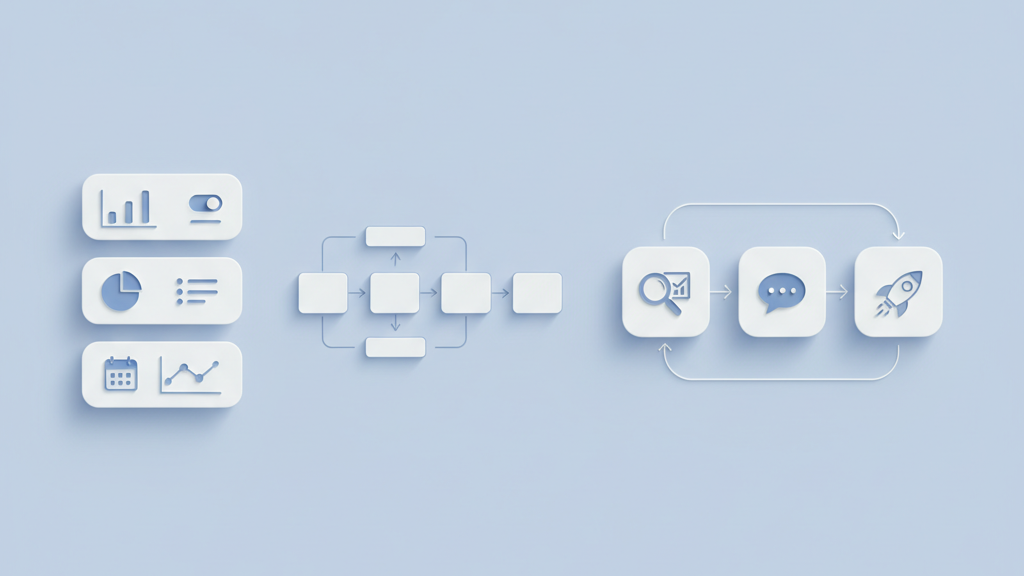
This guide explains a clear process for iterating product features based on feedback for startup teams. It blends user research, simple analytics, and fast experiments. You will see a repeatable flow that keeps changes small and measurable. Many startups miss the step where they tie feedback to a single metric. This makes changes feel busy but not useful. The approach here is pragmatic. You will find warnings about common traps and small templates you can reuse. Use the steps to shrink risk and ship with more confidence. If you want a related deep dive, read Process for Running Effective Early User Interviews for Product Teams.
Why A Structured Feedback Loop Matters
Startups often confuse activity with progress. A structured feedback loop turns opinions into measurable actions. It gives teams a rhythm so product work is tied to learning. The loop starts with a hypothesis and ends with a metric that proves or disproves it. That clarity prevents feature creep and helps prioritize real user value over vanity projects. In my experience, founders who skip this step end up with a product that serves no one well. This is not a theoretical exercise. It is a discipline that reduces wasted engineering time and keeps the roadmap flexible. The next sections show how to run each phase with tools and behaviors that scale. For a practical follow-up, see How To Set Product Metrics And KPIs For Startups That Scale.
- Turn opinions into testable hypotheses
- Focus on one metric per experiment
- Shorten the loop time to increase learning
- Avoid large risky launches
Define Goals And Metrics
Start by naming the outcome you want from a feature. A goal keeps teams aligned and prevents vague success criteria. Pick one primary metric that reflects user value and two supporting metrics to catch regressions. Metrics must be easy to measure with existing tools. If you need a new data event add it before you build so you avoid blind spots. Goals should map to business priorities and be time bound. Set a hypothesis that links the change to the metric. This discipline forces better design and clearer trade offs. Many teams jump to solutions before they can explain how success will be known. That is a common and costly mistake. If you need implementation support, explore Backend API development.
- Choose one primary success metric
- Add supporting metrics to detect regressions
- Instrument data before building
- Write a clear hypothesis statement
Gather Feedback Efficiently
Collecting feedback is both art and process. Use a mix of quantitative signals and qualitative notes. Analytics show trends and hot spots. Interviews explain the why behind the numbers. Capture feedback in a single system so it is searchable and linked to user segments. Make it easy for customer facing teams to log insights with short templates. Prioritize raw feedback that ties back to your metric. Avoid generic survey questions that generate noise. A few focused user interviews give far more value than a broad but shallow poll. Schedule regular synthesis sessions to turn scattered notes into themes you can act on.
- Combine analytics with targeted interviews
- Store feedback in one searchable place
- Use short templates for notes
- Synthesize themes weekly
Prioritize With Clarity
Prioritization must be intentional. Use the hypothesis and metric to set priority. Score ideas by expected impact, confidence, and cost. Be honest about uncertainty and resource limits. Small wins with high learning value often beat large bets. Create a visible backlog that links each idea to evidence and to the hypothesis it tests. Hold a lightweight review ritual where product and engineering align on what to build next and why. Many teams default to the loudest request. That is poor strategy. Prioritization that favors learning over features produces quicker insight and fewer wasted releases.
- Score ideas by impact confidence and cost
- Prefer experiments that maximize learning
- Link backlog items to evidence
- Run a weekly review to align decisions
Prototype And Validate Fast
Prototyping reduces risk. Build the smallest thing that tests the hypothesis. Use low fidelity mockups, feature flags, or concierge flows to validate assumptions. The prototype should measure the primary metric or at least a strong proxy. Test with real users in the environment they will use the product. Keep iterations quick and limit scope. If you need custom code, prefer short lived branches and feature flags so you can roll back easily. Fast validation lets you learn before committing major resources. In my view, too many teams treat prototypes as optional. That is a missed opportunity to save time and money. A related guide worth reviewing is The Impact of Low-Code Development on Custom IT Solutions What You Need to Know.
- Build the minimal testable prototype
- Use feature flags for safe releases
- Test in the real user environment
- Keep iterations short and scoped
Implement Iterations With Discipline
When an experiment succeeds, implement the feature with discipline. Break work into small deployable units and keep the release path reversible. Document the final acceptance criteria and the metric targets. Ensure QA focuses on the outcome and not on feature polish alone. Use canary releases where appropriate to limit blast radius. Communicate changes clearly to customer facing teams so they can capture new feedback. If an experiment fails do a quick post mortem and capture the learning. Failure is valuable when it is documented and shared. Teams that hide failures repeat them. Be transparent and keep the focus on improving the product for users. Teams moving from strategy to execution can review MVP development for startups.
- Deliver in small reversible steps
- Set acceptance criteria tied to metrics
- Use canary releases to limit risk
- Document learnings from failed tests
Measure Impact And Iterate Again
Measurement closes the loop. Compare results to the hypothesis and decide if the feature is a win, needs refinement, or should be discarded. Look beyond the primary metric for unintended consequences. Watch supporting metrics and qualitative feedback. Translate results into new hypotheses and repeat the loop. Create a dashboard with the experiment history so teams can see trends across cycles. Many startups forget to archive context and end up repeating work. Keep a simple experiment log that shows assumptions, results, and the next action. This habit builds institutional memory and speeds future decisions.
- Compare outcomes to the hypothesis
- Watch supporting metrics for side effects
- Log experiments and results
- Turn results into a next hypothesis
Scale The Learning Process
As the team grows you must scale the feedback loop without slowing down. Create templates for hypotheses, interview guides, and experiment reports. Train new hires on the rhythm and the tools you use. Automate common tasks like data collection and report generation. Delegate ownership of experiments to small teams with clear goals. Keep governance light and focus on quality of learning not on process compliance. A gentle warning is needed here many organizations over formalize and kill momentum. Maintain a bias for action and a culture that accepts fast failure when it delivers new insight.
- Create reusable templates and guides
- Automate repetitive data tasks
- Delegate small experiment ownership
- Keep governance light and nimble